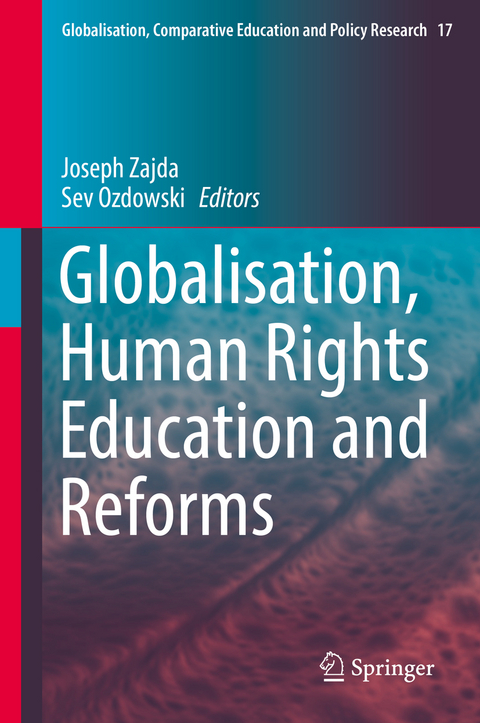
Globalisation, Human Rights Education and Reforms (eBook)
275 Seiten
Springer-Verlag
978-94-024-0871-3 (ISBN)
This book, the seventeenth instalment in the 24-volume series Globalisation, Comparative Education and Policy Research, explores the interrelationship between ideology, the state and human rights education reforms, setting it in a global context. The book examines major human rights education reforms and policy issues in a global culture. It focuses on the ambivalent and problematic relationship between the state, globalisation and human rights education discourses. Using a number of diverse paradigms, ranging from critical theory to historical-comparative research, the authors examine the reasons for, and the outcomes of human rights education reforms and policy. The authors discuss discourses surrounding the major dimensions affecting the human rights education, namely national identity, democracy, and ideology. These dimensions are among the most critical and significant dimensions defining and contextualising the processes surrounding the nation-building, identitypolitics and human rights education globally. With this as its focus, the chapters represent hand-picked scholarly research on major discourses in the field of human rights education reforms. The book draws upon recent studies in the areas of globalisation, equality, and the role of the state in human rights education reforms. Furthermore, the perception of globalisation as dynamic and multi-faceted processes clearly necessitates a multiple-perspective approach in the study of human rights education. This book provides that perspective commendably. It also critiques current human rights education practices and policy reforms. It illustrates the way shifts in the relationship between the state and human rights education policy. In the book, the authors, who come from diverse backgrounds and regions, attempt insightfully to provide a worldview of current developments in research concerning human rights education, and citizenship education globally. The book contributes, in a very scholarly way, to a more holistic understanding of the nexus between nation-state, human rights education both locally and globally.
Foreword 8
Preface 10
Reference 11
Globalisation, Comparative Education and Policy Research Series Volumes 13–24 12
Contents 14
Contributors 16
Chapter 1: Globalisation and Human Rights Education: Emerging Issues 22
Research on Human Rights Education: History 22
Defining Human Rights 24
Social and Cultural Dimension of Human Rights Education 24
Children’s Rights 25
Conceptualising Human Rights Education 26
Current Research on Human Rights Education 26
Human Rights Education and Implementation and Emerging Issues 28
Conclusion 30
Note 30
References 31
Part I: Research Trends in Globalisation and Human Rights Education 33
Chapter 2: Universal Human Rights Education for the Post-2015 Development Agenda 34
Introduction: Human Rights Education and International Development Agendas 35
Human Rights Education in International Law 37
Implementation of International Human Rights Education 39
The Impact of Human Rights Education 42
Human Rights and International Development 44
Linking Law, Education and Development Through Human Rights 46
Conclusion 48
References 48
Chapter 3: From Human Rights to Global Citizenship Education: Movement, Migration, Conflict and Capitalism in the Classroom 53
Human Rights to Global Citizenship Education: Introduction 54
Emerging Models, Definitions, and Concepts of HRE 56
Economic Globalization, Conflict and Migration 60
HRE and GCE Old Wine in New Bottles
HRE and Rights-Respecting Citizens 67
Conclusion 68
References 69
Chapter 4: Changing the Culture of Child Rights Through Education 72
Human Rights Education: Introduction 73
Child Rights as Human Rights 74
Child Rights and Education 77
Changing Ideas Through Education 79
Changing Teaching Styles 79
Research Inspired Instruction 80
Community Climate Change 84
Education: A Human Rights Change Agent 86
Conclusion 87
Notes 87
References 88
Chapter 5: Globalization, Decentralization and Local Governments International Networking on Human Rights 90
Networks and International Interaction 94
Final Reflection 100
References 102
Chapter 6: Curriculum Reform in Transitional Justice Environments: The South African Human Rights Commission, Human Rights Education and the Schooling Sector 104
Introduction: The Role of the South African Human Rights Commission 105
South Africa and Transitional Justice 106
Curriculum Reform in a Transitional Justice Environment 107
Curriculum and Social Justice 107
Concepts, Strategies and Supports for Curriculum Reform 108
Background to Educational Reform in South Africa in the Immediate Post-Apartheid Period 109
HRE Civil Society Organizations and People’s Education 110
Progressive Curriculum Reform in Late Apartheid Period 110
White Paper One 111
South African Human Rights Commission and the Promotion of Human Rights Education in the Schooling Sector 112
SAHRC Links with International HRE Standards 112
The SAHRC and Promotion of Inclusive Processes 113
HRE Input into the Curriculum Writing Process 113
HRE Curriculum Review Results 115
Reflections on Curriculum Reform in the Immediate Post-Apartheid Period 116
Competing Purposes of Schooling 116
The State and Legitimacy 117
Human Rights and Schools 118
Conclusion 119
Notes 120
Appendices 121
Appendix A: Human Rights and Inclusivity Checklist for Social Sciences (Grade 9) 121
Appendix B: Exit-Level Outcomes: Human Rights and Responsibilities 123
Exit-Level Outcomes: Principles, Values and Attitudes 123
Exit-Level Outcomes: Participatory Citizenship, Civics and Governance 123
References 124
Chapter 7: The Role of Human Rights Education in Social Movements: Case Studies in South Africa and the United States 127
Introduction 127
Social Movements 128
Human Rights Education in Social Movements 129
South Africa: The Anti-Apartheid Movement 130
Human Rights Education and Social Movements in South Africa Today 133
United States: The U.S. Civil Rights Movement 135
The Human Rights Education Movement in the United States Today 137
Conclusion 139
References 139
Chapter 8: Human Rights Education in the Context of Global Education 142
Human Rights Education and Civic Education in the Context of Globalization: Introduction 143
The UN Universal Declaration of Human Rights 145
Some Reflections on the Rise of Human Rights Education 146
The Council of Europe: Selected Recent Initiatives in the Field of Human Rights Education 148
Helsinki Foundation for Human Rights 152
Evaluation 153
Conclusion 154
Notes 155
References 156
Part II: Globalisation and Human Rights Education: Policy and Pedagogy 157
Chapter 9: The Importance of Including Human Rights Education in Primary and Secondary Schools: A Focus on Empathy and Respect 158
Human Rights Education: Introduction 159
HRE Creates a Framework for Intercultural Respect and Understanding and Reduces Bullying 160
Historical Perspectives on HRE 160
Legal Perspectives on HRE 160
Sociological Perspectives on HRE 161
Bullying in Schools 161
HRE Begins with Sharing the Language or Discourse of Human Dignity and Empathy 162
HRE: Promotes Critical Engagement with Social and Political Realities and Encourages Curiosity 164
HRE: Develops a Person’s Capacity to Understand, Clarifying and Appreciating Similarities and Differences Among Cultures, and Increases Self-Esteem 165
HRE Can Help to Clarify a Child’s Rights and Responsibilities to Participate in Society 167
Power of the Child’s Participation 167
Conclusion 169
References 169
Chapter 10: Human Rights Education with Children in Global South 171
Human Rights Education with Children in Global South: Introduction 172
Definition 172
CR and CRE in an International Comparison 173
Aim of the Study 174
What Is COMPASITO? 174
COMPASITO in Iran: Challenges and Opportunities 175
Themes 175
Practicable 176
Adaptable 176
Hard to Discuss 176
Structure 177
Policy Suggestion 177
Conclusion 178
References 179
Chapter 11: Building Bridges to Religions by Justifying Human Rights 180
Historical Development of Human Rights Education: Introduction 180
The Pre-interaction 183
The Cum-Interaction 189
The Post-interaction 191
Conclusions 193
Notes 194
References 194
Chapter 12: Racism, Equality and Civil Liberties in a Multicultural Australia 197
Universal Human Rights, Local Culture and Human Rights Education: Introduction 198
The Roots of Australian Human Rights Culture 199
Australian Democracy and Political Rights 199
Civil Liberties and the Absence of a Bill of Rights 201
Equality: The Australian “fair go” 202
Economic and Social Rights 204
Equality and the “White Australia” Policy 204
Contemporary Human Rights Culture in Australia 205
Expansion of the Egalitarian Ethos 206
Non-discriminatory Immigration 207
From Assimilation to Multicultural Australia 208
Combating Racial Discrimination 211
Human Rights Education 216
What Do Australians Know About Human Rights? 216
Teaching Human Rights at Schools 217
Key Sources of Learning About Human Rights 219
What Australians Learn About Human Rights? 222
Conclusion 224
Notes 225
References 227
Chapter 13: Human Rights Education: Refugees and Asylum Seekers’ Right to Education 231
The Right to Education of School-Aged Children of Refugees and Asylum Seekers: Introduction 232
The Israeli Context 234
Background 234
Population 234
School Structure 235
School Finance in Israel 235
Educational Investment 235
The Structure of School Finance in Israel 236
Refugees and Asylum Seekers in Israel 236
Policy Actors and the Composition of Their Voices 238
Methods 239
Results 240
The Israeli Ministry of Education’s Regulations 240
Localities 241
The Case of Tel Aviv 241
The Case of Eilat 242
Eilat’s Recent Policy Reform 242
The Right to Education and the Prisoner’s Dilemma 243
Discussion 245
Conclusion 246
References 246
Chapter 14: Human Rights Education and Intercultural Education 248
Democracy and Human Rights: Introduction 248
Beyond Mere Human Rightism? 250
Intercultural Education and the Hegemony of Human Rights: Problematic Supranational Initiatives 252
Working on the ‘fragilities’ of Human Rights in Intercultural Education 255
Conclusion 256
References 257
Chapter 15: Human Rights in History Textbooks 259
Human Rights in History Education: Introduction 259
Indonesia Merdeka Part 1 (1946–1965) 261
Human Rights as Education Rights 263
Indonesia Merdeka Part II 265
Textbooks and Human Rights 267
Conclusion 269
Notes 270
References 270
Chapter 16: Globalisation and Research in Human Rights Education 272
Global Neo-liberal Economic Capitalism and Human Rights Education Research 272
New Paradigm Shift in Pedagogy: Creating a Peaceful and More Inclusive World 274
Globalisation and Research in Human Rights Education: The Synthesis 275
References 278
Index 280
| Erscheint lt. Verlag | 23.9.2016 |
|---|---|
| Reihe/Serie | Globalisation, Comparative Education and Policy Research | Globalisation, Comparative Education and Policy Research |
| Zusatzinfo | XX, 275 p. 1 illus. |
| Verlagsort | Dordrecht |
| Sprache | englisch |
| Themenwelt | Geisteswissenschaften |
| Sozialwissenschaften ► Pädagogik ► Erwachsenenbildung | |
| Schlagworte | academic success in higher education • centralisation • commodification of higher education • comparative education • decentralisation • Global competition in higher education • globalisation of education • Global university rankings • higher education curriculum • Higher education policy • Higher education reforms • human capital theory • marketisation of higher education • Neo-liberalism • neo-liberal restructuring of universities • Quality in Higher Education • research-based teaching |
| ISBN-10 | 94-024-0871-1 / 9402408711 |
| ISBN-13 | 978-94-024-0871-3 / 9789402408713 |
| Informationen gemäß Produktsicherheitsverordnung (GPSR) | |
| Haben Sie eine Frage zum Produkt? |
 PDF (Wasserzeichen)
Größe: 4,5 MB
DRM: Digitales Wasserzeichen
Dieses eBook enthält ein digitales Wasserzeichen und ist damit für Sie personalisiert. Bei einer missbräuchlichen Weitergabe des eBooks an Dritte ist eine Rückverfolgung an die Quelle möglich.
Dateiformat: PDF (Portable Document Format)
Mit einem festen Seitenlayout eignet sich die PDF besonders für Fachbücher mit Spalten, Tabellen und Abbildungen. Eine PDF kann auf fast allen Geräten angezeigt werden, ist aber für kleine Displays (Smartphone, eReader) nur eingeschränkt geeignet.
Systemvoraussetzungen:
PC/Mac: Mit einem PC oder Mac können Sie dieses eBook lesen. Sie benötigen dafür einen PDF-Viewer - z.B. den Adobe Reader oder Adobe Digital Editions.
eReader: Dieses eBook kann mit (fast) allen eBook-Readern gelesen werden. Mit dem amazon-Kindle ist es aber nicht kompatibel.
Smartphone/Tablet: Egal ob Apple oder Android, dieses eBook können Sie lesen. Sie benötigen dafür einen PDF-Viewer - z.B. die kostenlose Adobe Digital Editions-App.
Zusätzliches Feature: Online Lesen
Dieses eBook können Sie zusätzlich zum Download auch online im Webbrowser lesen.
Buying eBooks from abroad
For tax law reasons we can sell eBooks just within Germany and Switzerland. Regrettably we cannot fulfill eBook-orders from other countries.
aus dem Bereich