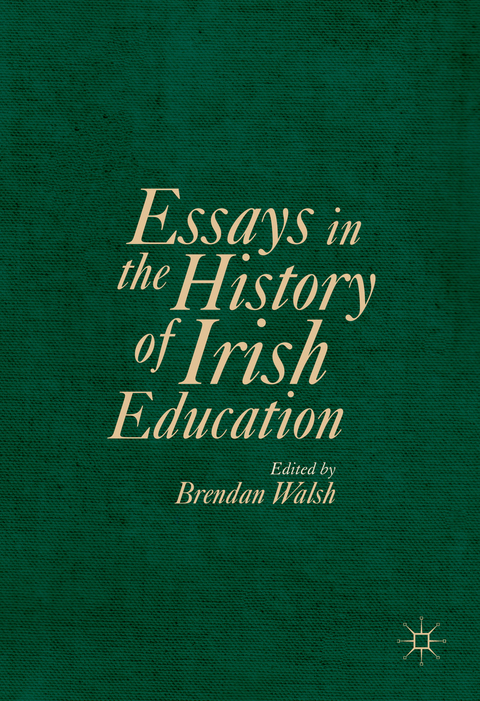
Essays in the History of Irish Education (eBook)
393 Seiten
Palgrave Macmillan UK (Verlag)
978-1-137-51482-0 (ISBN)
Brendan Walsh is a research fellow at Dublin City University, Ireland in The Centre for Evaluation, Quality and Inspection (EQI) Dublin. He is currently researching the relationship between Irish schools and the British Armed Forces in the nineteenth and early twentieth century and writing a history of secondary schooling in Ireland.
This book provides a complete overview of the development of education in Ireland including the complex issue of how religion can coexist with education and how a national identity can be aided through Irish language teaching. It also offers a comprehensive exploration of the development, issues, challenges and future of education in Ireland within the context of historical studies.
Brendan Walsh is a research fellow at Dublin City University, Ireland in The Centre for Evaluation, Quality and Inspection (EQI) Dublin. He is currently researching the relationship between Irish schools and the British Armed Forces in the nineteenth and early twentieth century and writing a history of secondary schooling in Ireland.
Dedication 6
Acknowledgments 8
Contents 10
Notes on Contributors 12
List of Figures and Tables 18
Chapter 1: Introduction 19
Chapter 2: The National System of Education, 1831–2000 25
Introduction 25
The Origins of the National School System 26
The Stanley Letter (1831) 27
Factors Impacting upon the Development of the School System 29
Religious 29
Political 31
Social 31
Economic 32
Cultural 33
The Establishment of the National System, 1831–1872 34
Teacher Education, 1831–1872 35
The Era of Payment by Results 35
Teacher Education, 1872–1900 36
The period of the Revised Programme of Instruction (1900) [1900–1922] 37
Teacher Education, 1900–1922 38
The Curricula Developed Following Independence, 1922–1971 39
Teacher Education, 1922–1971 41
The Primary School Curriculum, 1971–1999 42
Teacher Education, 1971–1999 44
Moving Towards the Primary School Curriculum (1999) 45
Conclusion: The Changing Philosophy and Ideology of the National System 45
Appendix 1: Compulsory and Optional Subjects in the Primary School Curriculum, 1872–1999139 48
Appendix 2. 12 Practical Rules for National Teachers140 52
Chapter 3: ‘An Essential Service’: The National Board and Teacher Education, 1831–1870 62
National Board Training Institution, 1838 65
National Board Model Schools, Merrion Street, 1832 66
Marlborough Street Training Institution and Central Model Schools, 1838–1855 70
Teaching Staff at Marlborough Street 73
Prestige of the Marlborough Street in the 1840s 76
District and Minor Model Schools, 1840–1860 78
Paid Monitors and Classification of National Teachers 81
Growing Opposition of the Catholic Church, 1850–1865 83
Report of the Powis Commission on Primary Education in Ireland, 1870 86
Conclusion 89
Chapter 4: Forged in the Fire of Persecution: Edmund Rice (1762–1844) and the Counter-Reformationary Character of the Irish Christian Brothers 100
I 100
II 102
III 105
IV 107
V 108
VI 113
VII 115
Chapter 5: Girls at School in Nineteenth-Century Ireland 121
Schooling Poor Girls 124
Educating Middle-Class Girls 131
Conclusion 137
Chapter 6: ‘Injurious to the Best Interests of Education’? Teaching and Learning Under the Intermediate Education System, 1878–1922 145
Introduction 145
‘The Discouragement of Smattering’: A Very Brief History of the Intermediate System 150
‘A Happy Useful Life’: Teachers, Pupils and Schools 155
Brute Force and Buttercups: School Life 163
‘Work of the Utmost Importance under the Most Unsatisfactory Conditions’: Schools and Teachers in the Early Twentieth Century 167
Conclusion: A ‘Happy and Useful Life’? 175
Chapter 7: Historical Overview of Developments in Special Education in Ireland 196
Introduction 196
Isolated Interventions 197
Invisibility and State Neglect 199
State Engagement 201
Initiatives for Change 205
Campaigning for Fundamental Rights 208
Challenging an Inequitable System 209
Enabling Legislation 210
Concluding Comments 212
Chapter 8: Teachers’ Experience of School: First-hand Accounts, 1943–1965 217
Introduction 217
Tight Ships and High Expectations: Primary and Secondary School 218
Non-Teachers Talking About Their Teachers 232
Reasons for Becoming Teachers 233
Conclusion 235
Chapter 9: Creating a Modern Educational System? International Influence, Domestic Elites and the Transformation of the Irish Educational Sector, 1950–1975 248
A Conservative Consensus 249
‘A Stagnant Pond’ 250
Origins of Reform 251
‘A Revolutionary Step’ 253
The Impact of Investment in Education 257
Curriculum Reform 260
Rationalisation and Resistance 262
Free Post-primary Education 263
Community Schools 266
Higher Education 267
Conclusion 272
Interviews 273
Chapter 10: The Transformation of Irish Education: The Ministerial Legacy, 1919–1999 280
‘Towards the Irishising of Primary Education’ 280
‘Just Dead-End Schools for Dead-End Kids’ 287
‘If a Nation Is to Depend on Agriculture, It Must Produce Mainly a Population of Farmers’ 290
‘Our System of Education Approaches the Ideal’ 293
‘To-day’s One Right Way Is Tomorrow’s Obsolete Policy’ 296
‘That Stagnant Pond Which Is the Department of Education’ 299
Chapter 11: The Development of Vocational and Technical Education in Ireland, 1930–2015 310
Introduction 310
Vocational Education: The Initial Years 310
The Introduction of Vocational Education 311
Continuation Education in Vocational Schools 312
Education and the Economy: New Perspectives 317
Adult Education 318
Further Education 320
Apprenticeship Education 322
The Development of Higher Technical Education 325
Conclusion 328
Chapter 12: Current Developments at Third-Level Institutions in the Light of the Origins of the University 333
The Origins of the University 336
The Curriculum at the University 339
The Origins and the Current University 343
The Situation in Ireland 344
Current Discussion 346
Chapter 13: Advanced Education for Working People: The Catholic Workers’ College, a Case Study 351
Introduction 351
Inspirations and Precursors 353
The CWC’s Founders 356
Teaching and Curriculum 359
Ethos: Mary or Joseph? 361
Analysis 363
Conclusion 364
Chapter 14: Teacher Accountability in Education: The Irish Experiment 371
Introduction and Background 371
School Inspection and Teacher Accountability in Pre-independence Ireland 373
School Inspection and Teacher Accountability in the Free State 379
Conclusion 387
INDEX 394
| Erscheint lt. Verlag | 29.9.2016 |
|---|---|
| Zusatzinfo | XVII, 393 p. |
| Verlagsort | London |
| Sprache | englisch |
| Themenwelt | Geisteswissenschaften ► Geschichte |
| Sozialwissenschaften ► Pädagogik ► Allgemeines / Lexika | |
| Schlagworte | History • Ireland • schools • Sociology of Education • students |
| ISBN-10 | 1-137-51482-5 / 1137514825 |
| ISBN-13 | 978-1-137-51482-0 / 9781137514820 |
| Informationen gemäß Produktsicherheitsverordnung (GPSR) | |
| Haben Sie eine Frage zum Produkt? |
 PDF (Wasserzeichen)
DRM: Digitales Wasserzeichen
Dieses eBook enthält ein digitales Wasserzeichen und ist damit für Sie personalisiert. Bei einer missbräuchlichen Weitergabe des eBooks an Dritte ist eine Rückverfolgung an die Quelle möglich.
Dateiformat: PDF (Portable Document Format)
Mit einem festen Seitenlayout eignet sich die PDF besonders für Fachbücher mit Spalten, Tabellen und Abbildungen. Eine PDF kann auf fast allen Geräten angezeigt werden, ist aber für kleine Displays (Smartphone, eReader) nur eingeschränkt geeignet.
Systemvoraussetzungen:
PC/Mac: Mit einem PC oder Mac können Sie dieses eBook lesen. Sie benötigen dafür einen PDF-Viewer - z.B. den Adobe Reader oder Adobe Digital Editions.
eReader: Dieses eBook kann mit (fast) allen eBook-Readern gelesen werden. Mit dem amazon-Kindle ist es aber nicht kompatibel.
Smartphone/Tablet: Egal ob Apple oder Android, dieses eBook können Sie lesen. Sie benötigen dafür einen PDF-Viewer - z.B. die kostenlose Adobe Digital Editions-App.
Buying eBooks from abroad
For tax law reasons we can sell eBooks just within Germany and Switzerland. Regrettably we cannot fulfill eBook-orders from other countries.
aus dem Bereich