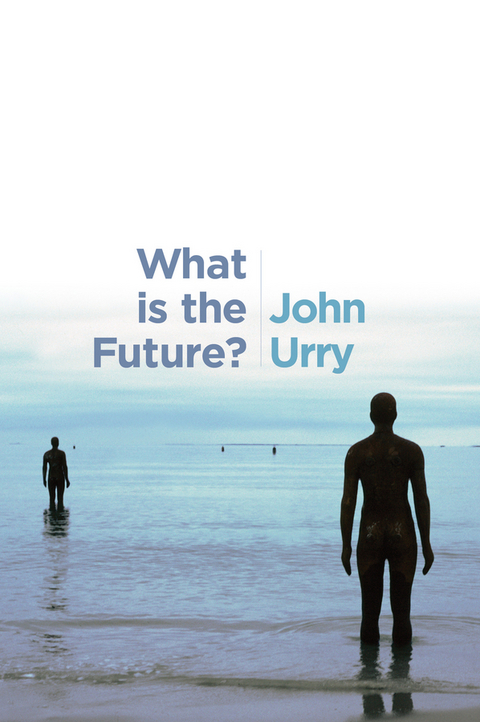
What is the Future? (eBook)
John Wiley & Sons (Verlag)
978-0-7456-9657-7 (ISBN)

In this important book, John Urry seeks to capture the many efforts that have been made to anticipate, visualize and elaborate the future. This includes examining the methods used to model the future, from those of the RAND Corporation to imagined future worlds in philosophy, literature, art, film, TV and computer games. He shows that futures are often contested and saturated with different interests, especially in relation to future generations. He also shows how analyses of social institutions, practices and lives should be central to examining potential futures, and issues such as who owns the future.
The future seems to be characterized by 'wicked problems'. There are multiple 'causes' and 'solutions', long-term lock-ins and complex interdependencies, and different social groups have radically different frames for understanding what is at stake. Urry explores these issues through case-studies of 3D printing and the future of manufacturing, mobilities in the city, and the futures of energy and climate change.
John Urry (1946-2016) was Distinguished Professor of Sociology at Lancaster University
Thinking about the future is essential for almost all organizations and societies. States, corporations, universities, cities, NGOs and individuals believe they cannot miss the future. But what exactly is the future? It remains a mystery perhaps the greatest mystery, especially because futures are unpredictable and often unknowable, the outcome of many factors, known and unknown. The future is rarely a simple extrapolation from the present. In this important book, John Urry seeks to capture the many efforts that have been made to anticipate, visualize and elaborate the future. This includes examining the methods used to model the future, from those of the RAND Corporation to imagined future worlds in philosophy, literature, art, film, TV and computer games. He shows that futures are often contested and saturated with different interests, especially in relation to future generations. He also shows how analyses of social institutions, practices and lives should be central to examining potential futures, and issues such as who owns the future. The future seems to be characterized by 'wicked problems'. There are multiple 'causes' and 'solutions', long-term lock-ins and complex interdependencies, and different social groups have radically different frames for understanding what is at stake. Urry explores these issues through case-studies of 3D printing and the future of manufacturing, mobilities in the city, and the futures of energy and climate change.
John Urry (1946-2016) was Distinguished Professor of Sociology at Lancaster University
* Contents
* Preface
* 1. Introduction: The Future Has Arrived
* Part 1 - A Brief History of the Future
* 2. Past Futures
* 3. New Catastrophic Futures
* Part 2 - Complex Systems and the Future
* 4. Time and Complex Systems
* 5. Innovating Futures
* 6. Methods for Making Futures
* Part 3 - Future Scenarios
* 7. Manufacturing Future Worlds
* 8. Cities on the Move
* 9. Climates
* 10. Conclusion: The Future of Futures
* References
* Index
1
Introduction: The Future Has Arrived
Welcome to the future
In 1994, the magazine New Scientist devoted a special issue to the subject of Futures, observing how the future is a foreign country since they do things differently there (New Scientist 1947, 5 October 1994). The Editorial argued that the increasingly complex nature of the world made it even more important to know the future so as to understand the present better. Somewhat similarly, John F. Kennedy said, quite close to his assassination in 1963, that: ‘Change is the law of life. And those who look only to the past or present are certain to miss the future’ (Kennedy Address 1963).
The future has most definitely arrived but what exactly it is remains a mystery, perhaps the greatest of mysteries. Futures are now everywhere. Thinking and anticipating the future are essential for almost all organizations and societies. Futures are on most contemporary agendas – many hold the future to be a better guide to what to do in the present than what happened in the past. States, corporations, universities, cities, NGOs and individuals believe they cannot miss the future; that foreign country is now everywhere.
Yet at the same time futures are unpredictable, uncertain and often unknowable, the outcome of many known and especially ‘unknown unknowns’. Garrett Hardin once maintained ‘We can never do merely one thing’: the one thing that would produce a single clear set of future outcomes (1972: 38). We do, in effect, many ‘things’, even when we think we are doing just one, and these many things have varied and unpredictable consequences for the future.
Thus, the first reason for writing a book on futures is to demonstrate the many efforts made, in the past and now, to anticipate, visualize and elaborate the future(s) within various domains of human activity. Powerful social institutions and thinkers are developing various kinds of anticipatory discourses and techniques (see Szerszynski 2016, on anticipation). This futures orientation is big and significant business for companies like Google or Shell, environmental organizations such as the Intergovernmental Panel on Climate Change (IPCC) or Forum for the Future, government bodies like Foresight in the UK or the European Strategy and Policy Analysis System (ESPAS) in the EU, military organizations such as the Pentagon, academic bodies such as the Oxford Martin School or the Tyndall Centre, and very many others. Some of those futures anticipated by these organizations have performative consequences, certain of which will be documented and examined below.
Specific methods have been developed for envisaging, visualizing and assessing potential futures. Some of these originated from scenario planning exercises that Hermann Kahn initiated at the Rand Corporation during the 1950s (Son 2015: 124). He especially promoted the development of alternative scenarios, noting how they enabled the imagining of different future possibilities. Also, many imagined future worlds have been developed within literature, art, film, TV, computer games and so on. These often involved spectacular future technologies such as time-travel, personal flying machines, roads and trains in the sky, teleportation, robots, walking upon water, off-earth communities, vacuum powered propulsion, driverless trains, equal utopias, as well as many dark dystopic futures (see the amusing www.bbc.co.uk/news/magazine-20913249). This book will document and assess some of these ways in which organizations, intellectuals, scientists, artists, policy makers and technologists have developed, or are developing, futures.
The future also seems to be appearing ever more quickly, something first analysed in depth in Toffler's Future Shock (1970). He described exponential rates of technological and social transformation. In recent decades, ‘Moore's Law’ meant that world computing power (the number of transistors in an integrated circuit) doubled every two years. Today's smartphones possess the computing power once found in large mainframe computers, as well as possessing ‘magical’ affordances housed within a ‘ready-to-hand’ small machine which no one knew they ‘needed’ only twenty years ago. Some indeed argue that the future has almost disappeared, being transformed into an ‘extended present’ with no long-term futures (Nowotny 1994). And many people feel that they themselves have no ‘future’, since opportunities, hopes and dreams seem endlessly dashed, especially during times of ‘austerity’.
A sense of a disappearing future is also found within new financial ‘products’ that are based upon computerized high-frequency trading occurring in millionths of a second (Gore 2013). Actions happening beyond the speed of thought involve movements of money and information that cannot be grasped by human minds, even by the ‘flash boys’ working in finance (Lewis 2015). In such an accelerating world, financial futures arrive before they have been understood by the relevant actors. This is a kind of nano-second ‘future shock’ in which efforts to slow down decision-making even to transactions taking a whole second are rejected by financial institutions (Gore 2013: 16–17).
Moreover, futures are incredibly contested, saturated with conflicting social interests. Over two centuries ago, Edmund Burke argued that a society should be seen as a: ‘partnership not only between those who are living, but between those who are living, those who are dead, and those who are to be born’ (Burke [1790] quoted in Beinhocker 2006: 454). Burke points to the interests of unborn members of a society and how they need a powerful ‘voice’ to counter societies and lives being based only upon the interests of the living.
The environmental movement has played a major role in developing this idea of an inter-generational global commons, as set out in the Brundtland Commission's iconic Report on Our Common Future (1987). Environmentalism deploys generational rhetoric to argue for the interests of children, grandchildren and those not yet born (see Hansen 2011; www.gaiafoundation.org/earth-law-network/alliance-future-generations). Interestingly Hungary initiated the position of the Parliamentary Commissioner for Future Generations (www.ajbh.hu/en/web/ajbh-en/dr.-marcel-szabo), while a Future Generations Commissioner for Wales was established by 2015 legislation to act as an advocate for future generations.
However, most societal processes mould futures to the interests of current generations. Those yet to be born generally possess no voice in what we can call the ‘parliament of generations’. Or, as Adam expresses it, future generations cannot charge the current generation for the use made of their present. Future generations have no voice or vote to register their interests and must accept most of what is handed down to them (Adam 2010: 369).
There are though moments when this power of the present generation is contested and efforts are made by governments and NGOs to form ‘imagined communities’ that do stretch across generations and seek a ‘common future’. Such moments of generational solidarity can transform social and political debate, laying down new institutions and structures of feeling. One moment when this happened in some societies was during 1970. On 22 April 1970, 20 million Americans demonstrated for a healthy, sustainable environment. This first Earth Day led to the creation of the United States Environmental Protection Agency, the passing of various environmental Acts, the founding of Greenpeace and the publication of many iconic texts. At such moments, the long-term or glacial future functioned as a powerful structure of feeling (see Lash, Urry 1994). The future became democratized. But these moments are unusual. Overall, the arguments in this book are oriented to democratizing futures.
Rejecting the future
However, even though there are many social conflicts over futures, social science was reluctant to enter this futures world and has made a limited contribution to its theorization and analysis (but see Bell, Wau 1971; Young 1968). This reluctance partly resulted from how Marx, the most significant nineteenth-century social scientist, was apparently mistaken in ‘predicting’ that capitalism would engender worldwide revolution led by the industrial working class. Marx argued: ‘The philosophers have only interpreted the world, in various ways; the point is to change it’ (Marx 1962[1845]: 405). He expected that steam-powered factories, large industrial cities, railways and worker immiseration would lead the industrial proletariat to develop into a ‘class-for-itself’ and thus revolutionize the capitalist world. The proletarian class and its transformative power would overthrow capitalism and realize ‘communism’ through the effects of global capitalist expansion.
But in fact worldwide social revolution did not start in societies with the most advanced capitalist political economies, such as Britain or Germany. It commenced in Tsarist Russia in 1917, it did not initially involve a large organized industrial working class and the Bolshevik revolution resulted not in communism or even socialism in one country but, according to many critics such as Karl Popper, a new barbarism.
However, Marx's...
| Erscheint lt. Verlag | 6.9.2016 |
|---|---|
| Sprache | englisch |
| Themenwelt | Sozialwissenschaften ► Politik / Verwaltung |
| Sozialwissenschaften ► Soziologie ► Allgemeines / Lexika | |
| Schlagworte | climate change • Development Studies • Entwicklung • Entwicklungsforschung • Entwicklung u. soziale Verschiebungen • Future • Mobilities • Social Change & Development • Sociology • Sociology of Science & Technology • Soziologie • Soziologie d. Naturwissenschaft u. Technik • Zukunft |
| ISBN-10 | 0-7456-9657-0 / 0745696570 |
| ISBN-13 | 978-0-7456-9657-7 / 9780745696577 |
| Informationen gemäß Produktsicherheitsverordnung (GPSR) | |
| Haben Sie eine Frage zum Produkt? |
 EPUB (Adobe DRM)
Kopierschutz: Adobe-DRM
Adobe-DRM ist ein Kopierschutz, der das eBook vor Mißbrauch schützen soll. Dabei wird das eBook bereits beim Download auf Ihre persönliche Adobe-ID autorisiert. Lesen können Sie das eBook dann nur auf den Geräten, welche ebenfalls auf Ihre Adobe-ID registriert sind.
Details zum Adobe-DRM
Dateiformat: EPUB (Electronic Publication)
EPUB ist ein offener Standard für eBooks und eignet sich besonders zur Darstellung von Belletristik und Sachbüchern. Der Fließtext wird dynamisch an die Display- und Schriftgröße angepasst. Auch für mobile Lesegeräte ist EPUB daher gut geeignet.
Systemvoraussetzungen:
PC/Mac: Mit einem PC oder Mac können Sie dieses eBook lesen. Sie benötigen eine
eReader: Dieses eBook kann mit (fast) allen eBook-Readern gelesen werden. Mit dem amazon-Kindle ist es aber nicht kompatibel.
Smartphone/Tablet: Egal ob Apple oder Android, dieses eBook können Sie lesen. Sie benötigen eine
Geräteliste und zusätzliche Hinweise
Buying eBooks from abroad
For tax law reasons we can sell eBooks just within Germany and Switzerland. Regrettably we cannot fulfill eBook-orders from other countries.
aus dem Bereich