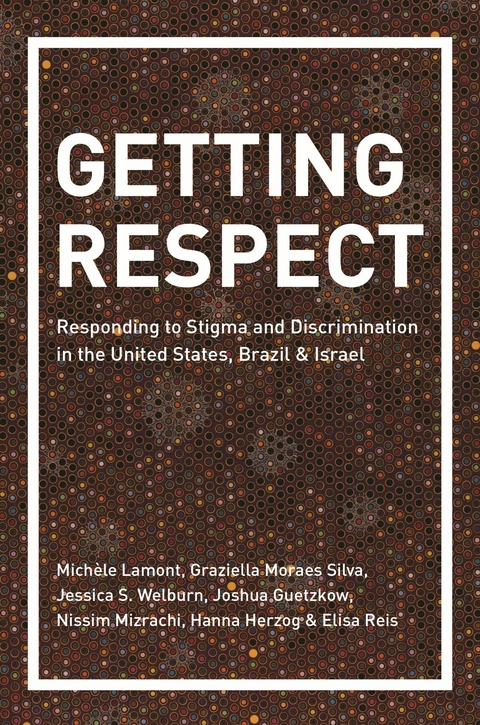
Getting Respect (eBook)
Princeton University Press (Verlag)
978-1-4008-8377-6 (ISBN)
Michèle Lamont is the director of the Weatherhead Center for International Affairs, Robert I. Goldman Professor of European Studies, and professor of sociology and African and African American studies at Harvard University. Graziella Moraes Silva is professor of sociology at the Federal University of Rio de Janeiro (UFRJ) and at the Graduate Institute of International and Development Studies, Geneva. Jessica S. Welburn is assistant professor of sociology and African American studies at the University of Iowa. Joshua Guetzkow is assistant professor in the Department of Sociology and Anthropology and in the Institute of Criminology at the Hebrew University of Jerusalem. Nissim Mizrachi is professor and chair of the Department of Sociology and Anthropology at Tel Aviv University. Hanna Herzog is professor emerita of sociology at Tel Aviv University. Elisa Reis is distinguished professor of political sociology at the Federal University of Rio de Janeiro.
A comparative look at how discrimination is experienced by stigmatized groups in the United States, Brazil, and IsraelRacism is a common occurrence for members of marginalized groups around the world. Getting Respect illuminates their experiences by comparing three countries with enduring group boundaries: the United States, Brazil and Israel. The authors delve into what kinds of stigmatizing or discriminatory incidents individuals encounter in each country, how they respond to these occurrences, and what they view as the best strategy-whether individually, collectively, through confrontation, or through self-improvement-for dealing with such events.This deeply collaborative and integrated study draws on more than four hundred in-depth interviews with middle- and working-class men and women residing in and around multiethnic cities-New York City, Rio de Janeiro, and Tel Aviv-to compare the discriminatory experiences of African Americans, black Brazilians, and Arab Palestinian citizens of Israel, as well as Israeli Ethiopian Jews and Mizrahi (Sephardic) Jews. Detailed analysis reveals significant differences in group behavior: Arab Palestinians frequently remain silent due to resignation and cynicism while black Brazilians see more stigmatization by class than by race, and African Americans confront situations with less hesitation than do Ethiopian Jews and Mizrahim, who tend to downplay their exclusion. The authors account for these patterns by considering the extent to which each group is actually a group, the sociohistorical context of intergroup conflict, and the national ideologies and other cultural repertoires that group members rely on.Getting Respect is a rich and daring book that opens many new perspectives into, and sets a new global agenda for, the comparative analysis of race and ethnicity.
Michèle Lamont is the director of the Weatherhead Center for International Affairs, Robert I. Goldman Professor of European Studies, and professor of sociology and African and African American studies at Harvard University. Graziella Moraes Silva is professor of sociology at the Federal University of Rio de Janeiro (UFRJ) and at the Graduate Institute of International and Development Studies, Geneva. Jessica S. Welburn is assistant professor of sociology and African American studies at the University of Iowa. Joshua Guetzkow is assistant professor in the Department of Sociology and Anthropology and in the Institute of Criminology at the Hebrew University of Jerusalem. Nissim Mizrachi is professor and chair of the Department of Sociology and Anthropology at Tel Aviv University. Hanna Herzog is professor emerita of sociology at Tel Aviv University. Elisa Reis is distinguished professor of political sociology at the Federal University of Rio de Janeiro.
| Erscheint lt. Verlag | 6.9.2016 |
|---|---|
| Zusatzinfo | 15 tables. |
| Verlagsort | Princeton |
| Sprache | englisch |
| Themenwelt | Sozialwissenschaften ► Ethnologie |
| Sozialwissenschaften ► Pädagogik | |
| Sozialwissenschaften ► Soziologie ► Makrosoziologie | |
| Schlagworte | Adoption • Affirmative Action • African Americans • Afro-Brazilians • Aggression • americans • Anti-Discrimination Law • Arab Palestinians • assault on worth • Black Brazilians • black people • black pride • brazilians • Case study • Centrality • Citizenship • Consideration • Crime • cultural membership • cultural repertoires • de facto • disadvantage • Discrimination • Economic Inequality • Education • Employment • Equal Opportunity • Ethiopian Jews • ethnic group • Ethnicity • ethnoracial exclusion • ethnoracial group • Exclusion • Explanation • Finding • group boundaries • groupness • Harvard University • Hate speech • Identity politics • Ideology • Immigration • income • Individualism • Ingroups and outgroups • Institution • interracial marriage • Intersectionality • Interview • Israelis • Jews • job interview • Laziness • marginalized groups • Melting Pot • Meritocracy • middle class • minority group • Mizrahi Jews • Multiculturalism • narrative • national identity • Nationality • Neoliberalism • New York • of education • one-drop rule • Operationalization • palestinians • Politics • Postdoctoral researcher • Poverty • Prejudice • Privatization • Race • Race (human categorization) • Race relations • Racial democracy • Racial Equality • racial integration • Racialization • racial profiling • Racial quota • Racial segregation • racial tension • Racism • racism in the united states • Recognition • Redistribution • residence • Respondent • Rio de Janeiro • security guard • self-concept • Self-Help • Self-identification • Slavery • Social Class • Social Exclusion • Social Inequality • social issue • Social mobility • Social Movement • Social Psychology • social relation • Social Science • social stigma • Society • Socioeconomic Status • Sociology • Stereotype • stigmatization • suburb • survey methodology • Symbolic boundaries • Tel Aviv • Tel Aviv University • The Other Hand • Unemployment • Working Class • World War II • Writing • Zionism |
| ISBN-10 | 1-4008-8377-6 / 1400883776 |
| ISBN-13 | 978-1-4008-8377-6 / 9781400883776 |
| Informationen gemäß Produktsicherheitsverordnung (GPSR) | |
| Haben Sie eine Frage zum Produkt? |
 PDF (Wasserzeichen)
Größe: 1,7 MB
DRM: Digitales Wasserzeichen
Dieses eBook enthält ein digitales Wasserzeichen und ist damit für Sie personalisiert. Bei einer missbräuchlichen Weitergabe des eBooks an Dritte ist eine Rückverfolgung an die Quelle möglich.
Dateiformat: PDF (Portable Document Format)
Mit einem festen Seitenlayout eignet sich die PDF besonders für Fachbücher mit Spalten, Tabellen und Abbildungen. Eine PDF kann auf fast allen Geräten angezeigt werden, ist aber für kleine Displays (Smartphone, eReader) nur eingeschränkt geeignet.
Systemvoraussetzungen:
PC/Mac: Mit einem PC oder Mac können Sie dieses eBook lesen. Sie benötigen dafür einen PDF-Viewer - z.B. den Adobe Reader oder Adobe Digital Editions.
eReader: Dieses eBook kann mit (fast) allen eBook-Readern gelesen werden. Mit dem amazon-Kindle ist es aber nicht kompatibel.
Smartphone/Tablet: Egal ob Apple oder Android, dieses eBook können Sie lesen. Sie benötigen dafür einen PDF-Viewer - z.B. die kostenlose Adobe Digital Editions-App.
Buying eBooks from abroad
For tax law reasons we can sell eBooks just within Germany and Switzerland. Regrettably we cannot fulfill eBook-orders from other countries.
 EPUB (Adobe DRM)
Kopierschutz: Adobe-DRM
Adobe-DRM ist ein Kopierschutz, der das eBook vor Mißbrauch schützen soll. Dabei wird das eBook bereits beim Download auf Ihre persönliche Adobe-ID autorisiert. Lesen können Sie das eBook dann nur auf den Geräten, welche ebenfalls auf Ihre Adobe-ID registriert sind.
Details zum Adobe-DRM
Dateiformat: EPUB (Electronic Publication)
EPUB ist ein offener Standard für eBooks und eignet sich besonders zur Darstellung von Belletristik und Sachbüchern. Der Fließtext wird dynamisch an die Display- und Schriftgröße angepasst. Auch für mobile Lesegeräte ist EPUB daher gut geeignet.
Systemvoraussetzungen:
PC/Mac: Mit einem PC oder Mac können Sie dieses eBook lesen. Sie benötigen eine
eReader: Dieses eBook kann mit (fast) allen eBook-Readern gelesen werden. Mit dem amazon-Kindle ist es aber nicht kompatibel.
Smartphone/Tablet: Egal ob Apple oder Android, dieses eBook können Sie lesen. Sie benötigen eine
Geräteliste und zusätzliche Hinweise
Buying eBooks from abroad
For tax law reasons we can sell eBooks just within Germany and Switzerland. Regrettably we cannot fulfill eBook-orders from other countries.
aus dem Bereich