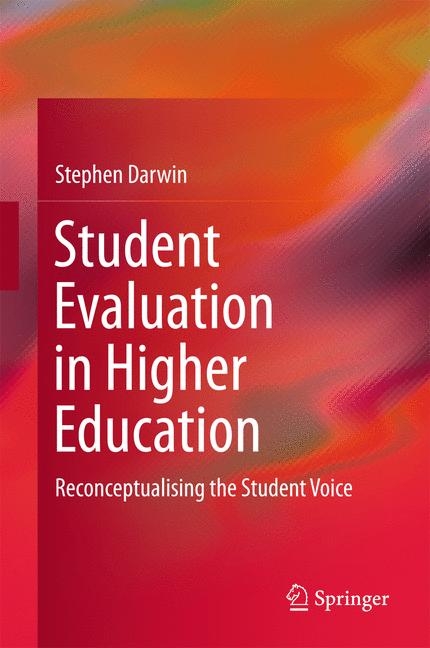
Student Evaluation in Higher Education (eBook)
XXI, 185 Seiten
Springer International Publishing (Verlag)
978-3-319-41893-3 (ISBN)

This book provides a comprehensive and engaging analysis of the purpose and function of student evaluation in higher education. It explores its foundations and the emerging functions, as well as its future potential to improve the quality of university teaching and student learning.
The book systematically assesses the core assumptions underpinning the design of student evaluation models as a tool to improve the quality of teaching. It also analyses the emerging influence of student opinion as a key metric and a powerful proxy for assuring the quality of teachers, teaching and courses in universities. Using the voices of teachers in the day-to-day practices of higher education, the book also explores the actual perceptions held by academics about student evaluation.
It offers the first real attempt to critically analyse the developing influence of student evaluation on contemporary approaches to academic teaching. Using a practice-based perspective and the powerful explanatory potential of cultural historical activity theory (CHAT), the implications of the changing focus in the use of the student voice - from development to measurement - are systematically explored and assessed.
Importantly, using the evidence provided by a unique series of practice-based case studies, the book also offers powerful new insights into how the student voice can be reconceptualised to more effectively improve the quality of teaching, curriculum and assessment. Based on this empirical analysis, a series of practical strategies are proposed to enhance the work of student evaluation in the future university to drive pedagogical innovation.
This unique volume provides those interested in student evaluation with a more complex understanding of the development, contemporary function and future potential of the student voice. It also demonstrates how the student voice - in combination with professional dialogue - can be used to encourage more powerful and substantial forms of pedagogical improvement and academic development in higher education environments.
Preface.- 1. The Emergence of Student Evaluation in Higher Education.- 2. Research on the Design and Function of Student Evaluation.- 3. What Higher Education Teachers Think about Quantitative Student Evaluation.- 4. Analysing the Potential of Student Evaluation in Practice.- 5. Student Evaluation in Situated Practice—the Case of a Recently Designed Program.- 6. Student Evaluation in Situated Practice - the Case of an Established Program.- 7. Assurance or Improvement: What Work Can Student Evaluation Most Effectively Perform?.- 8. Assessing the Developmental Potential of Student Feedback.- 9. Charting New Approaches to Student Evaluation.- Appendices.
| Erscheint lt. Verlag | 15.7.2016 |
|---|---|
| Zusatzinfo | XXI, 185 p. 3 illus. |
| Verlagsort | Cham |
| Sprache | englisch |
| Themenwelt | Geisteswissenschaften |
| Sozialwissenschaften ► Pädagogik ► Bildungstheorie | |
| Sozialwissenschaften ► Pädagogik ► Schulpädagogik / Grundschule | |
| Schlagworte | Action research in higher education • Boundary crossing between universities and work • Broadening forms of student evaluation in higher education • CHAT and action research • Cultural Historical Activity Theory and action research • cultural historical activity theory (CHAT) • Epistemologies of student evaluation • History of student evaluation in higher education • Improving higher education assessment • Improving higher education curriculum • Improving teaching in higher education • Innovative approaches to student evaluation • Professional dialogue in academic teaching • Qualitative student evaluation • Quantitative student evaluation • Student evaluation in higher education • Student ratings instruments in higher education • Student surveys in higher education |
| ISBN-10 | 3-319-41893-9 / 3319418939 |
| ISBN-13 | 978-3-319-41893-3 / 9783319418933 |
| Informationen gemäß Produktsicherheitsverordnung (GPSR) | |
| Haben Sie eine Frage zum Produkt? |
 PDF (Wasserzeichen)
DRM: Digitales Wasserzeichen
Dieses eBook enthält ein digitales Wasserzeichen und ist damit für Sie personalisiert. Bei einer missbräuchlichen Weitergabe des eBooks an Dritte ist eine Rückverfolgung an die Quelle möglich.
Dateiformat: PDF (Portable Document Format)
Mit einem festen Seitenlayout eignet sich die PDF besonders für Fachbücher mit Spalten, Tabellen und Abbildungen. Eine PDF kann auf fast allen Geräten angezeigt werden, ist aber für kleine Displays (Smartphone, eReader) nur eingeschränkt geeignet.
Systemvoraussetzungen:
PC/Mac: Mit einem PC oder Mac können Sie dieses eBook lesen. Sie benötigen dafür einen PDF-Viewer - z.B. den Adobe Reader oder Adobe Digital Editions.
eReader: Dieses eBook kann mit (fast) allen eBook-Readern gelesen werden. Mit dem amazon-Kindle ist es aber nicht kompatibel.
Smartphone/Tablet: Egal ob Apple oder Android, dieses eBook können Sie lesen. Sie benötigen dafür einen PDF-Viewer - z.B. die kostenlose Adobe Digital Editions-App.
Buying eBooks from abroad
For tax law reasons we can sell eBooks just within Germany and Switzerland. Regrettably we cannot fulfill eBook-orders from other countries.
aus dem Bereich