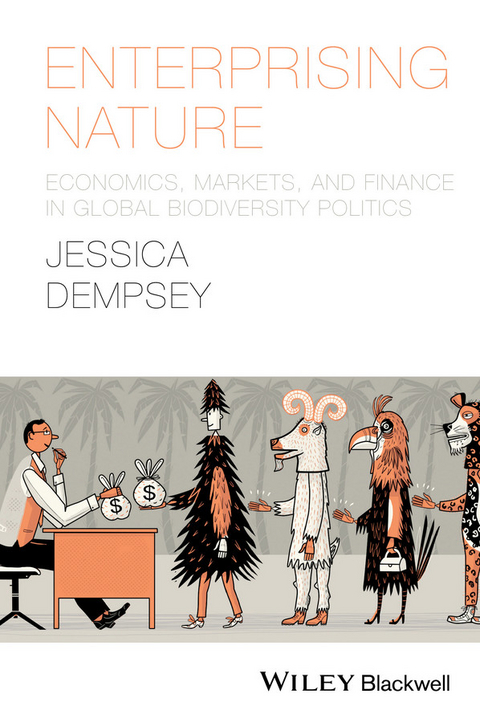
Enterprising Nature (eBook)
John Wiley & Sons (Verlag)
978-1-118-64053-1 (ISBN)
Enterprising Nature explores the rise of economic rationality in global biodiversity law, policy and science.
- Examines disciplinary apparatuses, ecological-economic methodologies, computer models, business alliances, and regulatory conditions creating the conditions in which nature can be produced as enterprising
- Relates lively, firsthand accounts of global processes at work drawn from multi-site research in Nairobi, Kenya; London, England; and Nagoya, Japan
- Assesses the scientific, technical, geopolitical, economic, and ethical challenges found in attempts to 'enterprise nature'
- Investigates the implications of this 'will to enterprise' for environmental politics and policy
Jessica Dempsey is an Assistant Professor at the Department of Geography at the University of British Columbia, Canada.
Winner of the 2018 James M. Blaut Award in recognition of innovative scholarship in cultural and political ecology!Enterprising Nature explores the rise of economic rationality in global biodiversity law, policy and science. To view Jessica's animation based on the book's themes please visit http://www.bioeconomies.org/enterprising-nature/ Examines disciplinary apparatuses, ecological-economic methodologies, computer models, business alliances, and regulatory conditions creating the conditions in which nature can be produced as enterprising Relates lively, firsthand accounts of global processes at work drawn from multi-site research in Nairobi, Kenya; London, England; and Nagoya, Japan Assesses the scientific, technical, geopolitical, economic, and ethical challenges found in attempts to enterprise nature Investigates the implications of this will to enterprise for environmental politics and policy
JESSICA DEMPSEY is an assistant professor in the Department of Geography at the University of British Columbia, Canada.
Acronyms vi
Series Editors' Preface ix
Preface x
1 Enterprising Nature 1
2 The Problem and Promise of Biodiversity Loss 28
3 An Ecological-Economic Tribunal for (Nonhuman) Life 56
4 Ecosystem Services as Political-Scientific Strategy 91
5 Protecting Profit: Biodiversity Loss as Material Risk 126
6 Biodiversity Finance and the Search for Patient Capital 159
7 Multilateralism vs. Biodiversity Market-Making: Battlegrounds to Unleash Capital 192
8 The Tragedy of Liberal Environmentalism 232
References 246
Index 276
'Jessica Dempsey's Enterprising Nature is necessary reading for understating the critical geographies of how market forces, biodiversity, environmentalism, and all kinds of so-called experts try, and often fail, to dictate the terms of conservation politics the world over. The book is fresh, robust, and offers healthy doses of both scepticism and deep insights into the battles that need to be fought.'
Nik Heynen, Professor of Geography, University of Georgia, USA
'Dempsey's Enterprising Nature is a must-read for all conservationists. From the vantage of political ecology, Dempsey provides a sympathetic but ringing critique of the ecosystem services paradigm. Nonetheless, her fresh analysis ultimately points towards a new and hopeful pathway - by forging unexpected collaborations among scientists, social movement activists, and scholars of power dynamics, she imagines reclaiming an "abundant biodiversity", as well as the ecosystem services it supplies.'
Claire Kremen, Professor in Environmental Sciences, Policy and Management, University of California, Berkeley, USA
'Through arguments with which liberal environmentalists will struggle to find fault, Dempsey carefully excavates the foundations of the global biodiversity industry, and finds them rotten. This is a compassionate and intelligent book, one that helps us ask far deeper questions about humans relations with the world than the mainstream environmental movement dare broach.'
Raj Patel, Research Professor at the Lyndon B. Johnson School of Public Affairs, University of Texas at Austin, USA
Preface
The first spark of this book began in May 2006, in the outskirts of Curitiba, Brazil. I was attending a negotiation of the United Nations Convention on Biological Diversity (CBD). Most attention centered whether or not the Parties, government signatories to the agreement, would reaffirm or overturn a moratorium on the field-testing of what is known colloquially as terminator technology (seeds engineered to produce sterile seeds). Hundreds of small farmers and landless people gathered outside the conference center every day reminding the suited delegates that they had responsibilities beyond the patent holders of the technology.
Outside this crucial debate, other agendas galloped ahead. The first of many events on concepts like “biodiversity offsets” took place, and bureaucrats were just beginning to speak in the language of ecosystem services. Compared to other CBD negotiations, where debates oriented around the definition of “primary forests,” it seemed as though the floor underneath international conservation was shifting. Global biodiversity policy was going (more) economic, and perhaps market based! This research was conceived following that negotiation, oriented around a simple question: how did this happen? How did economic and market-based approaches become so dominant, even commonsense, in global biodiversity conservation?
My role in these biodiversity circuits has never been one of passive observer, but of active participant, largely organized by the ongoing work of the Convention on Biological Diversity Alliance (CBD Alliance), a network of civil society groups that follows and intervenes in global biodiversity policies. For over a decade, working with all kinds of people, from all kinds of organizations and social movements – from WWF to Via Campesina – I researched and prepared briefing papers, coordinated joint policy statements, and fundraised endlessly to bring Southern NGOs, Indigenous communities, and social movement representatives to negotiations. Attending over a dozen negotiations, we worked to influence the shape of international biodiversity law and policy. This might sound as if I inhabited a glamorous world of international diplomats and the jet-set crowd, but I can say that it mostly involved sitting with headsets on for long periods of time, carefully following boring legalese as it shifted and shaped, crafting alternative text to circulate to friendly government delegates, and working all hours for one or two weeks.
These experiences, but especially the people I worked closely with, contributed to the particular lens through which I see “enterprising nature,” a phrase that I use to describe efforts to transform diverse natures into economically competitive entities. More than anything, I learned how to inhabit the uncomfortable, impure spaces of liberal environmentalism.
Let me explain. I went to my first CBD negotiation in Den Haag in 2002 armed with a straightforward narrative about the limits of the global, and especially the limits of the multilateral, a lens honed over the course of my undergraduate education and local political activities: the bad experts and elites of the globe continue to wreak havoc on the local, the Indigenous, the peasant, even when they are saving nature. Yet upon arrival I met a group of international activists, such as Ricardo Carrere, Pat Mooney, Ashish Kothari, Chee Yoke Ling, Patrick Mulvany, and Simone Lovera, who were at once deeply skeptical of the premises of the CBD and the “sustainable development compromise,” but who also used the negotiations as a site to draw attention to the persistent blind spots in international environmental law and policy: to how new financial mechanisms fail to address deep power imbalances and socioecological injustices, to the way that very small steps forward at the CBD are undermined by neoliberal trade rules, to the enormous gulfs between haves and have-nots, to the epistemological conceits of Western conservation and science.
They were (and still are) constantly reminding government delegates and international experts that global biodiversity loss is an effect of a kind of “imperial ruination” (to take a term from Anne Stoler), and that addressing this problem requires not just cooperation and consensus between nations, but also disassembling deeply etched power asymmetries and clusters of concentrated power and knowledge that mark some ways of knowing, valuing, and living with nature above others – over and over again, with violent effects for both humans and nonhumans. This tireless group of people showed me what global environmental justice politics looked like: the problems of trenchant poverty in the Global South and the sixth extinction were not oppositional problems, but rather problems with the same root.
But perhaps most crucially, I learned that there was no privileged or perfect place to conduct this struggle; on one day I was holding a banner outside the negotiation stating “no green economy,” then a bit later I was circulating concrete language to improve the Convention text, asking for further study and research on the impact of market-based approaches. We were engaged in advocacy that sometimes shamed governments, sometimes destabilized the worst policy initiatives, and occasionally saw victories (as with the ban on terminator technology that was reaffirmed by governments in Curitiba).
The research questions and approach of this book are overdetermined by this set of personal and political experiences: I see the global as neither homogenous nor smooth, but replete with contestation and even possibility. The shifting ground toward “enterprising nature” is deeply inflected by the hegemonic, elite processes of contemporary neoliberal capitalism, but it is also composed of people I know, often found easy to talk to, and with whom I could at times imagine becoming allies, depending on the issue or the political moment. And over the course of my research I was often surprised at what the most ardent advocates of “enterprising” said in the course of interviews, at the difficulties and hesitations articulated.
…
In this book I tell the story of how biodiversity is being tethered to economic and market logics and practices: when and where this is happening, who and what is involved, and how it is unfolding. This is the story of the making of enterprising nature. But the book is also a story of its non-making: attempts “to enterprise” are often halting and even marginal (while remaining strangely hegemonic).
Within this book I do not dismiss the people involved in enterprising nature, or their ideas, their knowledges and tools. My aim is to open a historically and geographically situated debate on this way of addressing the monoculturing of the planet. The approach I bring to enterprising nature is influenced by feminist scholarship, particularly that of Donna Haraway. Her work reminds us that science and technology are accumulation strategies, deeply implicated in producing classed, gendered, and racialized hierarchies. Yet she also asks that we sit awhile with the excess, with historical and geographical overabundance, that we engage with the “always messy projects of description, narration, intervention, inhabiting, conversing, exchanging, and building” (1994, 62). The point is not simply to “make a tangled mess,” but rather to “learn something about how worlds get made and unmade, and for whom” (1994, 70).
My hope is that this book will be of interest to scholars engaged with debates over the character of environmentalism and conservation in an era of neoliberalism. I hope, too, that it will be read by actors in the circuits I describe: scientists, economists, bureaucrats, employees of non-profit and international organizations, who are keen to reflect on broader implications of the processes in which they are enmeshed. While enterprising nature is so pervasive as to seem axiomatic, if we look closely at the specific operations of these circuits and calculative devices, their effects and non-effects, we can avoid the weary resignation, narrowing vision, and sense of inevitability that so many involved in resisting the sixth extinction nowadays experience. For this reason, I am particularly hopeful that activists and advocates in biodiversity politics will see the book as an invitation to engage and challenge the turn to enterprising nature in new ways.
…
I remember when I was a graduate student I would read other people’s book acknowledgments and think: why did it take them so long? Now I get it. This book took a stupidly long time to finish and so there are many people to thank.
For the most part this project emerged out of an almost decade-long participation in two worlds – the University of British Columbia’s Department of Geography where I was a student and around the world of global biodiversity politics. Around the negotiations of the Convention on Biological Diversity, I can’t believe my luck in meeting the inspiring, insightful and fierce policy wonks and activists already mentioned above, and many more, such as Faris Ahmed, Tasneem Balasinorwala, Joji Carino, S. Faizi, Ana Filipini, Barbara Gemmill, Antje Lorch, Malia Nobrega, Helena Paul, Hope Shand, Chandrika Sharma, Ricarda Steinbrecher, Jim Thomas, and Christine von Weizsacker. All of these people infuse this research project, although they may take issue with some of my interpretations.
Many other people generously gave of their time to be interviewed in the course of my research. It was rare...
| Erscheint lt. Verlag | 29.7.2016 |
|---|---|
| Reihe/Serie | Antipode Book Series |
| Antipode Book Series | Antipode Book Series |
| Sprache | englisch |
| Themenwelt | Naturwissenschaften ► Biologie ► Ökologie / Naturschutz |
| Naturwissenschaften ► Geowissenschaften ► Geografie / Kartografie | |
| Sozialwissenschaften ► Politik / Verwaltung | |
| Technik | |
| Schlagworte | Anthropogeographie • Biodiversity Policy • conservation biology • ecological conservation • ecological sciences</p> • Ecology • Economic Geography • Environmental economics • Environmental Ethics • Environmental Regulations • Geographie • Geography • Geopolitics • Human geography • International Environmental Politics • <p>Global biodiversity • Political Geography • Politische Geographie • Wirtschaftsgeographie |
| ISBN-10 | 1-118-64053-5 / 1118640535 |
| ISBN-13 | 978-1-118-64053-1 / 9781118640531 |
| Informationen gemäß Produktsicherheitsverordnung (GPSR) | |
| Haben Sie eine Frage zum Produkt? |
 EPUB (Adobe DRM)
Kopierschutz: Adobe-DRM
Adobe-DRM ist ein Kopierschutz, der das eBook vor Mißbrauch schützen soll. Dabei wird das eBook bereits beim Download auf Ihre persönliche Adobe-ID autorisiert. Lesen können Sie das eBook dann nur auf den Geräten, welche ebenfalls auf Ihre Adobe-ID registriert sind.
Details zum Adobe-DRM
Dateiformat: EPUB (Electronic Publication)
EPUB ist ein offener Standard für eBooks und eignet sich besonders zur Darstellung von Belletristik und Sachbüchern. Der Fließtext wird dynamisch an die Display- und Schriftgröße angepasst. Auch für mobile Lesegeräte ist EPUB daher gut geeignet.
Systemvoraussetzungen:
PC/Mac: Mit einem PC oder Mac können Sie dieses eBook lesen. Sie benötigen eine
eReader: Dieses eBook kann mit (fast) allen eBook-Readern gelesen werden. Mit dem amazon-Kindle ist es aber nicht kompatibel.
Smartphone/Tablet: Egal ob Apple oder Android, dieses eBook können Sie lesen. Sie benötigen eine
Geräteliste und zusätzliche Hinweise
Buying eBooks from abroad
For tax law reasons we can sell eBooks just within Germany and Switzerland. Regrettably we cannot fulfill eBook-orders from other countries.
aus dem Bereich