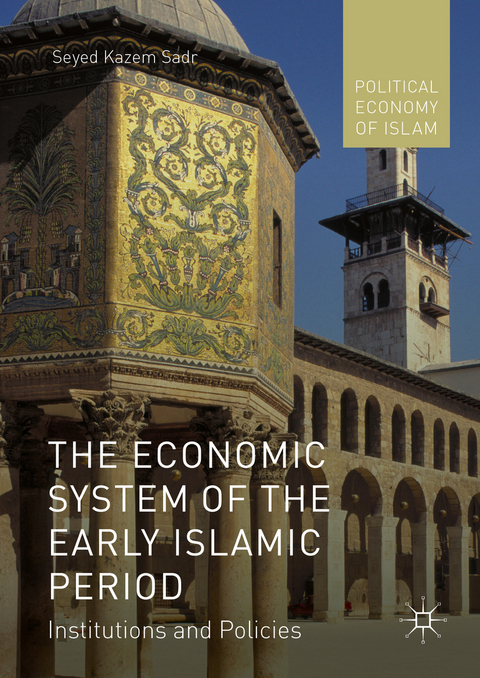
The Economic System of the Early Islamic Period (eBook)
311 Seiten
Palgrave Macmillan US (Verlag)
978-1-137-50733-4 (ISBN)
Seyed Kazem Sadr is Professor at the International Center for Education in Islamic Finance, Malaysia. He previously held the position of Professor at the Shahid Beheshti University, Tehran, Iran; he also has been a member of the Islamic Banking Drafting Committee and the Economic Curriculum Program in Iran. He is the author of several books and refereed journal articles on Islamic economics and banking, as well as natural resource economics. He received his PhD at Ohio State University, USA.
This book provides an economic analysis of the earliest Islamic society, focusing on the policies of the Messenger of Islam (Sawa) and his successors during the first four formative decades of Islam. Two institutions of great importance - the market and the public treasury (Baitul Mal) - and their roles in the development of the private and public sectors are particularly emphasized in this study. The first part of the book is devoted to the economic and cultural dimensions of life in the Arabian Peninsula during the pre-Islamic period, including an analysis of trade and financial relationships with the Roman and Persian economies; the challenges faced by the Messenger's mission and the economic policies of the Messenger after the migration to Madinah are also examined in detail. The author then moves on to a devoted analysis of the nature and functions of the public treasury, its revenues and expenditures, as well as financial and fiscal policies. Also examined is the role of the public sector in maintaining equilibrium in the financial and real sectors, as well as in promoting economic growth and employment. Analysis of the institution of the market, its characteristics, and its functions during the earliest Islamic period constitutes the third section of the book. The behaviors of consumers, producers, and investors in an economy without an interest rate mechanism are also addressed here. The final section investigates the fundamental objective of Islam for human societies - that is, justice - within the context of discussions in earlier parts of the book. The author uses historical economic data, facts, and evidences that are reported from the period, both prior to and after the establishment of the Islamic State, to explore the economic relations, policies, and models that were in practice and applied at that time.
Seyed Kazem Sadr is Professor at the International Center for Education in Islamic Finance, Malaysia. He previously held the position of Professor at the Shahid Beheshti University, Tehran, Iran; he also has been a member of the Islamic Banking Drafting Committee and the Economic Curriculum Program in Iran. He is the author of several books and refereed journal articles on Islamic economics and banking, as well as natural resource economics. He received his PhD at Ohio State University, USA.
Foreword 8
Preface 10
Acknowledgements 12
Contents 14
List of Figures 20
List of Tables 22
Part I: Arabian Peninsula in the Eve of the Introduction of Islam 23
Chapter 1: The Economic and Cultural Situation of the Arabian Peninsula prior to Islam 24
1 Economic Geography 24
2 Culture and Social Customs 29
3 The Era of Barbarism or Jahiliyyah 30
3.1 The Traditions of Abdul-Mottalib 35
3.2 The Bilateral Trades of the Era of Jahiliyyah (Ignorance) 38
3.2.1 Grit Throwing (Al Rami Bel Hesat) 39
3.2.2 Monabazah 39
3.2.3 Molamassah 40
3.2.4 Moavama 40
3.2.5 Mozabana 40
3.2.6 Mohaqalah 40
3.2.7 Habl ol Hableh 40
3.2.8 Tasreyeh 41
3.2.9 Sorar 41
3.2.10 Najsh 41
3.2.11 Maks 41
3.2.12 Talaqqi Rokban 41
4 Conclusion 41
References 42
Chapter 2: Invitation to Islam 43
1 Introduction 43
2 The Pre-Islam Social Position of Prophet Muhammad (SAAS) 44
3 The Post-Islam Conflicts of Quraysh with the Holy Prophet Muhammad (SAAS) 46
4 Before Hijrah to Madinah 48
5 Precautions of the Holy Messenger, Before Hijrah 49
5.1 Presentation of the Islamic Worldview and the Principles of Islamic Beliefs 50
5.2 Declaration of Islamic Verdicts 51
6 Summary 54
References 55
Chapter 3: Migration of the Holy Prophet (SAAS) to Madinah and the Formation of an Islamic State 56
1 Introduction 56
2 Post-Islam Economy of the Arabian Peninsula 57
2.1 Population 57
2.2 Occupations and Employment 61
2.3 Income 62
3 Formation of an Islamic Community and Codification of their Basic Rights 68
3.1 The Basic Articles of an Islamic State Treaty 68
3.1.1 The Community (Ummah) 68
3.1.2 Dimension and the Limits of the Community 68
3.1.3 The Community Leadership 68
3.1.4 The Rights and Obligations of the Community Members 69
3.1.5 The Rights of Non-Muslims 69
3.1.6 The Rights of Muslims 70
3.1.7 Dealing with the Quraysh 70
3.2 Economic Rights 72
3.2.1 Ownership of Natural Resources 72
3.2.2 Methods of Utilization 74
3.2.3 The Shares of the Owners of Factors of Production 75
3.2.4 The Rights of Muslims and Non-Muslims 76
3.2.5 The Priority of the Social Benefits over Individual Benefits 76
No Wastage 76
No Extravagance 77
No External Cost 77
No Worthless Earnings5 78
Prevention of System Distortions 79
4 Provisions of Production Facilities and Employment Opportunities 79
5 Summary 83
References 84
Part II: Public Treasury and Public Finance 86
Chapter 4: The Public Treasury (Baitul Mal) and the Governing System 87
1 Introduction 87
2 Establishment and Organization of the Baitul Mal 88
3 The Objectives, Obligations and Characteristics of Baitul Mal Attendants 90
3.1 Missions and Objectives of a Waaly (Governor) 91
3.2 The Functions of a Waaly 92
3.3 The Behavioral Model of a Governor (Waaly) 93
3.4 Characteristics of a Waaly (Governor) 94
3.5 The Significance of Public Relations 95
3.6 Different Groups in Masses 97
3.7 The Relationship of the Waaly with His Troops 98
3.8 The Relationship of the Waaly with the Judges 99
3.9 The Behavior of the Waaly (Governor) with His Executives 99
3.10 The Importance of Tax Payment and Collection 100
3.11 The Conduct of the Registrars 101
3.12 The Characteristics of Advisors 101
3.13 The Importance of Merchants and Craftsmen 103
3.14 The Importance of Looking After the Weak and Poor People 103
3.15 The Wizards of Kinsfolk and Relatives of the Governor 104
3.16 Affairs that Must be Attended to by the Waaly Personally 105
4 Summary 105
References 106
Chapter 5: Fiscal Policies in Early Islam 107
1 Introduction 107
2 The Revenues of the Public Treasury 107
2.1 Kharaj 107
2.2 Zakat 112
2.2.1 Zakat on Dinars and Dirhams 112
2.2.2 Zakat on Agricultural Crops and their Characteristics 113
2.2.3 Zakat on Livestock 114
Zakat on Sheep 114
Zakat on Cattle 115
Zakat on Camels 117
2.2.4 Characteristics of the Zakat on Sheep, Cattle and Camels 119
2.2.5 Zakat ul Fitr 120
2.3 Khums 121
2.4 The Jizyah (Poll Tax) 123
2.5 Other Revenues 124
3 Methods of Collecting Taxes 124
4 Expenditure Accounts of the Baitul Mal 126
4.1 The Propagation of Islam 126
4.2 Cultural Measures 128
4.3 Promotion of Science and Technologies 129
4.4 Infrastructure Investments 132
4.5 Development of Defense and Security Establishments 133
4.6 The Provision of Social Welfare 137
5 The Domain of the Public Treasury’s Activities 140
6 Fiscal Policies 141
6.1 The Expenditures of the Baitul Mal 141
6.2 The Methods of Financing Government Outlays 143
6.3 No Budget Deficit in the Annual Budget 144
7 Taxes 144
7.1 Automatic Stabilizers 144
7.2 Contractionary and Expansionary Fiscal Policies 145
7.3 Specific Uses of Different Taxes 145
7.4 The Regional Priorities of Spending Tax Revenues 146
7.5 Allocation of Resources and Income Distribution 146
7.6 Tax Collection Method 146
8 Fiscal Stimulus 146
9 The Outcome of Fiscal Policies 147
9.1 The Equilibrium of Aggregate Demand and Supply 147
9.2 Growth and Development 148
9.3 Social Justice 149
References 151
Chapter 6: Money and Finance in the Early Islamic Era 152
1 Introduction 152
2 Definition of Money 153
3 Money versus Capital 153
4 Capital and Debt 154
5 Money in the Early Islamic Era 155
6 The First Coin Struck in Islam 159
7 Money Supply and Demand in the Early Islamic Era 161
8 Circulation and Velocity of Money 162
9 Effects of Islamic Fiscal Policies on the Value of Money 163
10 Financial Services and Instruments 165
10.1 Saving Deposits 165
10.2 Payment System 166
10.3 Financial Services 167
11 Regulations 168
11.1 Prohibition of Tatfif, or Skimping 168
11.2 Kanz 169
11.3 Prohibition of Riba 169
11.4 Prohibition of the Kali-bi-Kali Transactions 171
12 Pecuniary Incentives 171
13 Summary 173
References 175
Part III: Market and the Private Sector 176
Chapter 7: The Markets in the Early Islamic Era 177
1 Introduction 177
2 Markets in Early Islam 178
3 Work and Business Ethics in Islam 179
4 The Characteristics of Markets in the Early Islamic Era 184
4.1 Large Number of Market Participants 184
4.2 No Trade Barriers 185
4.3 Private Goods 185
4.4 Codes of Conduct for Transactions 186
4.5 Maturity 186
4.6 Rules of Compliance with Shariah 186
4.7 Prohibition of Hoarding 187
4.8 No Price Setting 187
4.9 No Transaction Tax 188
4.10 No External Harm 188
4.11 Prohibition of Creating No Value Added5 188
4.12 Forbiddance of No Value Creating Intermediation 188
4.13 No Demolition and Damage 189
4.14 Prohibition of Extravagance 189
4.15 Prohibition of Najsh 189
4.16 Prohibition of Riba 190
4.17 Not to Skimp (Tatfif) 190
4.18 Abandonment of Prohibited Deals 190
4.19 Appointing a Market Superintendent 191
4.20 Options 191
5 Evaluation of the Performance of Early Islamic Markets 192
5.1 The Market Share 193
5.2 Information 193
5.3 Efficiency 195
5.4 Certainty and Security 196
5.5 Transaction Cost 196
5.6 Technological Advancement 197
5.7 Initiatives and Innovations 197
5.8 Returns to Scale 197
5.9 Excess Capacity 198
5.10 Stable and Continuous Supply 198
5.11 State of Competition 199
5.12 Profit Level 199
5.13 Customer Satisfaction 199
6 Summary 200
References 201
Chapter 8: Consumption Theory 202
1 Introduction 202
2 The Parts of a Scientific Theory 202
2.1 The Axiom of Consumption Theory 203
2.2 The Justification for the Assumptions 206
3 Citations from Consumption Manners of the Holy Prophet (SAAS) 208
3.1 Moderation 208
3.2 Food 209
3.3 Hospitability 210
3.4 Clothing 210
3.5 Love to Work 211
4 Pre-eminent Muslim Consumer Behaviors 211
4.1 Infaq (Philanthropic Expenditure) 212
4.2 Khums 214
4.3 Constraints on Consumer Behavior 215
5 The Supply of Factors of Production 218
6 Conclusion 222
References 222
Chapter 9: Production Theory 223
1 Introduction 223
2 The Rule of Diminishing Returns 224
2.1 No Wastage 224
3 Production Function, Isoquant Curves and the Producer’s Equilibrium 225
3.1 No Extravagance 227
3.2 No External Harm 227
4 Production Cost Curves 228
4.1 Equilibrium of the Firm 229
4.2 The Supply Curve of the Firm 230
5 Efficiency 231
6 Summary 233
Chapter 10: Exchange 235
1 Introduction 235
2 The Edgeworth Box Diagram 236
2.1 Initial Allocation of Resources 237
2.2 Exchange Efficiency 242
2.3 Infaq and Exchange 242
2.4 An Example of Exchange and Infaq amongst the Muslims from the Early Islamic Era 243
3 The Effects of Regulatory Guidelines 244
3.1 No Extravagance 244
3.2 No Valueless Intermediation 245
3.3 No Hoarding 246
3.4 Riba Prohibition on Exchanges 247
4 Initial Allocation of Wealth and the Exchange Efficiency in the Early Islamic Era 248
4.1 Initial Allocation of Production Possibilities Between Ansar and Muhajerin 248
4.2 Exchange Efficiency 252
5 Shares of the Owners of Factors of Production 253
6 Summary 256
References 257
Chapter 11: Investment and Saving 258
1 Introduction 258
2 Criteria for Intertemporal Decisions 259
3 An Intertemporal Analysis of the Consumer’s Behavior 259
4 An Analysis of Investor Behavior 265
5 Factors Affecting the Nesiah Rate 270
6 Nesiah Rates versus Interest Rates 271
7 The Consequences of Eliminating Riba 273
7.1 Harmonious generation of income in both financial and real sector of the economy 273
7.2 Saving Incentives Are Maintained 273
7.3 Investment Incentives Are Promoted 274
7.4 Increased Output and Redistribution of Income 276
7.5 Rapid Adjustment to External Shocks 276
8 Summary 279
References 280
Part IV: Justice 281
Chapter 12: Efficiency and Justice 282
1 Introduction 282
2 Relative Efficiency 283
3 Justice 285
3.1 Equality 285
3.2 Equal Utilization Opportunities 285
3.3 Inequality 286
4 Social Welfare Function 286
4.1 Total Welfare 287
4.2 Equality in Welfare 288
4.3 Intermediate State Welfare 289
5 General Equilibrium 290
6 Justice in Islam 293
6.1 The Three Definitions of Justice 294
6.2 Intrinsic Rights 296
6.3 Shariah Rights 297
7 Formation of Social Rights 299
8 Meaning of Justice from the Viewpoint of Martyr Motahhari 300
8.1 Social Welfare Function 301
9 General Equilibrium in the Economy of the Early Islamic Era 302
10 Summary 305
References 307
Index 308
| Erscheint lt. Verlag | 23.5.2016 |
|---|---|
| Reihe/Serie | Political Economy of Islam | Political Economy of Islam |
| Zusatzinfo | XXI, 311 p. 41 illus. in color. |
| Verlagsort | New York |
| Sprache | englisch |
| Themenwelt | Geschichte ► Allgemeine Geschichte ► Vor- und Frühgeschichte |
| Geschichte ► Allgemeine Geschichte ► Altertum / Antike | |
| Geisteswissenschaften ► Geschichte ► Regional- / Ländergeschichte | |
| Geschichte ► Teilgebiete der Geschichte ► Wirtschaftsgeschichte | |
| Geisteswissenschaften ► Religion / Theologie ► Islam | |
| Sozialwissenschaften ► Politik / Verwaltung | |
| Wirtschaft ► Volkswirtschaftslehre ► Wirtschaftspolitik | |
| Schlagworte | Ancient history • Arabian Peninsula • Baitul Mal • Consumption Theory • Early Islamic Era • Early Islamic Period • Economic Systems • Finance • Interest free economy • Islamic economics • Islamic treasury • Madinah • Market Institutes • Medina • Messenger of Islam • Muhammad • Production theory • Prophet of Islam • Public treasury |
| ISBN-10 | 1-137-50733-0 / 1137507330 |
| ISBN-13 | 978-1-137-50733-4 / 9781137507334 |
| Informationen gemäß Produktsicherheitsverordnung (GPSR) | |
| Haben Sie eine Frage zum Produkt? |
 PDF (Wasserzeichen)
DRM: Digitales Wasserzeichen
Dieses eBook enthält ein digitales Wasserzeichen und ist damit für Sie personalisiert. Bei einer missbräuchlichen Weitergabe des eBooks an Dritte ist eine Rückverfolgung an die Quelle möglich.
Dateiformat: PDF (Portable Document Format)
Mit einem festen Seitenlayout eignet sich die PDF besonders für Fachbücher mit Spalten, Tabellen und Abbildungen. Eine PDF kann auf fast allen Geräten angezeigt werden, ist aber für kleine Displays (Smartphone, eReader) nur eingeschränkt geeignet.
Systemvoraussetzungen:
PC/Mac: Mit einem PC oder Mac können Sie dieses eBook lesen. Sie benötigen dafür einen PDF-Viewer - z.B. den Adobe Reader oder Adobe Digital Editions.
eReader: Dieses eBook kann mit (fast) allen eBook-Readern gelesen werden. Mit dem amazon-Kindle ist es aber nicht kompatibel.
Smartphone/Tablet: Egal ob Apple oder Android, dieses eBook können Sie lesen. Sie benötigen dafür einen PDF-Viewer - z.B. die kostenlose Adobe Digital Editions-App.
Buying eBooks from abroad
For tax law reasons we can sell eBooks just within Germany and Switzerland. Regrettably we cannot fulfill eBook-orders from other countries.
aus dem Bereich