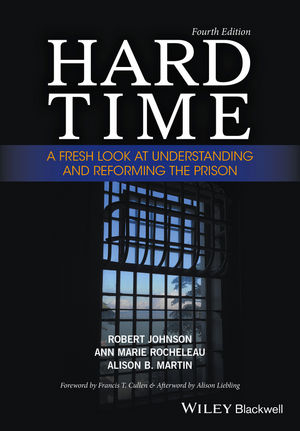
Hard Time (eBook)
John Wiley & Sons (Verlag)
978-1-119-08282-8 (ISBN)
Hard Time: A Fresh Look at Understanding and Reforming the Prison, 4th Edition, is a revised and updated version of the highly successful text addressing the origins, evolution, and promise of America's penal system.
- Draws from both ethnographic and professional material, and situates the prison experience within both contemporary and historical contexts
- Features first person accounts from male and female inmates and staff, revealing what it's actually like to live and work in prison
- Includes all-new chapters on prison reform and on supermax correctional facilities, including the latest research on confinement, long-term segregation, and death row
- Explores a wide range of topics, including the nature of prison as punishment; prisoner personality types and coping strategies; gang violence; prison officers' custodial duties; and psychological, educational, and work programs
- Develops policy recommendations for the future based on qualitative and quantitative research and evidence-based initiatives
Robert Johnson is a Professor of Justice, Law and Criminology at American University, Washington, D.C., and Editor and Publisher of BleakHouse Publishing. His publications include Death Work: A Study of the Modern Execution Process, which won the Outstanding Book Award of the Academy of Criminal Justice Sciences. Ann Marie Rocheleau is an Associate Professor at Stonehill College, Easton, Massachusetts. She collaborated on research studies on adult and juvenile corrections, community policing, and drug purchase for the National Institute of Justice and the Office of National Drug Control Policy. Alison B. Martin is a Policy Analyst with the Council of State Governments Justice Center. She is the co-author of Rights and Responsibilities of Citizenship the World Over and Gay and Lesbian Communities the World Over. The book includes a Foreword by Francis T. Cullen, Professor of Criminal Justice and Sociology at the University of Cincinnati and an Afterword by Alison Libeling, University Lecturer and Director of the Prisons Research Centre at the Cambridge University Institute of Criminology.
Foreword
The growth in incarceration in the United States has been so sustained and long-lasting that virtually all readers have spent their entire academic lives, if not their entire lives, in the era of mass imprisonment. During this time, the count of inmates behind bars rolled forward much like the odometer on an automobile – clicking upward relentlessly toward the next round number: a few hundred thousand in the 1970s eventually surpassed the 2 million mark and then moved beyond 2.4 million in 2008. In the past 5 years or so, it is as though policymakers have finally come to their senses, awakening to the reality that this mindless embrace of locking up fellow Americans was an astounding policy failure that has created a correctional nightmare. As Travis Pratt noted, the nation had become “addicted to incarceration.” The recovery process will not be easy.
In this context, it is perhaps understandable that scholars have focused an inordinate amount of attention on the sources, scope, and impact of mass imprisonment. We have learned much about the “culture of control,” “governing through crime,” “the punitive imperative,” “the prison experiment,” and similar concepts that have illuminated the nature of the incarceration movement. Indeed, criminologists did their best to form a collective Dear Abby, advising all who would listen that using imprisonment to deal with crime was expensive, of limited effectiveness, and often racially unjust. For a long time, nobody seemed to listen; fortunately, many policymakers from both ends of the political spectrum now are.
In short, it was difficult, if not impossible, for scholars to ignore the elephant in the correctional room – mass incarceration. But doing so came at a price: they gave far less attention to what was going on inside the nation's prisons and, with a few notable exceptions, remained silent on how to improve the experience of those who, day in and day out, resided within the society of captives. This neglect was to a degree inadvertent. Time spent focusing on one issue – the policy issue of mass imprisonment – is time not spent focusing on another issue – in this case, how to reform the internal quality of correctional facilities. But this neglect – this turning a blind eye to the plight of the incarcerated – also was a conscious choice rooted in criminologists' professional ideology.
A core belief, held explicitly or implicitly, by most criminologists is that prisons are inherently inhumane and thus beyond reform. There can be no such thing as a “good prison.” This idea can be traced to the first part of the 1970s. In 1971, Philip Zimbardo and colleagues conducted the famous Stanford Prison Experiment in which psychologically normal undergraduate students placed within a mock prison quickly were transformed into oppositional inmates and coercive custodians. The fact that the experiment had to be halted to prevent further harm to the participants sent a powerful message that prisons, by their nature, had a brutalizing effect on all inside. Shortly thereafter, in 1974, Robert Martinson published a famous essay in The Public Interest claiming that prison rehabilitation programs were, by and large, ineffective – a conclusion soon known by the shorthand phrase “nothing works.” Taken together, there seemed to be incontrovertible scientific evidence that the total institution of the prison was inhumane and that even the most well-intentioned efforts to help reform inmates could not work within its walls. Other events of the day lent credence to this view, including the lethal suppression of the Attica prison riot (which occurred in the month following the Stanford Prison Experiment), revelations of inhumanity in other total institutions (especially mental hospitals), and the broader abuse of state power within criminal justice and in other domains (e.g., foreign policy).
This conception encouraged many criminologists to abandon the social world of the prison as a valued object of investigation. Why study correctional institutions if it was an established truth that they were hopelessly coercive and brutal? Those scholars who still bothered to examine prisons did not question this truth; instead, their project was to document the ways in which institutions were violent, victimizing, disorderly, dehumanizing, and otherwise deleterious. They also held out little hope that this disquieting social order could ever be otherwise. Efforts to improve prison life were thus seen as a fool's errand – destined to fail. Worse, trying to make prisons less brutalizing would achieve, at best, minor incremental improvements that would come at the high price of lending legitimacy to the prison enterprise. Scholars who dared to align themselves with prison officials risked being labeled “administrative criminologists” and as “tools of the state.” Wishing to avoid such stigmatizing labels, most correctional scholars rejected a reform agenda and settled instead for a different policy: oppose putting all but the most violent, predatory offenders behind bars.
This anti-prison stance – with the prescription to divert as many people from incarceration as possible – was ideologically comforting but ultimately foolhardy, for two reasons. First, policymakers did not listen to criminologists or read their books. Instead, they continued to embrace get-tough rhetoric and to lock up massive numbers of Americans – as the Pew Charitable Trusts calculated, a figure that by 2008 reached 1 in 100 of us. Second, it placed these scholars in a position of having nothing to say about the internal regimen of prison. Their lack of involvement simply opened the way for different voices to be heard – those who favored mean-spirited corrections in which increasing prison austerity was trumpeted as a way of exacting retribution and of teaching offenders that crime does not pay.
In 1987, John DiIulio sought to counteract this dominant view in his controversial book Governing Prisons. A political scientist by training, DiIulio argued that, similar to other organizations, how prisons were managed shaped the quality of institutional life. Wardens and other correctional staff were not pawns who reacted in predetermined ways to the prison's structural arrangements. Rather, they were managers whose decisions and treatment of inmates produced either orderly, safe, and reformative prisons or disorderly, unsafe, and criminogenic prisons – or something in between. It is not clear, however, why DiIulio's thesis was so controversial. To be sure, his particular ideas about how best to govern prisons were speculative and clearly deserving of further empirical scrutiny. But objection in many quarters occurred simply because DiIulio challenged criminological orthodoxy in suggesting that prisons could be made more decent.
It is within this context that Hard Time was initially published, also in 1987. When I read the first edition, I was struck by Robert Johnson's intellectual courage to reject the reigning professional ideology that prisons were unredeemable institutions. He detailed meticulously the harsh realities that made prisons as bad as the critics claimed them to be. But he also unearthed the promising sides of this social world and articulated pathways to make prisons more decent places – issues I return to shortly. I was so taken by this analysis that I immediately assigned the book as required reading in my course titled “Prisons and Jails.” Indeed, I believed that Hard Time was a contemporary classic. Now, three decades later and entering its fourth edition, I can attest that, like fine wine, the book has improved with age. In part, I suspect this is because Professor Johnson has had the wisdom of adding quite capable coauthors, Ann Marie Rocheleau and Alison B. Martin. This scholarly trinity has succeeded in creating a volume that is wonderfully written and deeply researched (with 1775 endnotes!). But its pages are infused with something more: an abiding belief that prisons can be made more humane and effective – and that the people within them are not beyond redemption and do not have to live in immiserating conditions.
Hard Time is replete with a lengthy roster of special insights, each of which enriches our understanding of prison life. Accordingly, it is difficult to identify core themes that necessarily supersede in importance others on this list. Still, I can share the two key ideas in the volume that have long had a major impact on my thinking about corrections.
First, Johnson and colleagues document the public cultures that flourish in prison – one held by the inmates and the other by correctional officers. In many ways, these beliefs and actions – often involving violence, hypermasculinity, coercion, and demeaning rhetoric – are precisely what infuse the orthodox view within criminology that prisons are inherently inhumane and beyond genuine reform. These public cultures are real and affect the unhealthy choices that prisoners and their keepers make. But Johnson, Rocheleau, and Martin also unmask another set of cultures – the private cultures of inmates and correctional...
| Erscheint lt. Verlag | 9.6.2016 |
|---|---|
| Nachwort | Alison Liebling |
| Vorwort | Francis T. Cullen |
| Sprache | englisch |
| Themenwelt | Recht / Steuern ► Strafrecht ► Kriminologie |
| Sozialwissenschaften ► Politik / Verwaltung | |
| Sozialwissenschaften ► Soziologie | |
| Schlagworte | Ãffentliche Ordnung u. Verwaltung • American prison reform • American prisons • correctional officers</p> • Criminality • criminal justice system • Criminology • Gefängnis • Gefängnis • Kriminologie • Law • <p>Prison reform • Öffentliche Ordnung u. Verwaltung • Penal reform • Political Science • Politikwissenschaft • prison adjustment • prisoner violence • prison violence • Public Policy & Administration • Rechtswissenschaft • Sociology • Sociology Special Topics • Soziologie • Spezialthemen Soziologie • Supermax • U.S. prisons |
| ISBN-10 | 1-119-08282-X / 111908282X |
| ISBN-13 | 978-1-119-08282-8 / 9781119082828 |
| Informationen gemäß Produktsicherheitsverordnung (GPSR) | |
| Haben Sie eine Frage zum Produkt? |
 EPUB (Adobe DRM)
Kopierschutz: Adobe-DRM
Adobe-DRM ist ein Kopierschutz, der das eBook vor Mißbrauch schützen soll. Dabei wird das eBook bereits beim Download auf Ihre persönliche Adobe-ID autorisiert. Lesen können Sie das eBook dann nur auf den Geräten, welche ebenfalls auf Ihre Adobe-ID registriert sind.
Details zum Adobe-DRM
Dateiformat: EPUB (Electronic Publication)
EPUB ist ein offener Standard für eBooks und eignet sich besonders zur Darstellung von Belletristik und Sachbüchern. Der Fließtext wird dynamisch an die Display- und Schriftgröße angepasst. Auch für mobile Lesegeräte ist EPUB daher gut geeignet.
Systemvoraussetzungen:
PC/Mac: Mit einem PC oder Mac können Sie dieses eBook lesen. Sie benötigen eine
eReader: Dieses eBook kann mit (fast) allen eBook-Readern gelesen werden. Mit dem amazon-Kindle ist es aber nicht kompatibel.
Smartphone/Tablet: Egal ob Apple oder Android, dieses eBook können Sie lesen. Sie benötigen eine
Geräteliste und zusätzliche Hinweise
Buying eBooks from abroad
For tax law reasons we can sell eBooks just within Germany and Switzerland. Regrettably we cannot fulfill eBook-orders from other countries.
aus dem Bereich