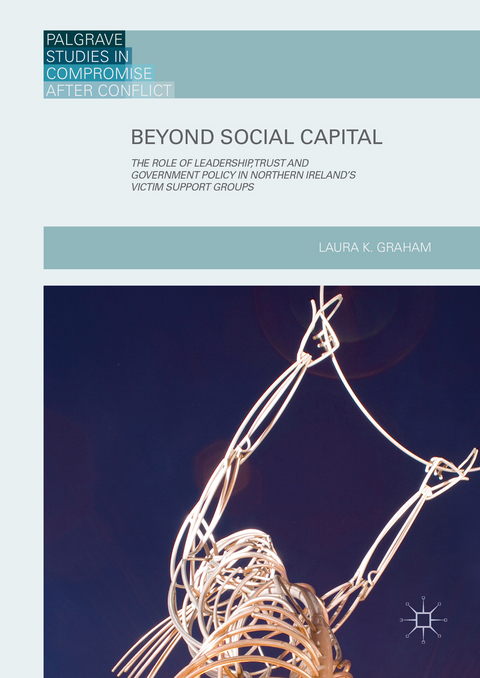
Beyond Social Capital (eBook)
171 Seiten
Palgrave Macmillan UK (Verlag)
978-1-137-51867-5 (ISBN)
Drawing on lessons from civil society in Northern Ireland, Beyond Social Capital examines the limitations of social capital theory in deeply divided societies. It draws on an ethnographic study of victim support groups and evidence drawn from policymakers in Northern Ireland to reconceptualize the traditional bonding-bridging distinction. The role of leadership is particularly examined, as the book highlights the complex and compelling ways in which leadership supports and shapes the activities, practices and motivations of the victim self-help industry in Northern Ireland. The multiple dimensions of this industry are explored, including: social and victim policy; private, statutory, and voluntary sector collaboration; the political motivations of victim support groups, and; the types of social capital being built in victim groups and the impact that this social capital has on victims and wider elements of the peace process.
Importantly, Laura K. Graham challenges the prevailing notion that all forms of social capital are inherently good for civic organizations and associational life. Instead, a new form of social capital existing in divided and post-conflict societies is advanced. This form of social capital, called 'dysfunctional bonding', may have negative impacts, causing distrust within a
nd outside a group and can be particularly problematic for those traumatized by political conflict. With international relevance, this book will be of great interest to those working in post-conflict studies as well as victim studies.Laura K. Graham is a Lecturer in Peace and Justice Studies at Tufts University, USA. She is a Tisch College Faculty Fellow and Principal Investigator on the Voices of Ferguson study of policing and justice in Ferguson, Missouri, USA.
Drawing on lessons from civil society in Northern Ireland, Beyond Social Capital examines the limitations of social capital theory in deeply divided societies. It draws on an ethnographic study of victim support groups and evidence from policymakers in Northern Ireland to reconceptualize the traditional bonding-bridging distinction in social capital theory. The role of leadership is particularly significant, as the book highlights the complex and compelling ways in which leadership supports and shapes the activities, practices and motivations of the victim self-help industry in Northern Ireland. Multiple dimensions of this industry are explored, including: social and victim policy; private, statutory, and voluntary sector collaboration; the political motivations of victim support groups; and the types of social capital being built in victim groups and the impact that this social capital has on victims and wider elements of the peace process. Importantly, Laura K. Graham challenges the prevailing notion that all forms of social capital are inherently good for civic organizations and associational life. Instead, a new form of social capital existing in divided and post-conflict societies is advanced. This form of social capital, called 'dysfunctional bonding', may have negative impacts, causing distrust within and outside a group and can be particularly problematic for those traumatized by political conflict. With international relevance, this book willbe of great interest to those working in post-conflict studies as well as victim studies.
Laura K. Graham is a Lecturer in Peace and Justice Studies at Tufts University, USA. She is a Tisch College Faculty Fellow and Principal Investigator on the Voices of Ferguson study of policing and justice in Ferguson, Missouri, USA.
Introduction1. Civil Society2. Rethinking Social Capital3. Inside Victim Support Groups4. Leadership Matters5. Bonding, Bridging, and ConstrictingConclusion
| Erscheint lt. Verlag | 11.4.2016 |
|---|---|
| Reihe/Serie | Palgrave Studies in Compromise after Conflict | Palgrave Studies in Compromise after Conflict |
| Zusatzinfo | XXXII, 171 p. 1 illus. |
| Verlagsort | London |
| Sprache | englisch |
| Themenwelt | Recht / Steuern ► Strafrecht ► Kriminologie |
| Sozialwissenschaften ► Pädagogik ► Sozialpädagogik | |
| Sozialwissenschaften ► Politik / Verwaltung ► Europäische / Internationale Politik | |
| Sozialwissenschaften ► Soziologie | |
| Schlagworte | Bonding • Bridging • conflict • constriction • Criminology • Northern Ireland • Peace Process • victims • victim support groups |
| ISBN-10 | 1-137-51867-7 / 1137518677 |
| ISBN-13 | 978-1-137-51867-5 / 9781137518675 |
| Informationen gemäß Produktsicherheitsverordnung (GPSR) | |
| Haben Sie eine Frage zum Produkt? |
 PDF (Wasserzeichen)
DRM: Digitales Wasserzeichen
Dieses eBook enthält ein digitales Wasserzeichen und ist damit für Sie personalisiert. Bei einer missbräuchlichen Weitergabe des eBooks an Dritte ist eine Rückverfolgung an die Quelle möglich.
Dateiformat: PDF (Portable Document Format)
Mit einem festen Seitenlayout eignet sich die PDF besonders für Fachbücher mit Spalten, Tabellen und Abbildungen. Eine PDF kann auf fast allen Geräten angezeigt werden, ist aber für kleine Displays (Smartphone, eReader) nur eingeschränkt geeignet.
Systemvoraussetzungen:
PC/Mac: Mit einem PC oder Mac können Sie dieses eBook lesen. Sie benötigen dafür einen PDF-Viewer - z.B. den Adobe Reader oder Adobe Digital Editions.
eReader: Dieses eBook kann mit (fast) allen eBook-Readern gelesen werden. Mit dem amazon-Kindle ist es aber nicht kompatibel.
Smartphone/Tablet: Egal ob Apple oder Android, dieses eBook können Sie lesen. Sie benötigen dafür einen PDF-Viewer - z.B. die kostenlose Adobe Digital Editions-App.
Buying eBooks from abroad
For tax law reasons we can sell eBooks just within Germany and Switzerland. Regrettably we cannot fulfill eBook-orders from other countries.
aus dem Bereich