


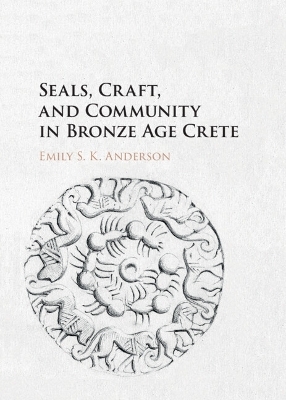
Seals, Craft, and Community in Bronze Age Crete
Seiten
2016
Cambridge University Press (Verlag)
978-1-107-13119-4 (ISBN)
Cambridge University Press (Verlag)
978-1-107-13119-4 (ISBN)
Focusing on the numerous sealstones which have been excavated across Crete, current discussions of material culture, community and space in the second millennium BCE are merged in an interdisciplinary approach. Reframing the origins of 'palace' society in the Aegean, this book will be of value to researchers and graduate students.
Generations of scholars have grappled with the origins of 'palace' society on Minoan Crete, seeking to explain when and how life on the island altered monumentally. Emily Anderson turns light on the moment just before the palaces, recognizing it as a remarkably vibrant phase of socio-cultural innovation. Exploring the role of craftspersons, travelers and powerful objects, she argues that social change resulted from creative work that forged connections at new scales and in novel ways. This study focuses on an extraordinary corpus of sealstones which have been excavated across Crete. Fashioned of imported ivory and engraved with images of dashing lions, these distinctive objects linked the identities of their distant owners. Anderson argues that it was the repeated but pioneering actions of such diverse figures, people and objects alike, that dramatically changed the shape of social life in the Aegean at the turn of the second millennium BCE.
Generations of scholars have grappled with the origins of 'palace' society on Minoan Crete, seeking to explain when and how life on the island altered monumentally. Emily Anderson turns light on the moment just before the palaces, recognizing it as a remarkably vibrant phase of socio-cultural innovation. Exploring the role of craftspersons, travelers and powerful objects, she argues that social change resulted from creative work that forged connections at new scales and in novel ways. This study focuses on an extraordinary corpus of sealstones which have been excavated across Crete. Fashioned of imported ivory and engraved with images of dashing lions, these distinctive objects linked the identities of their distant owners. Anderson argues that it was the repeated but pioneering actions of such diverse figures, people and objects alike, that dramatically changed the shape of social life in the Aegean at the turn of the second millennium BCE.
Emily S. K. Anderson teaches in the Departments of Classics and History of Art at The Johns Hopkins University, where her research primarily concerns the material and visual cultures of the Aegean and eastern Mediterranean Bronze Ages.
1. Rethinking prepalatial Crete - social innovation on an island of persistence; 2. Identity and relation through early Cretan glyptic; 3. Distance and nearness - fundamental changes to the dynamics of seal use in late prepalatial Crete; 4. In the hands of the craftsperson - innovation and repetition across Cretan communities; 5. The crafting of new social space - relation and incorporation in late prepalatial Crete.
| Erscheinungsdatum | 16.12.2016 |
|---|---|
| Zusatzinfo | 61 Halftones, black and white; 2 Line drawings, black and white |
| Verlagsort | Cambridge |
| Sprache | englisch |
| Maße | 185 x 260 mm |
| Gewicht | 920 g |
| Themenwelt | Geisteswissenschaften ► Archäologie |
| Geschichte ► Allgemeine Geschichte ► Vor- und Frühgeschichte | |
| Geisteswissenschaften ► Geschichte ► Regional- / Ländergeschichte | |
| Geschichte ► Teilgebiete der Geschichte ► Kulturgeschichte | |
| Sozialwissenschaften | |
| ISBN-10 | 1-107-13119-7 / 1107131197 |
| ISBN-13 | 978-1-107-13119-4 / 9781107131194 |
| Zustand | Neuware |
| Informationen gemäß Produktsicherheitsverordnung (GPSR) | |
| Haben Sie eine Frage zum Produkt? |
Mehr entdecken
aus dem Bereich

aus dem Bereich
auf den Spuren der frühen Zivilisationen
Buch | Hardcover (2023)
C.H.Beck (Verlag)
CHF 27,95
Erkennen. Bestimmen. Beschreiben
Buch | Softcover (2022)
Deutscher Kunstverlag
CHF 27,85


