


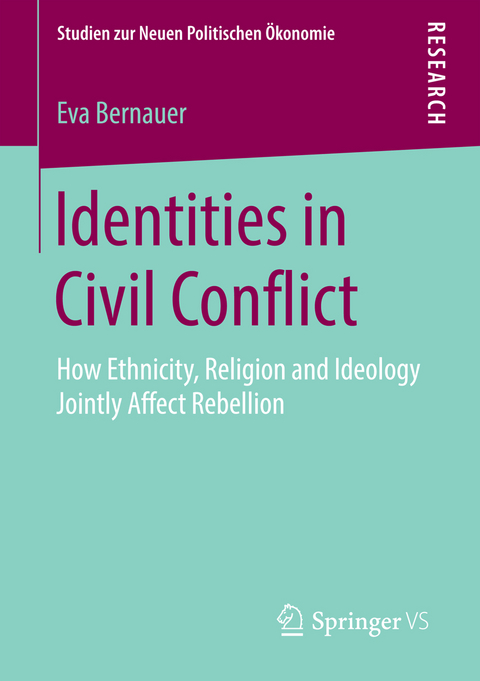
Identities in Civil Conflict
How Ethnicity, Religion and Ideology Jointly Affect Rebellion
Seiten
2016
|
1st ed. 2016
Springer Fachmedien Wiesbaden GmbH (Verlag)
978-3-658-14151-6 (ISBN)
Springer Fachmedien Wiesbaden GmbH (Verlag)
978-3-658-14151-6 (ISBN)
How Ethnicity, Religion and Ideology Jointly Affect Rebellion
Eva Bernauer predicts civil conflicts based upon the political exclusion of identity groups and their transnational links to external governments. The innovation lies in a simultaneous consideration of three identities - ethnicity, religion, and class-based ideology - thus extending previous studies with merely an ethnic focus. Most importantly, such a perspective implies a shift towards a society's unique three-dimensional identity setup, upon which the excluded population and their transnational links can be determined. The author presents original data on the three-dimensional identity setup for 57 countries and introduces a formal model where rebel leaders strategically use identities to garner the support of the population. Key quantities of interest, such as the largest excluded subgroup or the number of identity links to external governments, are tested in several quantitative analyses as predictors for the onset of civil conflicts. The author shows that there is an added valueof extending the mere ethnic perspective to also encompass religion and class-based ideology.
Eva Bernauer predicts civil conflicts based upon the political exclusion of identity groups and their transnational links to external governments. The innovation lies in a simultaneous consideration of three identities - ethnicity, religion, and class-based ideology - thus extending previous studies with merely an ethnic focus. Most importantly, such a perspective implies a shift towards a society's unique three-dimensional identity setup, upon which the excluded population and their transnational links can be determined. The author presents original data on the three-dimensional identity setup for 57 countries and introduces a formal model where rebel leaders strategically use identities to garner the support of the population. Key quantities of interest, such as the largest excluded subgroup or the number of identity links to external governments, are tested in several quantitative analyses as predictors for the onset of civil conflicts. The author shows that there is an added valueof extending the mere ethnic perspective to also encompass religion and class-based ideology.
Eva Bernauer received her doctor’s degree from the University of Mannheim.
National Political Exclusion and Support of Rebel Groups.- Transnational Support of Rebel Groups.
| Erscheinungsdatum | 08.10.2016 |
|---|---|
| Reihe/Serie | Studien zur Neuen Politischen Ökonomie |
| Zusatzinfo | XVI, 231 p. 41 illus. |
| Verlagsort | Wiesbaden |
| Sprache | englisch |
| Maße | 148 x 210 mm |
| Themenwelt | Sozialwissenschaften ► Politik / Verwaltung ► Europäische / Internationale Politik |
| Sozialwissenschaften ► Politik / Verwaltung ► Vergleichende Politikwissenschaften | |
| Sozialwissenschaften ► Soziologie | |
| Wirtschaft ► Volkswirtschaftslehre ► Wirtschaftspolitik | |
| Schlagworte | Civil War • Class • conflict studies • Demography • ethnic conflict • Political Economy • Political Science and International Studies • Social Structure, Social Inequality • Transnational linkages |
| ISBN-10 | 3-658-14151-4 / 3658141514 |
| ISBN-13 | 978-3-658-14151-6 / 9783658141516 |
| Zustand | Neuware |
| Informationen gemäß Produktsicherheitsverordnung (GPSR) | |
| Haben Sie eine Frage zum Produkt? |
Mehr entdecken
aus dem Bereich



aus dem Bereich
Amerikas Strategie der Vorherrschaft und der Kampf um Eurasien
Buch | Softcover (2024)
NOMEN Verlag
CHF 27,95
kurze Geschichte einer langen Beziehung
Buch | Hardcover (2025)
Suhrkamp (Verlag)
CHF 36,40
erfolgreiche Interessenvertretung durch Prozesskompetenz im komplexen …
Buch | Hardcover (2023)
Wiley-VCH (Verlag)
CHF 58,75


