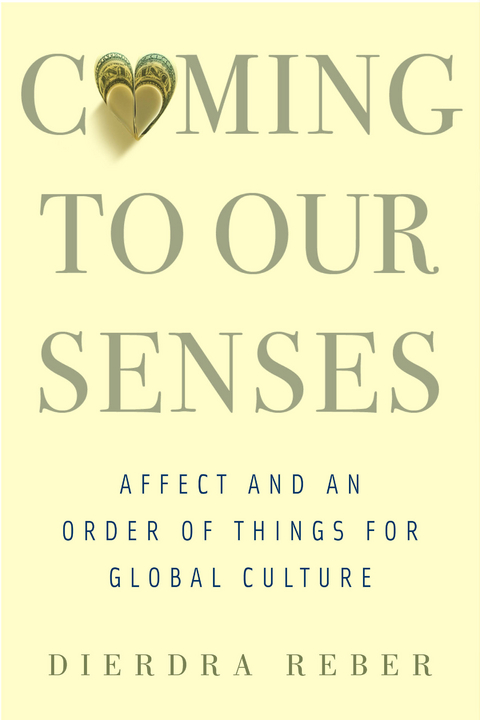
Coming to Our Senses (eBook)
Columbia University Press (Verlag)
978-0-231-54090-2 (ISBN)
Coming to Our Senses positions affect, or feeling, as our new cultural compass, ordering the parameters and possibilities of what can be known. From Facebook "e;likes"e; to Coca-Cola "e;loves,"e; from "e;emotional intelligence"e; in business to "e;emotional contagion"e; in social media, affect has displaced reason as the primary catalyst of global culture.Through examples of feeling in the books, film, music, advertising, cultural criticism, and political discourse of the United States and Latin America, Reber shows how affect encourages the public to "e;reason"e; on the strength of sentiment alone. Well-being, represented by happiness and health, and ill-being, embodied by unhappiness and disease, form the two poles of our social judgment, whether in affirmation or critique. We must then reenvision contemporary politics as operating at the level of the feeling body, so we can better understand the physiological and epistemological conditions affirming our cultural status quo and contestatory strategies for emancipation.
Dierdra Reber is assistant professor of Spanish at Emory University. Her essays on the cultural politics of Latin American film and fiction and the epistemology of global culture have appeared in Revista Iberoamericana, Modern Language Notes, Novel: A Forum on Fiction, Journal of Latin American Cultural Studies, differences, and nonsite.
Preface: Tracking the Feeling SomaAcknowledgmentsPrelude: Affective Contours of KnowledgeIntroduction: Headless CapitalismPart 1: The Feeling Soma1. The Feeling Soma: Humanity as a Singular "We"2. We Are the World: Sentient People and Planet in Sustainability DiscoursePart 2: Homeostatic Dynamics3. "Becoming well beings": Homeostatic Dynamics and the Metaphor of Health4. Legs, Love, and Life: The Affective Political Actor as a Well BeingConclusion: Affective BiopowerNotesWorks CitedIndex
| Erscheint lt. Verlag | 2.2.2016 |
|---|---|
| Verlagsort | New York |
| Sprache | englisch |
| Themenwelt | Geisteswissenschaften ► Philosophie ► Allgemeines / Lexika |
| Geisteswissenschaften ► Philosophie ► Philosophie der Neuzeit | |
| Geisteswissenschaften ► Sprach- / Literaturwissenschaft ► Anglistik / Amerikanistik | |
| Geisteswissenschaften ► Sprach- / Literaturwissenschaft ► Literaturwissenschaft | |
| Sozialwissenschaften ► Ethnologie | |
| Sozialwissenschaften ► Kommunikation / Medien ► Medienwissenschaft | |
| Sozialwissenschaften ► Soziologie | |
| ISBN-10 | 0-231-54090-6 / 0231540906 |
| ISBN-13 | 978-0-231-54090-2 / 9780231540902 |
| Informationen gemäß Produktsicherheitsverordnung (GPSR) | |
| Haben Sie eine Frage zum Produkt? |
 EPUB (Adobe DRM)
Kopierschutz: Adobe-DRM
Adobe-DRM ist ein Kopierschutz, der das eBook vor Mißbrauch schützen soll. Dabei wird das eBook bereits beim Download auf Ihre persönliche Adobe-ID autorisiert. Lesen können Sie das eBook dann nur auf den Geräten, welche ebenfalls auf Ihre Adobe-ID registriert sind.
Details zum Adobe-DRM
Dateiformat: EPUB (Electronic Publication)
EPUB ist ein offener Standard für eBooks und eignet sich besonders zur Darstellung von Belletristik und Sachbüchern. Der Fließtext wird dynamisch an die Display- und Schriftgröße angepasst. Auch für mobile Lesegeräte ist EPUB daher gut geeignet.
Systemvoraussetzungen:
PC/Mac: Mit einem PC oder Mac können Sie dieses eBook lesen. Sie benötigen eine
eReader: Dieses eBook kann mit (fast) allen eBook-Readern gelesen werden. Mit dem amazon-Kindle ist es aber nicht kompatibel.
Smartphone/Tablet: Egal ob Apple oder Android, dieses eBook können Sie lesen. Sie benötigen eine
Geräteliste und zusätzliche Hinweise
Buying eBooks from abroad
For tax law reasons we can sell eBooks just within Germany and Switzerland. Regrettably we cannot fulfill eBook-orders from other countries.
aus dem Bereich