


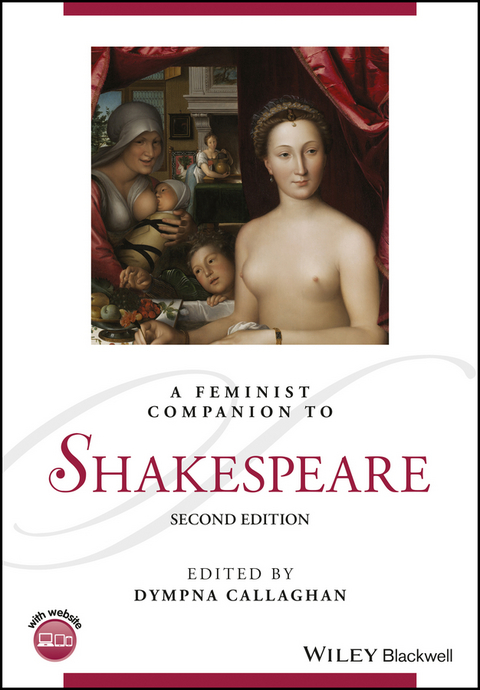
A Feminist Companion to Shakespeare (eBook)
John Wiley & Sons (Verlag)
978-1-118-50120-7 (ISBN)
The question is not whether Shakespeare studies needs feminism, but whether feminism needs Shakespeare. This is the explicitly political approach taken in the dynamic and newly updated edition of A Feminist Companion to Shakespeare.
- Provides the definitive feminist statement on Shakespeare for the 21st century
- Updates address some of the newest theatrical andcreative engagements with Shakespeare, offering fresh insights into Shakespeare's plays and poems, and gender dynamics in early modern England
- Contributors come from across the feminist generations and from various stages in their careers to address what is new in the field in terms of historical and textual discovery
- Explores issues vital to feminist inquiry, including race, sexuality, the body, queer politics, social economies, religion, and capitalism
- In addition to highlighting changes, it draws attention to the strong continuities of scholarship in this field over the course of the history of feminist criticism of Shakespeare
- The previous edition was a recipient of a Choice Outstanding Academic Title award; this second edition maintains its coverage and range, and bringsthe scholarship right up to the present day
Dympna Callaghan is William L. Safire Professor of Modern Letters at Syracuse University, New York. Her books inlcude Shakespeare Without Women (2000), The Impact of Feminism in English Renaissance Culture (2006), Shakespeare's Sonnets (2007), Who Was William Shakespeare (Wiley Blackwell, 2013), and Hamlet: Language and Writing (2015). She is a past president of Shakespeare Association of America.
The question is not whether Shakespeare studies needs feminism, but whether feminism needs Shakespeare. This is the explicitly political approach taken in the dynamic and newly updated edition of A Feminist Companion to Shakespeare. Provides the definitive feminist statement on Shakespeare for the 21st century Updates address some of the newest theatrical andcreative engagements with Shakespeare, offering fresh insights into Shakespeare s plays and poems, and gender dynamics in early modern England Contributors come from across the feminist generations and from various stages in their careers to address what is new in the field in terms of historical and textual discovery Explores issues vital to feminist inquiry, including race, sexuality, the body, queer politics, social economies, religion, and capitalism In addition to highlighting changes, it draws attention to the strong continuities of scholarship in this field over the course of the history of feminist criticism of Shakespeare The previous edition was a recipient of a Choice Outstanding Academic Title award; this second edition maintains its coverage and range, and bringsthe scholarship right up to the present day
Dympna Callaghan is William L. Safire Professor of Modern Letters at Syracuse University, New York. Her books inlcude Shakespeare Without Women (2000), The Impact of Feminism in English Renaissance Culture (2006), Shakespeare's Sonnets (2007), Who Was William Shakespeare (Wiley Blackwell, 2013), and Hamlet: Language and Writing (2015). She is a past president of Shakespeare Association of America.
Notes on Contributors x
Preface to the Second Edition xvii
Introduction 1
Dympna Callaghan
Part I The History of Feminist Shakespeare Criticism 19
1 The Ladies' Shakespeare 21
Juliet Fleming
2 Margaret Cavendish, Shakespeare Critic 39
Katherine M. Romack
3 Misogyny Is Everywhere 60
Phyllis Rackin
Part II Text and Language 75
4 Feminist Editing and the Body of the Text 77
Laurie E. Maguire
5 "Made to write 'whore' upon?": Male and Female Use of the Word "Whore" in Shakespeare's Canon 98
Kay Stanton
6 "A word, sweet Lucrece": Confession, Feminism, and The Rape of Lucrece 121
Margo Hendricks
Part III Social Economies 137
7 Gender, Class, and the Ideology of Comic Form: Much Ado about Nothing and Twelfth Night 139
Mihoko Suzuki
8 Gendered "Gifts" in Shakespeare's Belmont: The Economies of Exchange in Early Modern England 162
Jyotsna G. Singh
Part IV Race and Colonialism 179
9 The Great Indian Vanishing Trick - Colonialism, Property, and the Family in A Midsummer Night's Dream 181
Ania Loomba
10 Black Ram, White Ewe: Shakespeare, Race, and Women 206
Joyce Green MacDonald
11 Sycorax in Algiers: Cultural Politics and Gynecology in Early Modern England 226
Rachana Sachdev
12 Black and White, and Dread All Over: The Shakespeare Theatre's "Photonegative" Othello and the Body of Desdemona 244
Denise Albanese
Part V Performing Sexuality 267
13 Women and Boys Playing Shakespeare 269
Juliet Dusinberre
14 Mutant Scenes and "Minor" Conflicts in Richard II 281
Molly Smith
15 Lovesickness, Gender, and Subjectivity: Twelfth Night and As You Like It 294
Carol Thomas Neely
16 ... in the Lesbian Void: Woman-Woman Eroticism in Shakespeare's Plays 318
Theodora A. Jankowski
17 Duncan's Corpse 339
Susan Zimmerman
Part VI Religion 359
18 Others and Lovers in The Merchant of Venice 361
M. Lindsay Kaplan
19 Between Idolatry and Astrology: Modes of Temporal Repetition in Romeo and Juliet 378
Philippa Berry
Part VII Character, Genre, History 393
20 Putting on the Destined Livery: Isabella, Cressida, and our Virgin/Whore Obsession 395
Anna Kamaralli
21 The Virginity Dialogue in All's Well That Ends Well: Feminism, Editing, and Adaptation 411
Rory Loughnane
22 Competitive Mourning and Female Agency in Richard III 428
Mario DiGangi
23 Bearing Death in The Winter's Tale 440
Amy K. Burnette
24 Monarchs Who Cry: The Gendered Politics of Weeping in the English History Play 457
Jean E. Howard
25 Shakespeare's Women and the Crisis of Beauty 467
Farah Karim?]Cooper
Part VIII Appropriating Women, Appropriating Shakespeare 481
26 Women and Land: Henry VIII 483
Lisa Hopkins
27 Desdemona: Toni Morrison's Response to Othello 494
Ayanna Thompson
28 Woman?]Crafted Shakespeares: Appropriation, Intermediality, and Womanist Aesthetics 507
Sujata Iyengar
29 A Thousand Voices: Performing Ariel 520
Amanda Eubanks Winkler
Index 539
Notes on Contributors
Denise Albanese is Professor of English and Cultural Studies at George Mason University. Author of Extramural Shakespeare (2010) and New Science, New World (1996), Albanese has also published on Tudor‐Stuart mathematics, Shakespeare in performance, and the place of literature in cultural studies. She regularly teaches courses in Shakespeare, Milton, and other early modern writing; critical and literary theory; mass culture; and the cultural study of science and technology. Currently she is working on two book projects: one concerning science and life‐forms in the early modern period; and another on Shakespeare as a public object, focused on discourses of performance.
Philippa Berry was Fellow and Director of Studies in English at King's College Cambridge from 1988 until 2004. She is the author of Chastity and Power: Elizabethan Literature and the Unmarried Queen (1989) and of Shakespeare’s Feminine Endings: Disfiguring Death in the Tragedies (1999), and coeditor with Andrew Wernick of Shadow and Spirit: Postmodernism and Religion (1993) and of Textures of Renaissance Knowledge with Margaret Tudeau‐Clayton (2003).
Amy K. Burnette is a doctoral candidate in English at Syracuse University, New York. She is currently at work on her dissertation, “Praxis Memoriae: Memory as Aesthetic Technique in English Renaissance Literature, 1580–1630.” Her dissertation project explores how ideas circulating about memory, namely within the context of the humanist revival of the classical ars memoria, supplied late sixteenth‐ and early seventeenth‐century authors with a theory and practice of literary invention.
Dympna Callaghan is William L. Safire Professor of Modern Letters at Syracuse University, New York. In 2012–13 she served as the President of the Shakespeare Association of America. Callaghan is the editor of the Arden Shakespeare Language and Writing series and coeditor, with Michael Dobson, of the Palgrave Shakespeare Studies series. She has held fellowships all over the world, including Clare Hall and Hughes Hall, Cambridge, the Newberry Library, the Folger Shakespeare Library, the Huntington Library, the Getty Research Center, Queen’s University Belfast, the University of Queensland, Australia, and the Bogliasco Foundation, Italy. Her books include Woman and Gender in Renaissance Tragedy (1989), Shakespeare Without Women (2000), The Impact of Feminism in English Renaissance Culture (2006), Shakespeare’s Sonnets (2007), Who Was William Shakespeare? (2013) and Hamlet: Language and Writing (2015). She has also edited The Taming of the Shrew (2013) for Norton, and a contextual edition of Romeo and Juliet for Bedford/St. Martin’s (2009).
Mario DiGangi is Professor of English at Lehman College and the Graduate Center, City University of New York, where he serves as Executive Officer of the PhD Program in English. He is the author of The Homoerotics of Early Modern Drama (1997) and Sexual Types: Embodiment, Agency, and Dramatic Character from Shakespeare to Shirley (2011), and has also contributed to several collections, including Shakesqueer: A Queer Companion to the Complete Works of Shakespeare; Love, Sex, Intimacy and Friendship between Men, 1550–1800; A Companion to Renaissance Drama; and A Companion to Shakespeare's Works: The Comedies. He has edited Romeo and Juliet and A Midsummer Night’s Dream for the Barnes & Noble Shakespeare, and The Winter's Tale for the Bedford Shakespeare: Texts and Contexts series. His current project explores affective politics in early modern history plays.
Juliet Dusinberre is a Life Fellow of Girton College, Cambridge. Her first book, Shakespeare and the Nature of Women, still in print after 37 years, was a pioneer study of attitudes to women and gender in Shakespeare's plays. She taught Shakespeare, Renaissance literature, and Tragedy and directed studies at Girton for 20 years. In 1996 she was elected to the first M. C. Bradbrook Fellowship in English. Her second book, Alice to the Lighthouse: Children's Books and Radical Experiments in Art, still in print after 25 years, uncovered the links between nineteenth‐century children's books and the rise of modernism, with particular reference to Virginia Woolf. Her third book, Virginia Woolf's Renaissance: Woman Reader or Common Reader? (1997) investigated Woolf's sometimes unlikely forebears as woman reader and writer: Montaigne, Sir John Harington, Donne, Bunyan, Pepys, Dorothy Osborne and Madame de Sévigné. In 2006, after her retirement, she published the new Arden (Arden Third Series) edition of As You Like It. She continues to give occasional public lectures and to publish.
Juliet Fleming is Associate Professor of English at New York University. She is the author of Graffiti and the Writing Arts of Early Modern England (2001) and Cultural Graphology: Book History after Derrida (forthcoming).
Margo Hendricks is Professor Emerita of Renaissance and Early Modern English Literature at the University of California, Santa Cruz. A recipient of a number of fellowship and research grants, including awards from the American Council of Learned Societies, the Stanford Humanities Center, and the Folger Shakespeare Library, she has written and lectured extensively on the concept of race in pre‐1700 English culture and literature. She has published on early modern women, race, Shakespeare, and performance. She has contributed an essay on race and nation in the forthcoming Cambridge Guide to the Worlds of Shakespeare.
Lisa Hopkins is Professor of English and Head of Graduate School at Sheffield Hallam University. She is coeditor of Shakespeare, the journal of the British Shakespeare Association, and of the Arden Early Modern Drama Guides. Her most recent publications include Renaissance Drama on the Edge (2014) and Drama and the Succession to the Crown, 1561–1633 (2011).
Jean E. Howard has published, among others, Shakespeare's Art of Orchestration (1984); Shakespeare Reproduced: The Text in History and Ideology, edited with Marion O'Connor (1987); The Stage and Struggle in Early Modern England (1994); with Phyllis Rackin, Engendering a Nation: A Feminist Account of Shakespeare's English Histories (1997); Marxist Shakespeares, edited with Scott Shershow (2000); and four generically organized Companions to Shakespeare, edited with Richard Dutton (2001). She is a coeditor of The Norton Shakespeare (3rd edn, 2016). Theater of a City: The Places of London Comedy 1598–1642 (2007) won the Barnard Hewitt award for Outstanding Theater History for 2008. She is currently completing a book entitled Staging History that uses Shakespeare's history plays as a starting point for considering Tony Kushner and Caryl Churchill's use of history in framing debates about current political issues. A book on early modern tragedy is in the works. From 1996 to 1999 Professor Howard directed the Institute for Research on Women and Gender at Columbia University; in 1999–2000 she was President of the Shakespeare Association of America.
Sujata Iyengar teaches Shakespeare, expository writing, and book history at the University of Georgia. Her most recent single‐authored book, Shakespeare’s Medical Language, appeared in 2014 and her edited collection Disability, Health, and Happiness in the Shakespearean Body was published in 2015. With Christy Desmet, she cofounded and coedits Borrowers and Lenders: The Journal of Shakespeare and Appropriation. She is currently at work on three projects: a scholarly monograph, Shakespeare and the Art of the Book, which interprets as aesthetic and literary interventions Shakespeare books from the Folio to twenty‐first‐century “artists’ books”; Transformative Shakespeares, an edited collection of creative and critical essays about Shakespearean appropriation; and a suite of essays about intermediality, Shakespeare, and intersectional identities.
Theodora A. Jankowski, retired professor of English, is the author of Women in Power in the Early Modern Drama (1992) and Pure Resistance: Queer Virginity in Early Modern English Drama (2000). She is also the author of articles on Shakespeare, John Lyly, John Webster, and Thomas Heywood, among others. She is currently completing a book on John Lyly’s court comedies and entertainments.
Anna Kamaralli received her MA (Hons) from the University of New South Wales, Sydney and her PhD from Trinity College Dublin. Her book Shakespeare and the Shrew: Performing the Defiant Female Voice was published in 2012. Her articles have appeared in Shakespeare Survey and Shakespeare Bulletin. She is also a director, dramaturge and drama teacher.
M. Lindsay Kaplan is Associate Professor of English at Georgetown University. She authored The Culture of Slander in Early Modern England (1997), coedited, with Valerie Traub and Dympna Callaghan, Feminist Readings of Early Modern Culture (1996), and produced a contextual edition of The Merchant of Venice (2002). She has written several essays on the intersection of race and religion in medieval and early modern representations of Jews, and is currently completing her next...
| Erscheint lt. Verlag | 15.3.2016 |
|---|---|
| Reihe/Serie | Blackwell Companions to Literature and Culture |
| Blackwell Companions to Literature and Culture | Blackwell Companions to Literature and Culture |
| Sprache | englisch |
| Themenwelt | Geisteswissenschaften ► Sprach- / Literaturwissenschaft ► Anglistik / Amerikanistik |
| Geisteswissenschaften ► Sprach- / Literaturwissenschaft ► Literaturgeschichte | |
| Geisteswissenschaften ► Sprach- / Literaturwissenschaft ► Literaturwissenschaft | |
| Sozialwissenschaften ► Politik / Verwaltung ► Politische Theorie | |
| Sozialwissenschaften ► Soziologie | |
| Schlagworte | All's well that ends well • A Midsummer Night's Dream • As You Like It • Desdemona • Dympna Callaghan • Englische Literatur / Shakespeare • Feminismus • feminist Shakespeare criticism • gender in Early modern England • gender in Shakespeare • Henry VIII • history of feminist Shakespeare criticism • idolatry and Shakespeare • Literature • Literaturwissenschaft • Margaret Cavendish • misogyny and Shakespeare • Much Ado About Nothing • Othello • performing sexuality • Richard II • Romeo and Juliet • Shakespeare • Shakespeare and astrology • Shakespeare and colonialism • Shakespeare and feminism • Shakespeare and race • Shakespeare and Religion • Shakespeare and status • Shakespeare's Belmont • Shakespeare's canon • Shakespeare'sconflicts • Shakespeare's women • Shakespeare, William • Tale • temporal repetition • The Merchant of Venice • The Rape of Lucrece • The Winter's • Twelfth Night • women in Shakespeare • women in theater |
| ISBN-10 | 1-118-50120-9 / 1118501209 |
| ISBN-13 | 978-1-118-50120-7 / 9781118501207 |
| Informationen gemäß Produktsicherheitsverordnung (GPSR) | |
| Haben Sie eine Frage zum Produkt? |
 EPUB (Adobe DRM)
Kopierschutz: Adobe-DRM
Adobe-DRM ist ein Kopierschutz, der das eBook vor Mißbrauch schützen soll. Dabei wird das eBook bereits beim Download auf Ihre persönliche Adobe-ID autorisiert. Lesen können Sie das eBook dann nur auf den Geräten, welche ebenfalls auf Ihre Adobe-ID registriert sind.
Details zum Adobe-DRM
Dateiformat: EPUB (Electronic Publication)
EPUB ist ein offener Standard für eBooks und eignet sich besonders zur Darstellung von Belletristik und Sachbüchern. Der Fließtext wird dynamisch an die Display- und Schriftgröße angepasst. Auch für mobile Lesegeräte ist EPUB daher gut geeignet.
Systemvoraussetzungen:
PC/Mac: Mit einem PC oder Mac können Sie dieses eBook lesen. Sie benötigen eine
eReader: Dieses eBook kann mit (fast) allen eBook-Readern gelesen werden. Mit dem amazon-Kindle ist es aber nicht kompatibel.
Smartphone/Tablet: Egal ob Apple oder Android, dieses eBook können Sie lesen. Sie benötigen eine
Geräteliste und zusätzliche Hinweise
Buying eBooks from abroad
For tax law reasons we can sell eBooks just within Germany and Switzerland. Regrettably we cannot fulfill eBook-orders from other countries.
aus dem Bereich


