The Ultimate Star Trek and Philosophy (eBook)
John Wiley & Sons (Verlag)
978-1-119-14602-5 (ISBN)
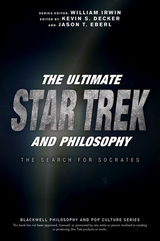
- Reunites the editors of Star Trek and Philosophy with Starfleet's finest experts for 31 new, highly logical essays
- Features a complete examination of the Star Trek universe, from the original series to the most recent films directed by J.J. Abrams, Star Trek (2009) and Star Trek Into Darkness (2013)
- Introduces important concepts in philosophy through the vast array of provocative issues raised by the series, such as the ethics of the Prime Directive, Star Trek's philosophy of peace, Data and Voyager's Doctor as persons, moral relativism and the Federation's quest for liberation, the effect of alternate universes on reality and identity, the Borg as transhumanists, Federation Trekonomics, Star Trek's secular society, and much, much more...!
- An enterprising and enlightening voyage into deep space that will appeal to hardcore fans and science fiction enthusiasts alike
- Publishing in time to celebrate the 50th Anniversary of the original TV series
Reunites the editors of Star Trek and Philosophy with Starfleet s finest experts for 31 new, highly logical essays Features a complete examination of the Star Trek universe, from the original series to the most recent films directed by J.J. Abrams, Star Trek (2009) and Star Trek Into Darkness (2013) Introduces important concepts in philosophy through the vast array of provocative issues raised by the series, such as the ethics of the Prime Directive, Star Trek s philosophy of peace, Data and Voyager s Doctor as persons, moral relativism and the Federation s quest for liberation, the effect of alternate universes on reality and identity, the Borg as transhumanists, Federation Trekonomics, Star Trek s secular society, and much, much more ! An enterprising and enlightening voyage into deep space that will appeal to hardcore fans and science fiction enthusiasts alike Publishing in time to celebrate the 50th Anniversary of the original TV series
Kevin S. Decker is Professor of Philosophy at Eastern Washington University, where he teaches ethics, American and Continental philosophy, and philosophy of popular culture. He is co-editor of Philosophy and Breaking Bad (2016) and Who is Who? The Philosophy of Doctor Who (2013). He is co-editor, with Jason T. Eberl, of The Ultimate Star Wars and Philosophy (Wiley-Blackwell, 2015), Star Trek and Philosophy (2008), and Star Wars and Philosophy (2005). Jason T. Eberlis the Semler Endowed Chair for Medical Ethics and Professor of Philosophy at Marian University in Indianapolis, Indiana, where he teaches bioethics, ethics, and medieval philosophy. He has edited or contributed to books on Battlestar Galactica, Sons of Anarchy, Metallica, Terminator, The Hunger Games, The Big Lebowski, Stanley Kubrick, J.J. Abrams, and Avatar. His most recent books are The Routledge Guidebook to Aquinas' Summa Theologiae (2015) and The Philosophy of Christopher Nolan (2016). He is co-editor, with Kevin S. Decker, of The Ultimate Star Wars and Philosophy (Wiley-Blackwell, 2015), Star Trek and Philosophy (2008), and Star Wars and Philosophy (2005).
Acknowledgments: The Command Staff of Utopia Planitia ix
Introduction: A Guide to Living Long and Prospering 1
I Alpha Quadrant: Home Systems 5
1 "The More Complex the Mind, the Greater the Need for the Simplicity of Play" 7
Jason T. Eberl
2 Aristotle and James T. Kirk: The Problem of Greatness 18
Jerold J. Abrams
3 The Moral Psychology of a Starship Captain 26
Tim Challans
4 "Make It So": Kant, Confucius, and the Prime Directive 36
Alejandro B´arcenas and Steve Bein
5 Destroying Utopias: Why Kirk Is a Jerk 47
David Kyle Johnson
6 "We Are Not Going to Kill Today": Star Trek and the Philosophy of Peace 59
David Boersema
II Beta Quadrant: Dangerous Rivalries 69
7 Klingons: A Cultural Pastiche 71
Victor Grech
8 The Borg as Contagious Collectivist Techno-Totalitarian Transhumanists 83
Dan Dinello
9 Assimilation and Autonomy 95
Barbara Stock
10 Q: A Rude, Interfering, Inconsiderate, Sadistic Pest--on a Quest for Justice? 105
Kyle Alkema and Adam Barkman
11 Federation Trekonomics: Marx, the Federation, and the Shift from Necessity to Freedom 115
Jeff Ewing
12 "The Needs of the Many Outweigh the Needs of the Few": Utilitarianism and Star Trek 127
Greg Littmann
13 Casuistry in the Final Frontier 138
Courtland Lewis
III Delta Quadrant: Questing for Home 149
14 "Today Is a Good Day to Die!" Transporters and Human Extinction 151
William Jaworski
15 Two Kirks, Two Rikers 162
Trip McCrossin
16 Data, Kant, and Personhood; or,Why Data Is Not a Toaster 172
Nina Rosenstand
17 Humans, Androids, Cyborgs, and Virtual Beings: All aboard the Enterprise 180
Dennis M.Weiss
18 Photons (and Drones) Be Free: Phenomenology and the Life-Worlds of Voyager's Doctor and Seven of Nine 190
Nicole R. Pramik
19 Vision Quest into Indigenous Space 199
Walter Robinson
IV Gamma Quadrant: Infinite Diversity in Infinite Combinations 211
20 Rethinking the Matter: Organians Are Still Organisms 213
Melanie Johnson-Moxley
21 "In Search of . . . " Friendship: What We Can Learn from Androids and Vulcans 223
James M. Okapal
22 Resistance Is Negligible: In Praise of Cyborgs 232
Lisa Cassidy
23 "Who I Really Am": Odo, Mead, and the Self 243
Pamela JG Boyer
24 Is Liberation Ever a Bad Thing? Enterprise's "Cogenitor" and Moral Relativism 253
William A. Lindenmuth
25 Resistance Really Is Futile: On Being Assimilated by Our Own Technology 264
Dena Hurst
V Beyond the Galactic Barrier: The Future as the Final Frontier 273
26 Life on a Holodeck: What Star Trek Can Teach Us about the True Nature of Reality 275
Dara Fogel
27 Which Spock Is the Real One? Alternate Universes and Identity 288
Andrew Zimmerman Jones
28 "Strangely Compelling": Romanticism in "The City on the Edge of Forever" 299
Sarah O'Hare
29 It Is a Q of Life: Q as a Nietzschean Figure 308
Charles Taliaferro and Bailey Wheelock
30 A God Needs Compassion, but Not a Starship: Star Trek's Humanist Theology 315
James F. McGrath
31 "The Human Adventure Is Just Beginning": Star Trek's Secular Society 326
Kevin S. Decker
Contributors: Federation Ambassadors to Babel 340
Index 349
1
“The More Complex the Mind, the Greater the Need for the Simplicity of Play”
Jason T. Eberl
This chapter's title comes from “Shore Leave” (TOS), in which the Enterprise crew encounters an “amusement planet” designed by an advanced civilization—they return to this world in “Once Upon a Planet” (TAS). It may seem counterintuitive for highly intelligent beings to need a realm for fantasy entertainment. Some forms of play, however, may be not only beneficial but also necessary for intellectual, moral, and spiritual beings to flourish. Edifying play isn't aimed at mere pleasure seeking, but rather can lead each of us to a greater understanding of our own self, the world in which we live, and what reality, if any, may lie beyond this world. Along these lines, Josef Pieper (1904–1997) argues that beings capable of understanding the world around them, as well as inquiring into the deeper reality that may transcend the physical world, must seek intellectual, moral, and spiritual fulfillment through forms of play that take them out of their workaday lives. In a phrase reminiscent of my Trek-inspired title, Pieper says, “The more comprehensive the power of relating oneself to the world of objective being, so the more deeply anchored must be the ‘ballast’ in the inwardness of the subject.”1 In other words, “Know thyself,” as the Oracle at Delphi proclaimed. Indeed, this idea was seized upon by Socrates as the starting point of all philosophy.
Pieper follows a philosophical tradition set down by Plato—who bears only a superficial relationship to “Plato's Stepchildren” (TOS)—Aristotle, and Thomas Aquinas, all of whom could find some affinity with Star Trek and other sci-fi/fantasy adventures that tell a good morality tale or stretch the limits of human imagination. As Aristotle points out, humans, as rational animals, aren't satisfied with mere pleasure seeking, but are driven to reflect upon the limitless possibilities of existence. Continuing that line of thought, Aquinas states, “The reason why the philosopher can be compared to the poet [or the sci-fi writer?] is that both are concerned with wonder.”2 Truly, a sense of wonder pervades Trek, in which the judicious use of visual effects and theatrical acting—just look at the endless crew reaction shots in The Motion Picture while the Enterprise flies through V'Ger—helps convey and inspire such wonder while “rebooting” wondrous mythological themes from Homer, Virgil, Dante, and others.
Aristotle notes that “we work in order to be at leisure.”3 But Pieper adds that we need to break out of the economic cycle of productivity and consumption to fully access our sense of wonder and explore the “final frontier” of reality and consciousness. We need to allow ourselves the leisure necessary to contemplate the universe and our place within it. But leisure isn't simply “recharging our batteries.” Rather, it's taking time to reflect upon those all-important questions of humanity, reflection that doesn't produce immediate, tangible goods that can be traded on the floor of the Ferengi stock exchange. Leisure is not idly twiddling one's thumbs; yet, Pieper finds there to be a “festive” element to human leisure that allows us to develop ourselves intellectually and culturally in a way that simple, pleasure-seeking hedonism—in the form, say, of Landru's “red hour”—fails to provide: “The leisure of man includes within itself a celebratory, approving, lingering gaze of the inner eye on the reality of creation.”4 Leisure, in all its proper forms, is a necessary element that must be reintegrated into the modern concept of a “happy life.” With that in mind, our mission will be to review Pieper's concept of leisure and consider how contemplating Star Trek can be a stimulating and edifying form of play.
Life Is Not for the Timid
The philosopher Robert Nozick (1938–2002) offered an ingenious thought experiment in which people would reject a method for getting as much pleasure as they'd ever want. Nozick asks us to consider an “experience machine” to which a person could be hooked up for an extended period of time or perhaps their entire life—think of the virtual reality of “The Thaw” (VOY) but without the creepy clown.5 During their time “in the machine,” they'd experience nothing but pleasurable experiences that had been pre-programmed, all the while being unaware that their experiences are artificially generated. Nozick thinks that rational persons would reject being plugged into the machine because we want to do certain things, not merely have the experience of doing them, and because we want to be a certain type of person. Nozick thus contends, “There is no answer to the question of what a person is like who has long been in the tank.”6 Ultimately, Nozick claims we also want to be in contact with a deeper reality than the artificially constructed world of the machine.
The problem with the idyllic enticement of the experience machine isn't that it's ideal, but rather that it's idle, presenting us with a mode of life that has lost its purpose. We have no unsatisfied desires, and there's no striving to change or to grow. In such a scenario, Q's ultimate verdict on humanity's guilt is all but assured and we suffer the “tedium of immortality.”7 It's not that the experience machine would make us immortal, but we'd endure the same purposelessness of continued existence that led to the first suicide of a Q in “Death Wish” (VOY). Philosophers from Aristotle to Alfred North Whitehead (1861–1947) have argued that change is the fundamental engine that drives reality forward, and that purposeful change is necessary if rational beings are to better themselves intellectually, morally, or spiritually—without it, they might live, but wouldn't flourish.8
Many depictions of similar “experience machines” in sci-fi also lead to the allegorical conclusion that human beings aren't meant to live in such a purely hedonistic environment. Consider “This Side of Paradise” (TOS), in which a group of human colonists become infected by spores that render them completely happy, peaceful, and healthy (even healing old scars). The “dark side” of life on Omicron Ceti III is that the colonists are stagnant. They produce only the bare minimum they need to survive and maintain a comfortable status quo. Once the Enterprise crew frees the colonists from the spores' hold—after initially succumbing to the spores' effects themselves—Kirk wonders: “Maybe we weren't meant for paradise. Maybe we were meant to fight our way through. Struggle, claw our way up, scratch for every inch of the way. Maybe we can't stroll to the music of the lute, we must march to the sound of drums.”9 There's more to life than mint juleps.
In what sort of activity should we engage? Humanity's “prime directive,” particularly in Western societies as analyzed by Pieper, but increasingly in Eastern societies as well, seems to be “Work! Produce! Buy! Contribute!” But wait, this sounds suspiciously like the Borg's prime directive. The Borg certainly aren't idle: they're always working, producing, consuming, and all quite efficiently—no time is ever wasted on a Borg cube or unicomplex. What makes humanity different from the Borg? For one set of answers, see the last four seasons of Voyager as Captain Janeway strives to help former Borg drone Seven of Nine regain her self-identity.10 For another, we can return to Pieper's analysis of the value of leisure. Pieper argues that the difference between Borg and human productivity stems from a difference between two types of goods: bonum utile and bonum commune. The first is the good of “utility”: what's useful. The second refers to the “common good” in which we seek the flourishing of each individual member of the community. Since there are no individuals within the Borg Collective, there can be no bonum commune; there's only the utility that each drone brings to the Collective. This difference, says Pieper, is also found in modern industrialized society, where employers often conceive of workers as little more than drones, and marketing gurus see consumers as absorbent, pleasure-seeking sponges.
So why isn't a perfectly pleasurable life under the spores' influence on Omicron Ceti III enough for a happy human life? Natural law ethicists Patrick Lee and Robert George place the value of pleasure within the larger context of “genuinely fulfilling” human goods, concluding that “pleasure is good (desirable, worthwhile, perfective) if and only if attached to a fulfilling or perfective activity or condition. Pleasure is like other goods in that a fulfilling...
| Erscheint lt. Verlag | 27.1.2016 |
|---|---|
| Reihe/Serie | The Blackwell Philosophy and Pop Culture Series |
| The Blackwell Philosophy and Pop Culture Series | The Blackwell Philosophy and Pop Culture Series |
| Mitarbeit |
Herausgeber (Serie): William Irwin |
| Sprache | englisch |
| Themenwelt | Geisteswissenschaften ► Philosophie ► Allgemeines / Lexika |
| Geisteswissenschaften ► Philosophie ► Östliche Philosophie | |
| Sozialwissenschaften ► Soziologie | |
| Schlagworte | AI • Android • Aristotle • Borg • Captain James T. Kirk • Confucius • Cultural Studies • Data • Deep Space Nine • Enterprise • federation • Film • Gene Roddenberry • Holodeck • Hologram • J.J. Abrams • Kant • Klingon • Kulturwissenschaften • Marx • Movies • Nietzsche • Philosophie • Philosophy • Philosophy Special Topics • Pop culture • popular culture • prime directive • Science Fiction • Spezialthemen Philosophie • Spock • starfleet • Star Trek • Television • The Final Frontier • The Next Generation • Transhumanism • TV • Virtual Reality • Volkskultur • Voyager • Vulcan |
| ISBN-10 | 1-119-14602-X / 111914602X |
| ISBN-13 | 978-1-119-14602-5 / 9781119146025 |
| Informationen gemäß Produktsicherheitsverordnung (GPSR) | |
| Haben Sie eine Frage zum Produkt? |
 EPUB (Adobe DRM)
Kopierschutz: Adobe-DRM
Adobe-DRM ist ein Kopierschutz, der das eBook vor Mißbrauch schützen soll. Dabei wird das eBook bereits beim Download auf Ihre persönliche Adobe-ID autorisiert. Lesen können Sie das eBook dann nur auf den Geräten, welche ebenfalls auf Ihre Adobe-ID registriert sind.
Details zum Adobe-DRM
Dateiformat: EPUB (Electronic Publication)
EPUB ist ein offener Standard für eBooks und eignet sich besonders zur Darstellung von Belletristik und Sachbüchern. Der Fließtext wird dynamisch an die Display- und Schriftgröße angepasst. Auch für mobile Lesegeräte ist EPUB daher gut geeignet.
Systemvoraussetzungen:
PC/Mac: Mit einem PC oder Mac können Sie dieses eBook lesen. Sie benötigen eine
eReader: Dieses eBook kann mit (fast) allen eBook-Readern gelesen werden. Mit dem amazon-Kindle ist es aber nicht kompatibel.
Smartphone/Tablet: Egal ob Apple oder Android, dieses eBook können Sie lesen. Sie benötigen eine
Geräteliste und zusätzliche Hinweise
Buying eBooks from abroad
For tax law reasons we can sell eBooks just within Germany and Switzerland. Regrettably we cannot fulfill eBook-orders from other countries.
aus dem Bereich