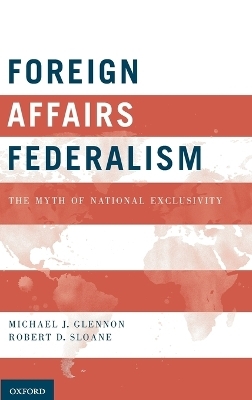
Foreign Affairs Federalism
Oxford University Press Inc (Verlag)
978-0-19-994149-0 (ISBN)
In the U.S. legal system, the federal government has traditionally been the only rightful arena for the conduct of foreign affairs, especially in the case of national security, military action, international trade, and treaty-making. However, the pervasiveness of globalization and the attendant ease of cross-border interactions, with implications for commerce and terrorism, have brought U.S. states, counties, and municipalities increasingly into the federal government's long-standing province of international relations. For example, states now forge trade relationships with foreign governments through energy and investment contracts that very much resemble treaties. If a foreign sovereign violates any of these contracts or statutes, then civil or criminal action against that sovereign could interfere with the U.S. federal government's diplomatic relations overseas. Consequently, the legal status of states and local governments in the conduct of foreign affairs is unclear and in need of thoughtful analysis and guidance. In Foreign Affairs Federalism, Michael Glennon and Robert Sloane study the constitutional allocation of foreign affairs powers between the federal government and the states. They explain the current law clearly and accessibly, identifying those areas where the law can be confidently ascertained. Where the law cannot be determined, they suggest the most plausible or compelling perspectives on existing doctrine. They also appraise existing doctrine against the background of the diverse and incompatible goals and challenges facing the United States in the twenty-first century.
Michael J. Glennon is Professor of International Law at the Fletcher School of Law and Diplomacy, Tufts University. Before going into teaching, he was the Legal Counsel to the Senate Foreign Relations Committee. He is the author of National Security and Double Government (Oxford, 2014); co-author of Foreign Relations and National Security Law, and the author of Constitutional Diplomacy, among other books. His op-ed pieces have appeared in the New York Times, Washington Post, Los Angeles Times, International Herald-Tribune, Financial Times, and Frankfurt Allgemeine Zeitung. Robert D. Sloane is Professor of Law and the R. Gordon Butler Scholar in International Law at Boston University School of Law.
Preface
Acknowledgments
CHAPTER 1
WHY EMPOWER STATES?
CHAPTER 2
STATES, CITIES, AND GLOBALIZATION
CHAPTER 3
CONSTITUTIONAL METHODOLOGY AND THE ROLE OF THE COURTS
CHAPTER 4
DORMANT FOREIGN AFFAIRS PREEMPTION
CHAPTER 5
THE DORMANT FOREIGN COMMERCE POWER
CHAPTER 6
THE TREATY POWER
CHAPTER 7
FEDERAL COMMON LAW AND STATE POWER
CHAPTER 8
FEDERAL APPROVAL: THE COMPACT CLAUSE
CHAPTER 9
FEDERAL DISAPPROVAL
CHAPTER 10
A CASE STUDY: STATES AS CYBER-DEFENDERS
CHAPTER 11
CONCLUSION
Index
| Erscheinungsdatum | 30.04.2016 |
|---|---|
| Verlagsort | New York |
| Sprache | englisch |
| Maße | 155 x 236 mm |
| Gewicht | 680 g |
| Themenwelt | Recht / Steuern ► EU / Internationales Recht |
| Recht / Steuern ► Öffentliches Recht | |
| Sozialwissenschaften ► Politik / Verwaltung ► Europäische / Internationale Politik | |
| Sozialwissenschaften ► Politik / Verwaltung ► Staat / Verwaltung | |
| ISBN-10 | 0-19-994149-1 / 0199941491 |
| ISBN-13 | 978-0-19-994149-0 / 9780199941490 |
| Zustand | Neuware |
| Informationen gemäß Produktsicherheitsverordnung (GPSR) | |
| Haben Sie eine Frage zum Produkt? |
aus dem Bereich