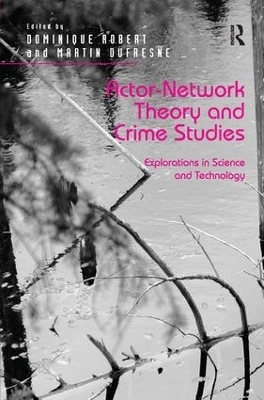
Actor-Network Theory and Crime Studies
Routledge (Verlag)
978-1-4724-1710-7 (ISBN)
Developed by Bruno Latour and his collaborators, actor-network theory (ANT) offers crimes studies a worthy intellectual challenge. It requires us to take the performativity turn, consider the role of objects in our analysis and conceptualize all actants (human and non-human) as relational beings. Thus power is not the property of one party, but rather it is an effect of the relationships among actants. This innovative collection provides a series of empirical and theoretical contributions that shows: ¢ The importance of conceptualizing and analyzing technologies as crucial actants in crime and crime control. ¢ The many facets of ANT: its various uses, its theoretical blending with other approaches, its methodological implications for the field. ¢ The fruitfulness of ANT for studying technologies and crime studies: its potential and limitations for understanding the world and revamping crime studies research goals. Students, academics and policy-makers will benefit from reading this collection in order to explore criminology-related topics in a different way.
Dominique Robert is Associate Professor in the Department of Criminology at the University of Ottawa in Canada. Martin Dufresne is Associate Professor in the Department of Criminology at the University of Ottawa in Canada.
Introduction: Thinking through Networks, Reaching for Objects and Witnessing Facticity, Dominique Robert, Martin Dufresne; Chapter 1 Situational Crime Prevention in Nightlife Spaces: An ANT Examination of PAD Dogs and Doorwork, Jakob Demant, Ella Dilkes-Frayne; Chapter 2 Actor Network Theory and CCTV Development, Anne-Cécile Douillet, Laurence Dumoulin; Chapter 3 How Does a Gene in a Scientific Journal Affect My Future Behavior?, Martin Dufresne; Chapter 4 Making Crime Messy, Anita Lam; Chapter 5 Seeing Crime: ANT, Feminism and Images of Violence Against Women, Dawn Moore, Rashmee Singh; Chapter 6 Translating Critical Scholarship Out of the Academy: ANT, Deconstruction and Public Criminology, Michael Mopas; Chapter 7 Can Electricity Soothe the Savage Breast? What Tasers Do to the Police Use of Force, Cédric Moreau de Bellaing; Chapter 8 The Relevance of Actor-Network Theory (ANT) for Research on the Use of Genetic Analysis for Identification in Criminal Justice, Bertrand Renard; Chapter 9 The Factishes of DNA Identification: How a Scientist Speaks about His Craft to Politicians, Dominique Robert, Martin Dufresne;
| Erscheint lt. Verlag | 2.1.2015 |
|---|---|
| Verlagsort | London |
| Sprache | englisch |
| Maße | 156 x 234 mm |
| Gewicht | 460 g |
| Themenwelt | Recht / Steuern ► Strafrecht ► Kriminologie |
| Sozialwissenschaften ► Soziologie ► Allgemeines / Lexika | |
| ISBN-10 | 1-4724-1710-0 / 1472417100 |
| ISBN-13 | 978-1-4724-1710-7 / 9781472417107 |
| Zustand | Neuware |
| Informationen gemäß Produktsicherheitsverordnung (GPSR) | |
| Haben Sie eine Frage zum Produkt? |
aus dem Bereich