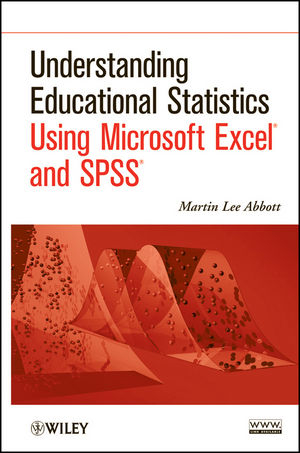
Understanding Educational Statistics Using Microsoft Excel and SPSS (eBook)
John Wiley & Sons (Verlag)
978-1-118-62718-1 (ISBN)
Mobilizing interesting real-world examples from the field of education, Understanding Educational Statistics Using Microsoft Excel and SPSS supplies a seamless presentation that identifies valuable connections between statistical applications and research design. Class-tested to ensure an accessible presentation, the book combines clear, step-by-step explanations and the use of software packages that are accessible to both the novice and professional alike to present the fundamental statistical practices for organizing, understanding, and drawing conclusions from educational research data.
The book begines with an introduction to descriptive and inferential statistics and then proceeds to acquaint readers with the various functions for working with quantitative data in the Microsoft Excel environment, such as spreadsheet navigation; sorting and filtering; and creating pivot tables. Subsequent chapters treat the procedures that are commonly-employed when working with data across various fields of social science research, including:
- Single-sample tests
- Repeated measure tests
- Independent t-tests
- One way ANOVA and factorial ANOVA
- Correlation
- Bivariate regression
- Chi square
- Multiple regression
Individual chapters are devoted to specific procedures, each ending with a lab exercise that highlights the importance of that procedure by posing a research question, examining the question through its application in Excel and SPSS, and concluding with a brief research report that outlines key findings drawn from the results. Real-world examples and data from modern educational research are used throughout the book, and a related Web site features additional data sets, examples, and labs, allowing readers to reinforce their comprehension of the material.
Bridging traditional statistical topics with the latest software and applications in the field of education, Understanding Educational Statistics Using Microsoft Excel and SPSS is an excellent book for courses on educational research methods and introductory statistics in the social sciences at the upper-undergraduate and graduate levels. It also serves as a valuable resource for researchers and practitioners in the fields of education, psychology, and the social sciences who require a statistical background to work with data in their everyday work.
MARTIN LEE ABBOTT, PhD, is Professor of Sociology at Seattle Pacific University, where he also serves as Executive Director of the Washington School Research Center, an independent research and data analysis center funded by the Bill and Melinda Gates Foundation. He has held positions in both academia and in industry, focusing his consulting and teaching in the areas of program evaluation, applied sociology, statistics, and research methods. Dr. Abbott is the author of The Program Evaluation Prism: Using Statistical Methods to Discover Patterns (Wiley).
MARTIN LEE ABBOTT, PhD, is Professor of Sociology at Seattle Pacific University, where he also serves as Executive Director of the Washington School Research Center, an independent research and data analysis center funded by the Bill and Melinda Gates Foundation. He has held positions in both academia and in industry, focusing his consulting and teaching in the areas of program evaluation, applied sociology, statistics, and research methods. Dr. Abbott is the author of The Program Evaluation Prism: Using Statistical Methods to Discover Patterns (Wiley).
Preface xix
Acknowledgments xxi
1 Introduction 1
2 Getting Acquainted with Microsoft Excel1 7
3 Using Statistics in Excel1 17
4 SPSS1 Basics 23
5 Descriptive Statistics--Central Tendency 41
6 Descriptive Statistics--Variablity 81
7 The Normal Distribution 101
8 The Z Distribution and Probability 127
9 The Nature of Research Design and Inferential Statistics 147
10 The T Test for Single Samples 175
11 Independent-Samples T Test 209
12 Analysis of Variance 257
13 Factorial Anova 307
14 Correlation 337
15 Bivariate Regression 383
16 Introduction to Multiple Linear Regression 429
17 Chi Square and Contingency Table Analysis 453
18 Repeated Measures Procedures: Tdep and ANOVAws 489
References 511
Appendix: Statistical Tables 513
Index 523
1
INTRODUCTION
Many students and researchers are intimidated by statistical procedures. This may in part be due to a fear of math, problematic math teachers in earlier education, or the lack of exposure to a “discovery” method for understanding difficult procedures. Readers of this book should realize that they have the ability to succeed in understanding statistical processes.
APPROACH OF THE BOOK
This is an introduction to statistics using EXCEL® and SPSS® to make it more understandable. Ordinarily, the first course leads the student through the worlds of descriptive and inferential statistics by highlighting the formulas and sequential procedures that lead to statistical decision making. We will do all this in this book, but I place a good deal more attention on conceptual understanding. Thus, rather than memorizing a specific formula and using it in a specific way to solve a problem, I want to make sure the student first understands the nature of the problem, why a specific formula is needed, and how it will result in the appropriate information for decision making.
By using statistical software, we can place more attention on understanding how to interpret findings. Statistics courses taught in mathematics departments, and in some social science departments, often place primary emphases on the formulas/ processes themselves. In the extreme, this can limit the usefulness of the analyses to the practitioner. My approach encourages students to focus more on how to understand and make applications of the results of statistical analyses. EXCEL® and other statistical programs are much more efficient at performing the analyses; the key issue in my approach is how to interpret the results in the context of the research question.
Beginning with my first undergraduate course through teaching statistics with conventional textbooks, I have spent countless hours demonstrating how to conduct statistical tests by hand and teaching students to do likewise. This is not always a bad strategy; performing the analysis by hand can lead the student to understand how formulas treat data and yield valuable information. However, it is often the case that the student gravitates to memorizing the formula or the steps in an analysis. Again, there is nothing wrong with this approach as long as the student does not stop there. The outcome of the analysis is more important than memorizing the steps to the outcome. Examining the appropriate output derived from statistical software shifts the attention from the nuances of a formula to the wealth of information obtained by using it.
It is important to understand that I do indeed teach the student the nuances of formulas, understanding why, when, how, and under what conditions they are used. But in my experience, forcing the student to scrutinize statistical output files accomplishes this and teaches them the appropriate use and limitations of the information derived.
Students in my classes are always surprised (ecstatic) to realize they can use their textbooks, notes, and so on, on my exams. But they quickly find that, unless they really understand the principles and how they are applied and interpreted, an open book is not going to help them. Over time, they come to realize that the analyses and the outcomes of statistical procedures are simply the ingredients for what comes next: building solutions to research problems. Therefore, their role is more detective and constructor than number juggler.
This approach mirrors the recent national and international debate about math pedagogy. In my recent book, Winning the Math Wars (Abbott et al., 2010), my colleagues and I addressed these issues in great detail, suggesting that, while traditional ways of teaching math are useful and important, the emphases of reform approaches are not to be dismissed. Understanding and memorizing detail are crucial, but problem solving requires a different approach to learning.
PROJECT LABS
Labs are a very important part of this course since they allow students to take charge of their learning. This is the “discovery learning” element I mentioned above. Understanding a statistical procedure in the confines of a classroom is necessary and helpful. However, learning that lasts is best accomplished by students directly engaging the processes with actual data and observing what patterns emerge in the findings that can be applied to real research problems.
In this course, we will have several occasions to complete Project Labs that pose research problems on actual data. Students take what they learn from the book material and conduct a statistical investigation using EXCEL® and SPSS®. Then, they have the opportunity to examine the results, write research summaries, and compare findings with the solutions presented at the end of the book.
These are labs not using data created for classroom use but instead using real-world data from actual research databases. Not only does this engage students in the learning process with specific statistical processes, but it presents real-world information in all its “grittiness.” Researchers know that they will discover knotty problems and unusual, sometimes idiosyncratic, information in their data. If students are not exposed to this real-world aspect of research, it will be confusing when they engage in actual research beyond the confines of the classroom.
The project labs also introduce students to two software approaches for solving statistical problems. These are quite different in many regards, as we will see in the following chapters. EXCEL® is widely accessible and provides a wealth of information to researchers about many statistical processes they encounter in actual research. SPSS® provides additional, advanced procedures that educational researchers utilize for more complex and extensive research questions. The project labs provide solutions in both formats so the student can learn the capabilities and approaches of each.
REAL-WORLD DATA
As I mentioned, I focus on using real-world data for many reasons. One reason is that students need to be grounded in approaches they can use with “gritty” data. I want to make sure that students leave the classroom prepared for encountering the little nuances that characterize every research project.
Another reason I use real-world data is to familiarize students with contemporary research questions in education. Classroom data often are contrived to make a certain point or show a specific procedure, which are both helpful. But I believe that it is important to draw the focus away from the procedure per se and understand how the procedure will help the researcher resolve a research question. The research questions are important. Policy reflects the available information on a research topic, to some extent, so it is important for students to be able to generate that information as well as to understand it. This is an “active” rather than “passive” learning approach to understanding statistics.
RESEARCH DESIGN
People who write statistics books have a dilemma with respect to research design. Typically, statistics and research design are taught separately in order for students to understand each in greater depth. The difficulty with this approach is that the student is left on their own to synthesize the information; this is often not done successfully.
Colleges and universities attempt to manage this problem differently. Some require statistics as a prerequisite for a research design course, or vice versa. Others attempt to synthesize the information into one course, which is difficult to do given the eventual complexity of both sets of information. Adding somewhat to the problem is the approach of multiple courses in both domains.
I do not offer a perfect solution to this dilemma. My approach focuses on an in-depth understanding of statistical procedures for actual research problems. What this means is that I cannot devote a great deal of attention in this book to research design apart from the statistical procedures that are an integral part of it. However, I try to address the problem in two ways.
First, wherever possible, I connect statistics with specific research designs. This provides an additional context in which students can focus on using statistics to answer research questions. The research question drives the decision about which statistical procedures to use; it also calls for discussion of appropriate design in which to use the statistical procedures. We will cover essential information about research design in order to show how these might be used.
Second, I am making available an online course in research design as part of this book. In addition to databases and other research resources, you can follow the web address in the Preface to gain access to the online course that you can take in tandem with reading this book or separately.
“PRACTICAL SIGNIFICANCE”—IMPLICATIONS OF FINDINGS
I emphasize “practical significance” (effect size) in this book as well as statistical significance. In many ways, this is a more comprehensive approach to uncertainty, since effect size is a measure of “impact” in the research evaluation. It is important to measure the likelihood of chance findings (statistical significance), but the extent of influence represented in the analyses affords the researcher another vantage point to determine the relationship among the research variables.
I call attention to problem solving as the important part of statistical analysis. It is tempting for students to focus so much on using statistical procedures to...
| Erscheint lt. Verlag | 21.8.2014 |
|---|---|
| Sprache | englisch |
| Themenwelt | Mathematik / Informatik ► Mathematik ► Statistik |
| Mathematik / Informatik ► Mathematik ► Wahrscheinlichkeit / Kombinatorik | |
| Sozialwissenschaften ► Pädagogik | |
| Sozialwissenschaften ► Soziologie ► Empirische Sozialforschung | |
| Technik | |
| Schlagworte | Bildungswesen • Data Analysis • Datenanalyse • Education • Educational Research & Statistics • Evaluation & Research Methods • Evaluierung u. Researchmethoden • Pädagogik • Pädagogik / wissenschaftliche Studien u. Statistik • Pädagogik • Pädagogik / wissenschaftliche Studien u. Statistik • quantitative methods, analyze research data, analyze statistical data, educational research data, analyze educational research data, analyze educational data • Statistics • Statistik |
| ISBN-10 | 1-118-62718-0 / 1118627180 |
| ISBN-13 | 978-1-118-62718-1 / 9781118627181 |
| Informationen gemäß Produktsicherheitsverordnung (GPSR) | |
| Haben Sie eine Frage zum Produkt? |
 EPUB (Adobe DRM)
Kopierschutz: Adobe-DRM
Adobe-DRM ist ein Kopierschutz, der das eBook vor Mißbrauch schützen soll. Dabei wird das eBook bereits beim Download auf Ihre persönliche Adobe-ID autorisiert. Lesen können Sie das eBook dann nur auf den Geräten, welche ebenfalls auf Ihre Adobe-ID registriert sind.
Details zum Adobe-DRM
Dateiformat: EPUB (Electronic Publication)
EPUB ist ein offener Standard für eBooks und eignet sich besonders zur Darstellung von Belletristik und Sachbüchern. Der Fließtext wird dynamisch an die Display- und Schriftgröße angepasst. Auch für mobile Lesegeräte ist EPUB daher gut geeignet.
Systemvoraussetzungen:
PC/Mac: Mit einem PC oder Mac können Sie dieses eBook lesen. Sie benötigen eine
eReader: Dieses eBook kann mit (fast) allen eBook-Readern gelesen werden. Mit dem amazon-Kindle ist es aber nicht kompatibel.
Smartphone/Tablet: Egal ob Apple oder Android, dieses eBook können Sie lesen. Sie benötigen eine
Geräteliste und zusätzliche Hinweise
Buying eBooks from abroad
For tax law reasons we can sell eBooks just within Germany and Switzerland. Regrettably we cannot fulfill eBook-orders from other countries.
aus dem Bereich