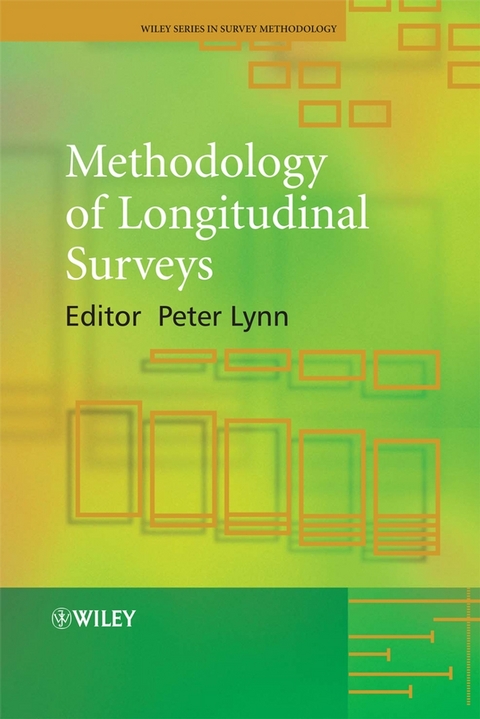
Methodology of Longitudinal Surveys (eBook)
John Wiley & Sons (Verlag)
978-0-470-74391-1 (ISBN)
Focusing on the design, implementation and analysis of longitudinal surveys, Methodology of Longitudinal Surveys discusses the current state of the art in carrying out these surveys. The book also covers issues that arise in surveys that collect longitudinal data via retrospective methods. Aimed at researchers and practitioners analyzing data from statistical surveys the book will also be suitable as supplementary reading for graduate students of survey statistics.
This book:
- Covers all the main stages in the design, implementation and analysis of longitudinal surveys.
- Reviews recent developments in the field, including the use of dependent interviewing and mixed mode data collection.
- Discusses the state of the art in sampling, weighting and non response adjustment.
- Features worked examples throughout using real data.
- Addresses issues arising from the collection of data via retrospective methods, as well as ethical issues, confidentiality and non-response bias.
- Is written by an international team of contributors consisting of some of the most respected Survey Methodology experts in the field
Peter Lynn is Professor of Survey Methodology at the Institute for Social and Economic Research, University of Essex. He is responsible for the methodological research programme of the UK Longitudinal Studies Centre and the UK Household Longitudinal Study and has over 20 years of experience in the field of survey methodology.
Longitudinal surveys are surveys that involve collecting data from multiple subjects on multiple occasions. They are typically used for collecting data relating to social, economic, educational and health-related issues and they serve as an important tool for economists, sociologists, and other researchers. Focusing on the design, implementation and analysis of longitudinal surveys, Methodology of Longitudinal Surveys discusses the current state of the art in carrying out these surveys. The book also covers issues that arise in surveys that collect longitudinal data via retrospective methods. Aimed at researchers and practitioners analyzing data from statistical surveys the book will also be suitable as supplementary reading for graduate students of survey statistics. This book: Covers all the main stages in the design, implementation and analysis of longitudinal surveys. Reviews recent developments in the field, including the use of dependent interviewing and mixed mode data collection. Discusses the state of the art in sampling, weighting and non response adjustment. Features worked examples throughout using real data. Addresses issues arising from the collection of data via retrospective methods, as well as ethical issues, confidentiality and non-response bias. Is written by an international team of contributors consisting of some of the most respected Survey Methodology experts in the field
Peter Lynn is Professor of Survey Methodology at the Institute for Social and Economic Research, University of Essex. He is responsible for the methodological research programme of the UK Longitudinal Studies Centre and the UK Household Longitudinal Study and has over 20 years of experience in the field of survey methodology.
Methodology of Longitudinal Surveys 3
Contents 7
Preface 17
1 Methods for Longitudinal Surveys 21
1.1 Introduction 21
1.2 Types of Longitudinal Surveys 22
1.3 Strengths of Longitudinal Surveys 24
1.3.1 Analysis Advantages 24
1.3.2 Data Collection Advantages 26
1.4 Weaknesses of Longitudinal Surveys 28
1.4.1 Analysis Disadvantages 28
1.4.2 Data Collection Disadvantages 29
1.5 Design Features Specific to Longitudinal Surveys 31
1.5.1 Population, Sampling and Weighting 31
1.5.2 Other Design Issues 33
1.6 Quality in Longitudinal Surveys 35
1.6.1 Coverage Error 35
1.6.2 Sampling Error 36
1.6.3 Nonresponse Error 36
1.6.4 Measurement Error 36
1.7 Conclusions 37
References 38
2 Sample Design for Longitudinal Surveys 41
2.1 Introduction 41
2.2 Types of Longitudinal Sample Design 41
2.3 Fundamental Aspects of Sample Design 43
2.3.1 Defining the Longitudinal Population 43
2.3.2 Target Variables 44
2.3.3 Sample Size 45
2.3.4 Clustering 46
2.3.5 Treatment of Movers 46
2.3.6 Stratification 47
2.3.7 Variances and Design Effects 47
2.3.8 Selection Probabilities 48
2.4 Other Aspects of Design and Implementation 48
2.4.1 Choice of Rotation Period and Pattern 48
2.4.2 Dealing with Births (and Deaths) 49
2.4.3 Sample Overlap 50
2.4.4 Stability of Units and Hierarchies 51
2.5 Conclusion 52
References 52
3 Ethical Issues in Longitudinal Surveys 55
3.1 Introduction 55
3.2 History of Research Ethics 55
3.3 Informed Consent 58
3.3.1 Initial Consent 58
3.3.2 Continuing Consent 59
3.3.3 Consent to Trace Respondents 59
3.3.4 Consent for Unanticipated Activities or Analyses 60
3.3.5 Implications for Consent of Changing Circumstances of Sample Members 60
3.3.6 Consent for Linkage to Administrative Data 61
3.3.7 Using Administrative Data without Full Consent 62
3.3.8 Can Fully Informed Consent be Realised? 63
3.4 Free Choice Regarding Participation 63
3.5 Avoiding Harm 66
3.6 Participant Confidentiality and Data Protection 69
3.6.1 Dependent Interviewing 69
3.6.2 The Treatment of Research Data 70
3.7 Independent Ethical Overview and Participant Involvement 72
Acknowledgements 73
References 73
4 Enhancing Longitudinal Surveys by Linking to Administrative Data 75
4.1 Introduction 75
4.2 Administrative Data as a Research Resource 76
4.3 Record Linkage Methodology 78
4.4 Linking Survey Data with Administrative Data at Individual Level 81
4.4.1 Sampling, Sample Maintenance and Sample Evaluation 81
4.4.2 Evaluation Methodology 82
4.4.3 Supplementing and Validating Survey Data 83
4.5 Ethical and Legal Issues 87
4.5.1 Ethical Issues 88
4.5.2 Legal Issues 88
4.5.3 Disclosure Control 88
4.6 Conclusion 89
References 89
5 Tackling Seam Bias Through Questionnaire Design 93
5.1 Introduction 93
5.2 Previous Research on Seam Bias 94
5.3 SIPP and its Dependent Interviewing Procedures 95
5.3.1 SIPP’s Pre-2004 Use of DI 96
5.3.2 Development of New DI Procedures 96
5.3.3 Testing and Refining the New Procedures 98
5.4 Seam Bias Comparison – SIPP 2001 and SIPP 2004 99
5.4.1 Seam Bias Analysis for Programme Participation and Other ‘Spell’ Characteristics 99
5.4.2 Seam Bias Evaluation for Income Amount Transitions 107
5.5 Conclusions and Discussion 109
Acknowledgements 110
References 110
6 Dependent Interviewing: A Framework and Application to Current Research 113
6.1 Introduction 113
6.2 Dependent Interviewing – What and Why? 114
6.2.1 Data Quality 114
6.2.2 Survey Processes 115
6.3 Design Options and their Effects 115
6.3.1 Reactive Dependent Interviewing 116
6.3.2 Proactive Dependent Interviewing 117
6.4 Empirical Evidence 119
6.4.1 Income Sources 120
6.4.2 Current Earnings 124
6.4.3 Current Employment 125
6.4.4 Labour Market Activity Histories 125
6.4.5 School-Based Qualifications 126
6.5 Effects of Dependent Interviewing on Data Quality Across Surveys 127
6.6 Open Issues 129
Acknowledgements 129
References 130
7 Attitudes Over Time: The Psychology of Panel Conditioning 133
7.1 Introduction 133
7.2 Panel Conditioning 134
7.3 The Cognitive Stimulus Hypothesis 136
7.4 Data and Measures 137
7.5 Analysis 138
7.6 Discussion 143
References 144
8 Some Consequences of Survey Mode Changes in Longitudinal Surveys 147
8.1 Introduction 147
8.2 Why Change Survey Modes in Longitudinal Surveys? 148
8.3 Why Changing Survey Mode Presents a Problem 150
8.3.1 Changes in Question Structure 150
8.3.2 Effects of Visual vs. Aural Communication Channels 152
8.3.3 Interviewer Presence 155
8.3.4 How Answers to Scalar Questions are Affected by Visual vs. Aural Communication 156
8.4 Conclusions 157
References 157
9 Using Auxiliary Data for Adjustment in Longitudinal Research 161
9.1 Introduction 161
9.2 Missing Data 162
9.3 Calibration 164
9.4 Calibrating Multiple Waves 167
9.5 Differences Between Waves 169
9.6 Single Imputation 170
9.7 Multiple Imputation 171
9.8 Conclusion and Discussion 173
References 175
10 Identifying Factors Affecting Longitudinal Survey Response 177
10.1 Introduction 177
10.2 Factors Affecting Response and Attrition 179
10.2.1 Locating the Sample Member 179
10.2.2 Contacting the Sample Member 180
10.2.3 Obtaining the Cooperation of the Sample Member 182
10.2.4 The Role of Respondent Characteristics 184
10.3 Predicting Response in the HILDA Survey 187
10.3.1 The HILDA Survey Data 188
10.3.2 Estimation Approach 189
10.3.3 Explanatory Variables 189
10.3.4 Results 191
10.4 Conclusion 198
References 199
11 Keeping in Contact with Mobile Sample Members 203
11.1 Introduction 203
11.2 The Location Problem in Panel Surveys 204
11.2.1 The Likelihood of Moving 205
11.2.2 The Likelihood of Being Located, Given a Move 207
11.3 Case Study 1: Panel Study of Income Dynamics 210
11.4 Case Study 2: Health and Retirement Study 216
11.5 Discussion 220
Acknowledgements 221
References 222
12 The Use of Respondent Incentives on Longitudinal Surveys 225
12.1 Introduction 225
12.2 Respondent Incentives on Cross-Sectional Surveys 226
12.2.1 Effects of Incentives on Response Rates on Mail Surveys 226
12.2.2 Effects of Incentives on Response Rates on Interviewer-Administered Surveys 227
12.2.3 Effects of Incentives on Sample Composition and Bias 227
12.2.4 Effects of Incentives on Data Quality 228
12.2.5 Summary: Effects of Incentives 228
12.3 Respondent Incentives on Longitudinal Surveys 228
12.4 Current Practice on Longitudinal Surveys 231
12.5 Experimental Evidence on Longitudinal Surveys 238
12.5.1 Previous Experiments on UK Longitudinal Surveys 241
12.5.2 British Household Panel Survey Incentive Experiment 242
12.6 Conclusion 249
Acknowledgements 250
References 251
13 Attrition in Consumer Panels 255
13.1 Introduction 255
13.2 The Gallup Poll Panel 257
13.3 Attrition on the Gallup Poll Panel 261
13.3.1 Descriptive Analysis 261
13.3.2 Experiments 264
13.3.3 Logistic Regression 266
13.3.4 A Serendipitous Finding: The Relationship Between Type of Survey and Attrition 266
13.4 Summary 268
References 268
14 Joint Treatment of Nonignorable Dropout and Informative Sampling for Longitudinal Survey Data 271
14.1 Introduction 271
14.2 Population Model 275
14.3 Sampling Design and Sample Distribution 276
14.3.1 Theorem 1 276
14.3.2 Theorem 2 277
14.4 Sample Distribution Under Informative Sampling and Informative Dropout 277
14.5 Sample Likelihood and Estimation 278
14.5.1 Two-Step Estimation 279
14.5.2 Pseudo Likelihood Approach 279
14.6 Empirical Example: British Labour Force Survey 280
14.7 Conclusions 282
References 283
15 Weighting and Calibration for Household Panels 285
15.1 Introduction 285
15.2 Follow-up Rules 286
15.2.1 Population Definitions 286
15.2.2 Samples and Follow-up 288
15.3 Design-Based Estimation 289
15.3.1 The Horvitz–Thompson Estimator 289
15.3.2 Link Functions 290
15.3.3 Convexity and Variance of the Weighted Estimator 293
15.4 Calibration 294
15.4.1 Types of Calibration within Panels 295
15.4.2 Bias and Variance 296
15.5 Nonresponse and Attrition 298
15.5.1 Empirical Evidence Regarding Nonresponse and Attrition 298
15.5.2 Treatment via Model-Based Prediction 301
15.5.3 Treatment via Estimation of Response Probabilities 301
15.6 Summary 305
References 305
16 Statistical Modelling for Structured Longitudinal Designs 307
16.1 Introduction 307
16.2 Methodological Framework 308
16.3 The Data 310
16.4 Modelling One Response from One Cohort 312
16.5 Modelling One Response from More Than One Cohort 315
16.6 Modelling More Than One Response from One Cohort 317
16.7 Modelling Variation Between Generations 318
16.8 Conclusion 320
References 321
17 Using Longitudinal Surveys to Evaluate Interventions 323
17.1 Introduction 323
17.2 Interventions, Outcomes and Longitudinal Data 324
17.2.1 Form of the Intervention 324
17.2.2 Types of Effects 325
17.2.3 Conditions for the Evaluation 325
17.2.4 Controlling for Confounders in the Analysis 326
17.2.5 Value of Longitudinal Surveys 327
17.3 Youth Media Campaign Longitudinal Survey 329
17.4 National Survey of Parents and Youth 331
17.5 Gaining Early Awareness and Readiness for Undergraduate Programs (GEAR UP) 334
17.6 Concluding Remarks 335
References 335
18 Robust Likelihood-Based Analysis of Longitudinal Survey Data with Missing Values 337
18.1 Introduction 337
18.2 Multiple Imputation for Repeated-Measures Data 338
18.3 Robust MAR Inference with a Single Missing Outcome 340
18.4 Extensions of PSPP to Monotone and General Patterns 343
18.5 Extensions to Inferences Other than Means 344
18.6 Example 345
18.7 Discussion 348
Acknowledgements 350
References 350
19 Assessing the Temporal Association of Events Using Longitudinal Complex Survey Data 353
19.1 Introduction 353
19.2 Temporal Order 354
19.2.1 Close Precursor 354
19.2.2 Nonparametric Test for Close Precursor 355
19.3 Nonparametric Density Estimation 355
19.3.1 Kernel Density Estimation 356
19.3.2 Local Likelihood Approach 357
19.4 Survey Weights 360
19.4.1 Assessing the Standard Error 361
19.5 Application: The National Population Health Survey 361
19.5.1 Pregnancy and Smoking Cessation 362
19.5.2 Subsample 362
19.5.3 Interval-Censored Times 362
19.5.4 Results 363
19.6 Application: The Survey of Labour and Income Dynamics 364
19.6.1 Job Loss and Separation or Divorce 365
19.6.2 Subsample 365
19.6.3 Interval-Censored Times 365
19.6.4 Results 366
19.7 Discussion 367
Acknowledgements 368
References 368
20 Using Marginal Mean Models for Data from Longitudinal Surveys with a Complex Design: Some Advances in Methods 371
20.1 Introduction 371
20.2 Survey-Weighted GEE and Odds Ratio Approach 374
20.3 Variance Estimation: One-Step EF–Bootstrap 376
20.4 Goodness-of-Fit Tests 377
20.4.1 Construction of Groups 378
20.4.2 Quasi-Score Test 378
20.4.3 Adjusted Hosmer–Lemeshow Test 380
20.5 Illustration Using NPHS Data 381
20.5.1 Parameter Estimates and Standard Errors 382
20.5.2 Goodness-of-Fit Tests 383
20.6 Summary 384
References 385
21 A Latent Class Approach for Estimating Gross Flows in the Presence of Correlated Classification Errors 387
21.1 Introduction 387
21.2 Correlated Classification Errors and Latent Class Modelling 388
21.3 The Data and Preliminary Analysis 391
21.4 A Model for Correlated Classification Errors in Retrospective Surveys 393
21.5 Concluding Remarks 398
Acknowledgements 399
References 399
22 A Comparison of Graphical Models and Structural Equation Models for the Analysis of Longitudinal Survey Data 401
22.1 Introduction 401
22.2 Conceptual Framework 402
22.3 Graphical Chain Modelling Approach 403
22.4 Structural Equation Modelling Approach 404
22.5 Model Fitting 405
22.6 Results 406
22.7 Conclusions 410
Acknowledgements 411
References 411
Index 413
Wiley Series in Survey Methodology 417
"This text is a ''must'' on the
bookshelves of those of us who are engaged day to day in designing,
conducting, or analyzing longitudinal survey data."
(Public Opinion Quarterly, 14 February 2012)
| Erscheint lt. Verlag | 26.1.2009 |
|---|---|
| Reihe/Serie | Wiley Series in Survey Methodology |
| Wiley Series in Survey Methodology | Wiley Series in Survey Methodology |
| Sprache | englisch |
| Themenwelt | Mathematik / Informatik ► Mathematik ► Statistik |
| Mathematik / Informatik ► Mathematik ► Wahrscheinlichkeit / Kombinatorik | |
| Sozialwissenschaften ► Soziologie ► Empirische Sozialforschung | |
| Technik | |
| Schlagworte | ART • Current • Data • Datenerhebung • Design • Economists • implementation • important • involve collecting • Longitudinal • Longitudinalanalyse • Longitudinal Analysis • Longitudinal Surveys • Methoden der Daten- u. Stichprobenerhebung • Methodology • Methods • Multiple • occasions • Social • State • Statistics • Statistik • subjects • Survey Research Methods & Sampling • Tool • typically |
| ISBN-10 | 0-470-74391-3 / 0470743913 |
| ISBN-13 | 978-0-470-74391-1 / 9780470743911 |
| Informationen gemäß Produktsicherheitsverordnung (GPSR) | |
| Haben Sie eine Frage zum Produkt? |
 PDF (Adobe DRM)
Kopierschutz: Adobe-DRM
Adobe-DRM ist ein Kopierschutz, der das eBook vor Mißbrauch schützen soll. Dabei wird das eBook bereits beim Download auf Ihre persönliche Adobe-ID autorisiert. Lesen können Sie das eBook dann nur auf den Geräten, welche ebenfalls auf Ihre Adobe-ID registriert sind.
Details zum Adobe-DRM
Dateiformat: PDF (Portable Document Format)
Mit einem festen Seitenlayout eignet sich die PDF besonders für Fachbücher mit Spalten, Tabellen und Abbildungen. Eine PDF kann auf fast allen Geräten angezeigt werden, ist aber für kleine Displays (Smartphone, eReader) nur eingeschränkt geeignet.
Systemvoraussetzungen:
PC/Mac: Mit einem PC oder Mac können Sie dieses eBook lesen. Sie benötigen eine
eReader: Dieses eBook kann mit (fast) allen eBook-Readern gelesen werden. Mit dem amazon-Kindle ist es aber nicht kompatibel.
Smartphone/Tablet: Egal ob Apple oder Android, dieses eBook können Sie lesen. Sie benötigen eine
Geräteliste und zusätzliche Hinweise
Buying eBooks from abroad
For tax law reasons we can sell eBooks just within Germany and Switzerland. Regrettably we cannot fulfill eBook-orders from other countries.
aus dem Bereich