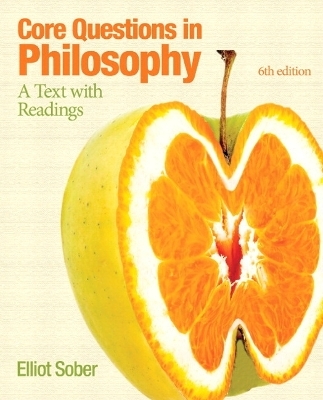
Core Questions in Philosophy
Pearson
978-0-205-86115-6 (ISBN)
- Titel ist leider vergriffen;
keine Neuauflage - Artikel merken
Packages
Access codes for Pearson's MyLab & Mastering products may not be included when purchasing or renting from companies other than Pearson; check with the seller before completing your purchase.
Used or rental books
If you rent or purchase a used book with an access code, the access code may have been redeemed previously and you may have to purchase a new access code.
Access codes
Access codes that are purchased from sellers other than Pearson carry a higher risk of being either the wrong ISBN or a previously redeemed code. Check with the seller prior to purchase.
-- Applying philosophy to everyday life.
Core Questions in Philosophy emphasizes the idea that philosophy is a subject devoted to evaluating arguments and constructing theories.
Presented in an engaging lecture-style format, this text/reader focuses on the basic issues and ideas in philosophy with lectures/discussions, supported by readings from historically important sources. Discussions emphasize the logic of philosophical arguments and how they relate to the content of modern physical and social sciences.
Teaching & Learning Experience
The teaching and learning experience with this program helps to:
Improve Critical Thinking – Review questions at the end of each chapter allow students to review what they’ve just learned and think critically about related problems.
Engage Students – Following a lecture format, the text portion is written in an engaging conversational tone.
Explore Theory – Emphasis on evaluating arguments and constructing theories.
Support Instructors – An instructor’s manual, test bank, MyTest Test Bank, and PowerPoint presentation provide more teaching resources.
Elliott Sober is Hans Reichenbach Professor of Philosophy and William F. Vilas Research Professor at University of Wisconsin-Madison. His research is in the philosophy of science, especially in the philosophy of evolutionary biology. Sober’s books include The Nature of Selection -- Evolutionary Theory in Philosophical Focus (1984), Reconstructing the Past -- Parsimony, Evolution, and Inference (1988), Philosophy of Biology (1993), Unto Others -- The Evolution and Psychology of Unselfish Behavior (1998, coauthored with David Sloan Wilson), Evidence and Evolution – the Logic Behind the Science (2008), and Did Darwin Write the Origin Backwards? (2011). He won the Lakatos Prize in 1991 and the American Philosophical Association named him Prometheus Laureate for 2008. He has been president of the Philosophy of Science Association and the American Philosophical Association (Central Division). He is currently president of the International Union for History and Philosophy of Science (Division of Logic, Methodology, and Philosophy of Science).
Part 1: Introduction
Chapter 1: What Is Philosophy?
Reading: What is Philosophy - Bertrand Russell
Chapter 2: Deductive Arguments
Chapter 3: Inductive and Abductive Arguments
Part 2: The Philosophy of Religion
Chapter 4: Aquinas’s First Four Ways
Reading: Five Ways to Prove That God Exists - Saint Thomas Aquinas
Chapter 5: The Design Argument
Readings: The Design Argument - William Paley
Critique of the Design Argument - David Hume
Chapter 6: Evolution and Creationism
Chapter 7: Can Science Explain Everything?
Chapter 8: The Ontological Argument
Reading: Debate - Saint Anselm and Gaunilo
Chapter 9: Is the Existence of God Testable?
Reading: The Meaninglessness of Religious Discourse - Alfred Jules Ayer
Chapter 10: Pascal and Irrationality
Readings: Belief in God – What Do You Have to Lose? - Blaise Pascal
The Will to Believe - William James
Chapter 11: The Argument from Evil
Part 3: Theory of Knowledge
Chapter 12: What Is Knowledge?
Reading: The Theaetetus — Knowledge is Something More than True Belief Plato
Chapter 13: Descartes’ Foundationalism
Reading: Meditations on First Philosophy, 1-5 - René Descartes
Chapter 14: The Reliability Theory of Knowledge
Chapter 15: Justified Belief and Hume’s Problem of Induction
Reading: Induction Cannot Be Rationally Justified - David Hume
Chapter 16: Can Hume’s Skepticism Be Refuted?
Chapter 17: Beyond Foundationalism
Chapter 18: Locke on the Existence of External Objects
Readings: The External World Probably Exists - Hans Reichenbach
Yada yada - John Locke
Part 4: Philosophy of Mind
Chapter 19: Dualism and the Mind/Body Problem
Reading: Meditations on First Philosophy, 6 - René Descartes
Chapter 20: Logical Behaviorism
Reading: Other Minds Are Known by Analogy from One’s Own Case -Bertrand Russell
Chapter 21: Methodological Behaviorism
Chapter 22: The Mind/Brain Identity Theory
Chapter 23: Functionalism
Chapter 24: Freedom, Determinism, and Causality
Chapter 25: A Menu of Positions on Free Will
Readings: Determinism Shows That Free Will Is an Illusion - Baron D’Holbach
Of Liberty and Necessity - David Hume
Has the Self “Free Will”? - C. A. Campbell
Chapter 26: Compatibilism
Chapter 27: Psychological Egoism
Reading: What Motivates People to Act Justly? - Plato
Part 5: Ethics
Chapter 28: Ethics–Normative and Meta
Chapter 29: The Is/Ought Gap and the Naturalistic Fallacy
Chapter 30: Observation and Explanation in Ethics
Chapter 31: Conventionalist Theories
Readings: The Euthyphro — A Critique of the Divine Command Theory- Plato
Existentialism - Jean-Paul Sartre
Chapter 32: Utilitarianism
Readings: Defense of Utilitarianism - John Stuart Mill
Principle of Utility - Jeremy Bentham
On Liberty- John Stuart Mill
Chapter 33: Kant’s Moral Theory
Reading Ethics Founded on Reason Immanuel Kant
Chapter 34: Aristotle on the Good Life
| Erscheint lt. Verlag | 21.2.2013 |
|---|---|
| Sprache | englisch |
| Gewicht | 703 g |
| Themenwelt | Geisteswissenschaften ► Philosophie |
| Sozialwissenschaften ► Pädagogik ► Allgemeines / Lexika | |
| ISBN-10 | 0-205-86115-6 / 0205861156 |
| ISBN-13 | 978-0-205-86115-6 / 9780205861156 |
| Zustand | Neuware |
| Informationen gemäß Produktsicherheitsverordnung (GPSR) | |
| Haben Sie eine Frage zum Produkt? |
aus dem Bereich