


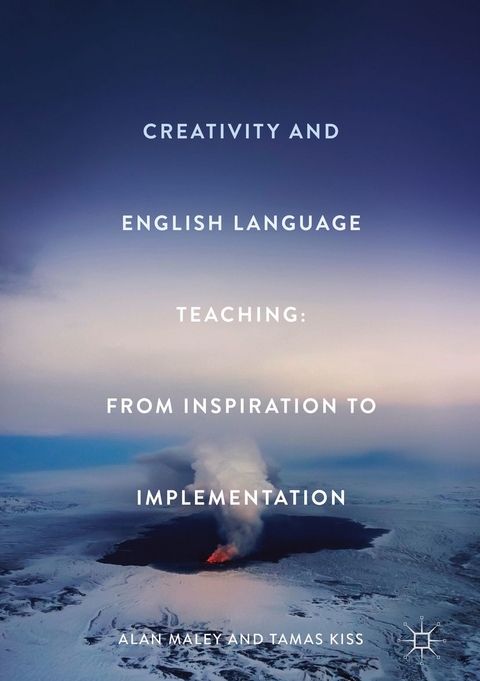
Creativity and English Language Teaching (eBook)
XX, 339 Seiten
Palgrave Macmillan UK (Verlag)
978-1-137-46729-4 (ISBN)
This book offers a unique perspective on creativity in an educational environment where there is a relative dearth of literature on this subject. The authors link practice and principle to provide a practical and valuable guide for more creative language learning and teaching, using not only theoretical ideas but useful practical advice and recommendations on how better to introduce creativity into teaching and daily life. This innovative volume is sure to become a crucial reference point for teachers and practitioners of language teaching, and anyone interested in the ways in which creativity can be channelled into the teaching and learning process.
Alan Maley has worked in the field of English Language Teaching for over 50 years. He has lived and worked in 10 countries, including India and China. He has published over 40 books in the field of language teaching. He is a Past President of IATEFL and in 2012 received the ELTons Lifetime Achievement Award. His research interests lie primarily in creative writing and innovative materials development. Tamas Kiss is Associate Professor at Xi’an Jiaotong – Liverpool University, China. He has been involved with language teacher education programmes in Europe, the Middle East, South Asia, Latin America and South East Asia. His main interests include language teacher education, materials development, complexity science, language as a complex dynamic system and creativity.
Chapter 1. IntroductionChapter 2. Creativity TheoryChapter 3. Creativity and EducationChapter 4. Creativity and Applied LinguisticsChapter 5. Creativity and MethodologyChapter 6. Creativity in Materials and ResourcesChapter 7. What is a creative teacher?Chapter 8. Becoming a creative personChapter 9. Becoming a creative teacherChapter 10. Pre-conditions for classroom creativityChapter 11. Some possible frameworks and proceduresChapter 12. Measuring CreativityChapter 13. Research into creativityChapter 14. Network analysis of research papers on creativity in ELTChapter 15. Suggestions for further researchChapter 16. Conclusion.
| Erscheint lt. Verlag | 5.10.2017 |
|---|---|
| Zusatzinfo | XX, 339 p. 5 illus., 3 illus. in color. |
| Verlagsort | London |
| Sprache | englisch |
| Themenwelt | Schulbuch / Wörterbuch ► Wörterbuch / Fremdsprachen |
| Geisteswissenschaften ► Sprach- / Literaturwissenschaft ► Sprachwissenschaft | |
| Sozialwissenschaften ► Pädagogik | |
| Schlagworte | Creativity • creativity in education • language education • Language Learning • Language Teaching • learning creatively • role of creativity • Teaching Languages |
| ISBN-10 | 1-137-46729-0 / 1137467290 |
| ISBN-13 | 978-1-137-46729-4 / 9781137467294 |
| Informationen gemäß Produktsicherheitsverordnung (GPSR) | |
| Haben Sie eine Frage zum Produkt? |
 PDF (Wasserzeichen)
DRM: Digitales Wasserzeichen
Dieses eBook enthält ein digitales Wasserzeichen und ist damit für Sie personalisiert. Bei einer missbräuchlichen Weitergabe des eBooks an Dritte ist eine Rückverfolgung an die Quelle möglich.
Dateiformat: PDF (Portable Document Format)
Mit einem festen Seitenlayout eignet sich die PDF besonders für Fachbücher mit Spalten, Tabellen und Abbildungen. Eine PDF kann auf fast allen Geräten angezeigt werden, ist aber für kleine Displays (Smartphone, eReader) nur eingeschränkt geeignet.
Systemvoraussetzungen:
PC/Mac: Mit einem PC oder Mac können Sie dieses eBook lesen. Sie benötigen dafür einen PDF-Viewer - z.B. den Adobe Reader oder Adobe Digital Editions.
eReader: Dieses eBook kann mit (fast) allen eBook-Readern gelesen werden. Mit dem amazon-Kindle ist es aber nicht kompatibel.
Smartphone/Tablet: Egal ob Apple oder Android, dieses eBook können Sie lesen. Sie benötigen dafür einen PDF-Viewer - z.B. die kostenlose Adobe Digital Editions-App.
Buying eBooks from abroad
For tax law reasons we can sell eBooks just within Germany and Switzerland. Regrettably we cannot fulfill eBook-orders from other countries.
aus dem Bereich


