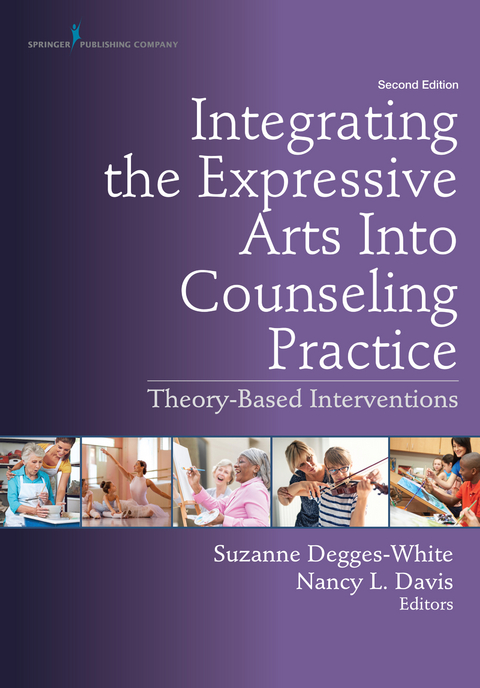
Integrating the Expressive Arts Into Counseling Practice (eBook)
344 Seiten
Springer Publishing Company (Verlag)
978-0-8261-7702-5 (ISBN)
"When I used it, I felt it was a very valuable resource, linking work with the arts to the theoretical foundations of counseling."--Sally S. Atkins, EdD Professor Emerita Founding Director of Expressive Arts, Appalachian State
"They [Students] like the activities since it helps them learn more about the counseling theory which was discussed in the Theories of Counseling class. It provides more application. Some activities are pretty detailed and class time does not allow for much practice. But, we discuss how this could be used in therapy sessions/groups… [The book] is short and very pointed in its information and use. We like it!"--Judy A. Schmidt, EdD, CRC, LPCA University of North Carolina at Chapel Hill
Expanded and revised to reflect a broader understanding of the complementary approach to therapeutic treatment, this is the only text to integrate expressive arts counseling techniques with major theories of counseling and psychology. Substantial changes to the second edition include new chapters that address Neuroscience and Counseling, Trauma-Informed Counseling, Animal-Assisted Therapy, Mindfulness and Counseling, and Family Counseling, along with a greater emphasis on cultural and diversity considerations throughout. The book is updated with over 30 new interventions including animal-assisted and videographic interventions, and new information about the neuroscientific foundations of expressive arts therapies. Updated references in each chapter, and a suite of Instructor’s Materials also add to value of the second edition.
The text integrates expressive arts therapies with 12 commonly used treatment modalities. Each chapter reviews a particular theory and describes how expressive and creative techniques can support and be easily integrated within that orientation. Over 90 field-tested, step-by-step interventions—created by leading practitioners—offer students and clinicians techniques that can be put to use immediately.
New to the Second Edition:
- New chapters address Neuroscience and Counseling, Trauma-Informed Counseling, Animal-Assisted Therapy, Mindfulness and Counseling, and Family Counseling and the Expressive Arts.
- Cultural and diversity considerations in each chapter.
- Updated with new references.
- Over 30 new interventions including videography.
- Instructor’s materials.
Key Features:
- Integrates expressive arts counseling techniques with 12 major theories of counseling and psychology.
- Presents over 90 expressive art interventions in easy, step-by-step format.
- Includes art, writing, bibliotherapy, drama, music, movement, dance, puppetry, and sand play.
- Discusses appropriate populations, settings, and diagnoses for each intervention.
- Includes interventions that can be put to use immediately.
Chapter 1: Introduction to the Use of Expressive Arts in Counseling
- Suzanne Degges-White
Section I: Theories of Counseling and Expressive Arts Approaches
Chapter 2: Adlerian Theory
- Mary Amanda Graham and Dale-Elizabeth Pehrsson
Chapter 3: Solution Focused Therapy
- Mark Gillen
Chapter 4: Cognitive-Behavioral Theory
- Dixie Meyer
Chapter 5: Choice Theory
- Torey Portrie-Bethke
Chapter 6: Existential Theory
- Michele P. Mannion
Chapter 7: Feminist Theory
- Heather Trepal and Thelma Duffey
Chapter 8: Gestalt Theory
- Brian J. Mistler
Chapter 9: Person-Centered Therapy
- Melissa Luke
Chapter 10: Narrative Approaches
- Shawn Patrick
Chapter 11: Trauma-Informed Counseling and the Expressive Arts
- Charles Myers
Chapter 12: Family Counseling and the Expressive Arts
- Edward F. Hudspeth, Krystal Burks, and Keith Bowden
Chapter 13: Integrative Theory in the Expressive Arts
- Sally S. Atkins, Keith M. Davis, and Lauren E. Atkins
Section II: Emerging and Special Issues in Expressive Arts and Counseling
Chapter 14: Neuroscientific Applications for Expressive Therapies
- Jim Nelson and Patrick McMillion
Chapter 15: Clinical Supervision
- Montserrat Casado-Kehoe and Kathy Ybanez
Additional Clinical Uses of the Expressive Arts
Chapter 16: Adventure Therapy
- Mark Gillen
Chapter 17: Animal-Assisted Therapy
- Cynthia Chandler
Chapter 18: Child-Centered Play Therapy
- Charles Myers
Chapter 19: Mindfulness in Counseling
- Cheryl Fulton
Chapter 20: Sandplay Therapy
- Suzanne Degges-White
Appendix
| Erscheint lt. Verlag | 28.9.2017 |
|---|---|
| Sprache | englisch |
| Themenwelt | Schulbuch / Wörterbuch ► Schulbuch / Allgemeinbildende Schulen |
| Geisteswissenschaften ► Psychologie | |
| Medizin / Pharmazie ► Medizinische Fachgebiete ► Psychiatrie / Psychotherapie | |
| Medizin / Pharmazie ► Physiotherapie / Ergotherapie ► Ergotherapie | |
| Medizin / Pharmazie ► Physiotherapie / Ergotherapie ► Rehabilitation | |
| Sozialwissenschaften ► Pädagogik ► Berufspädagogik | |
| Sozialwissenschaften ► Pädagogik ► Didaktik | |
| Schlagworte | Adlerian theory • adventure therapy • Animal-assisted therapy • child-centered play therapy • Choice Theory • cognitive behavioral theory • counseling student • Counselor • counselor educator • existential theory • expressive arts intervention • Family counseling • feminist theory • gestalt theory • Integrative Theory • Mindfulness • person-centered therapy • Sandplay therapy • Solution-focused therapy • trauma-informed counseling |
| ISBN-10 | 0-8261-7702-6 / 0826177026 |
| ISBN-13 | 978-0-8261-7702-5 / 9780826177025 |
| Informationen gemäß Produktsicherheitsverordnung (GPSR) | |
| Haben Sie eine Frage zum Produkt? |
 EPUB (Adobe DRM)
Kopierschutz: Adobe-DRM
Adobe-DRM ist ein Kopierschutz, der das eBook vor Mißbrauch schützen soll. Dabei wird das eBook bereits beim Download auf Ihre persönliche Adobe-ID autorisiert. Lesen können Sie das eBook dann nur auf den Geräten, welche ebenfalls auf Ihre Adobe-ID registriert sind.
Details zum Adobe-DRM
Dateiformat: EPUB (Electronic Publication)
EPUB ist ein offener Standard für eBooks und eignet sich besonders zur Darstellung von Belletristik und Sachbüchern. Der Fließtext wird dynamisch an die Display- und Schriftgröße angepasst. Auch für mobile Lesegeräte ist EPUB daher gut geeignet.
Systemvoraussetzungen:
PC/Mac: Mit einem PC oder Mac können Sie dieses eBook lesen. Sie benötigen eine
eReader: Dieses eBook kann mit (fast) allen eBook-Readern gelesen werden. Mit dem amazon-Kindle ist es aber nicht kompatibel.
Smartphone/Tablet: Egal ob Apple oder Android, dieses eBook können Sie lesen. Sie benötigen eine
Geräteliste und zusätzliche Hinweise
Buying eBooks from abroad
For tax law reasons we can sell eBooks just within Germany and Switzerland. Regrettably we cannot fulfill eBook-orders from other countries.
aus dem Bereich