


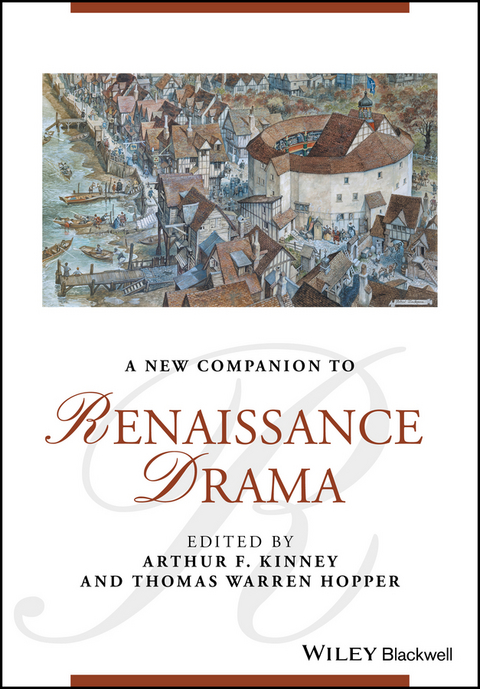
A New Companion to Renaissance Drama (eBook)
John Wiley & Sons (Verlag)
978-1-118-82400-9 (ISBN)
- A colorful, comprehensive and interdisciplinary overview of the material conditions of Renaissance plays, England's most important dramatic period
- Contributors are both established and emerging scholars, with many leading international figures in the discipline
- Offers a unique approach by organizing the chapters by cultural context, theatre history, genre studies, theoretical applications, and material studies
- Chapters address newest departures and future directions for Renaissance drama scholarship
- Arthur Kinney is a world-renowned figure in the field
Arthur F. Kinney is Thomas W. Copeland Professor of Literary History Emeritus in the University of Massachusetts and Founding Director of the Massachusetts Center for Interdisciplinary Renaissance Studies. He is the author and editor of a number of books and essays, including Renaissance Drama (editor, 2005), Shakespeare and Cognition (2006), Elizabethan and Jacobean England (2010), The Oxford Handbook of Shakespeare (editor, 2012), and Renaissance Reflections, Selected Essays 1976-2014 (2014). He is the only recipient of both the Paul Oskar Kristeller Lifetime Achievement Award from the Renaissance Society of America and the Jean Roberts Lifetime Achievement Award from the International Sidney Society.
Thomas Warren Hopper is a Ph.D. candidate at the University of Massachusetts Amherst whose research focuses on classical reception. He has previously worked as the Walter T. Chmielewski Fellow for English Literary Renaissance, contributed to the editing of The Oxford Handbook of Shakespeare (2012). He teaches at Eagle Hill School in Hardwick, MA.
A New Companion to Renaissance Drama provides an invaluable summary of past and present scholarship surrounding the most popular and influential literary form of its time. Original interpretations from leading scholars set the scene for important paths of future inquiry. A colorful, comprehensive and interdisciplinary overview of the material conditions of Renaissance plays, England's most important dramatic period Contributors are both established and emerging scholars, with many leading international figures in the discipline Offers a unique approach by organizing the chapters by cultural context, theatre history, genre studies, theoretical applications, and material studies Chapters address newest departures and future directions for Renaissance drama scholarship Arthur Kinney is a world-renowned figure in the field
Arthur F. Kinney is Thomas W. Copeland Professor of Literary History Emeritus in the University of Massachusetts and Founding Director of the Massachusetts Center for Interdisciplinary Renaissance Studies. He is the author and editor of a number of books and essays, including Renaissance Drama (editor, 2005), Shakespeare and Cognition (2006), Elizabethan and Jacobean England (2010), The Oxford Handbook of Shakespeare (editor, 2012), and Renaissance Reflections, Selected Essays 1976-2014 (2014). He is the only recipient of both the Paul Oskar Kristeller Lifetime Achievement Award from the Renaissance Society of America and the Jean Roberts Lifetime Achievement Award from the International Sidney Society. Thomas Warren Hopper is a Ph.D. candidate at the University of Massachusetts Amherst whose research focuses on classical reception. He has previously worked as the Walter T. Chmielewski Fellow for English Literary Renaissance, contributed to the editing of The Oxford Handbook of Shakespeare (2012). He teaches at Eagle Hill School in Hardwick, MA.
List of Illustrations x
Notes on Contributors xi
Acknowledgments xviii
Introduction 1
Arthur F. Kinney and Thomas Warren Hopper
Part I Context 9
1 The Politics of Renaissance England 11
Norman Jones
2 Continental Influences 21
Lawrence F. Rhu
3 Medieval and Reformation Roots 35
Raphael Falco
4 Popular Culture and the Early Modern Stage 51
Sophie Chiari and Francois Laroque
5 Multiculturalism and Early Modern Drama 65
Scott Oldenburg
6 London and Westminster 75
Ian W. Archer
7 Travel and Trade 88
William H. Sherman
8 The Theater and the Early Modern Culture of Debt 98
Amanda Bailey
9 Vagrancy 112
William C. Carroll
10 Domestic Life 125
Martin Ingram
11 Religious Persuasions, c.1580-c.1620 143
Lori Anne Ferrell
12 Science, Natural Philosophy, and New Philosophy in Early Modern England 154
Barbara H. Traister
13 Magic and Witchcraft 170
Deborah Willis
14 Antitheatricality: The Theater as Scourge 182
Leah S. Marcus
Part II Theater History 193
15 Performance: Audiences, Actors, Stage Business 195
S. P. Cerasano
16 Playhouses 211
David Kathman
17 Theatrical License and Censorship 225
Richard Dutton
18 Playing Companies and Repertory 239
Roslyn L. Knutson
19 Rehearsal and Acting Practice 250
Don Weingust
20 Boy Companies and Private Theaters 268
Michael Shapiro
21 Women's Involvement in Theatrical Production 282
Natasha Korda
22 "To travayle amongst our frendes": Touring 296
Peter H. Greenfield
23 Progresses and Court Entertainments 309
R. Malcolm Smuts
24 "What revels are in hand?" Performances in the Great Households 322
Suzanne Westfall
25 Civic Drama 337
Lawrence Manley
Part III Genres 355
26 Masque 357
David Lindley
27 The History Play: Shakespeare and Beyond 371
Brian Walsh
28 Domestic Tragedy: Private Life on the Public Stage 388
Lena Cowen Orlin
29 Revenge Tragedy 403
Marissa Greenberg
30 Romance and Tragicomedy 417
Jane Hwang Degenhardt and Cyrus Mulready
Part IV Critical Approaches 441
31 Sexuality and Queerness on the Early Modern Stage 443
Valerie Billing
32 Gendering the Stage 456
Alison Findlay
33 Race and Early Modern Drama 474
Mary Floyd?-Wilson
34 Staging Disability in Renaissance Drama 487
David Houston Wood
35 Space and Place 501
Adam Zucker
36 The Matter of Wit and the Early Modern Stage 513
Ian Munro
37 Materialisms 529
Elizabeth Williamson
Part V Playwrights, Publishers, and Textual Studies 543
38 The Transmission of an English Renaissance Play?]Text 545
Grace Ioppolo
39 Publishers of Drama 560
Tara L. Lyons
40 Sidney, Cary, Cavendish: Playwrights of the Printed Page and a Future Stage 576
Lara Dodds and Margaret Ferguson
41 Nonprofessional Playwrights 598
Matteo Pangallo
Index 612
Notes on Contributors
Ian W. Archer is Associate Professor in History at the University of Oxford, and a Fellow of Keble College, Oxford. He is the author of several books and articles on early modern London.
Amanda Bailey is an Associate Professor of English at the University of Maryland. She is the author of Of Bondage: Debt, Property, and Personhood in Early Modern England (2013) and Flaunting: Style and the Subversive Male Body in Renaissance England (2007), and coeditor with Roze Hentschell of Masculinity and the Metropolis of Vice, 1550–1650 (2010), and with Mario DiGangi of Affect Theory and Early Modern Texts (2017). Her essays have appeared in Criticism, Renaissance Drama, English Literary Renaissance, and Shakespeare Quarterly, as well as in numerous edited collections and companions. She is currently working on a book about the relation among dramatic literature, astrology, and political feeling, tentatively titled A Natural History of Politics: Sympathy, Shakespeare, and the Stars.
Valerie Billing is a Visiting Assistant Professor of English at Knox College. She received her PhD from the University of California, Davis, and is currently working on a book titled Size Matters: The Erotics of Stature in Early Modern English Literature and Culture. Her previous publications have appeared in Renaissance Drama and the Journal for Early Modern Cultural Studies.
William C. Carroll is Professor of English, Boston University. He has published The Great Feast of Language in Love’s Labour’s Lost, The Metamorphoses of Shakespearean Comedy, and Fat King, Lean Beggar: Representations of Poverty in the Age of Shakespeare; editions of Shakespeare’s Macbeth: Texts and Contexts (Bedford), The Two Gentlemen of Verona (Arden), Love’s Labour’s Lost (New Cambridge); and editions of Thomas Middleton, Women Beware Women (New Mermaids), and Thomas Middleton: Four Plays (New Mermaids).
S. P. Cerasano is the Edgar W. B. Fairchild Professor of Literature at Colgate University and Editor of Medieval and Renaissance Drama in England. Most recently she has edited Shakespeare’s Julius Caesar for the Norton Critical Editions series. She is currently writing on Philip Henslowe, the owner of the Rose Playhouse, his son‐in‐law, the actor‐entrepreneur Edward Alleyn, and Christopher Marlowe.
Sophie Chiari is Professor of Early Modern English Literature at Clermont Auvergne University (France). She is the author of L’image du labyrinthe à la Renaissance (2010), Renaissance Tales of Desire (2012), and Love’s Labour’s Lost: Shakespeare’s Anatomy of Wit (2014). She has also edited collections of essays devoted to early modern English culture. Her latest publications include Transmission and Transgression: Cultural Challenges in Early Modern England, coedited with Hélène Palma (2014) and The Circulation of Ideas in Early Modern English Literature (2015).
Jane Hwang Degenhardt is Associate Professor of English at the University of Massachusetts Amherst. Her new project, Fortune’s Empire, focuses on the ways that narratives of fortune, chance, and luck intervened in the discursive relationship between imperial exploration and divine providence. She considers the economic and cosmic dimensions of “fortune” to explicate the term’s shifting meanings at the start of the seventeenth century and ultimately to complicate our received history of secularization. She is the author of Islamic Conversion and Christian Resistance on the Early Modern Stage (2010) and Religion and Drama in Early Modern England (2011).
Lara Dodds is Associate Professor of English and Graduate Coordinator at Mississippi State University. She is the author of The Literary Invention of Margaret Cavendish (2013) and of essays on John Milton, Cavendish, and other early modern topics in several journals. She is currently working on a book project on early modern women’s writing and negative affect.
Richard Dutton is Humanities Distinguished Professor Emeritus of English at Ohio State University. His books include Mastering the Revels: the Regulations and Censorship of English Renaissance Drama (1991), Licensing, Censorship and Authorship in Early Modern England: Buggeswords (2000), and Ben Jonson, Volpone and the Gunpowder Plot (2008). Edited collections include four volumes of Companions to the Works of Shakespeare (with Jean Howard) (2003), and The Oxford Handbook to Early Modern Theatre (2009). His scholarly editions include Women Beware Women and Other Plays by Thomas Middleton (1999), Jonson’s Epicene for the Revels Plays (2008) and Volpone for the Cambridge edition of Ben Jonson (2012). He is currently working on a book on the adaptation of Shakespeare’s plays for Court performance.
Raphael Falco is a Professor of English at the University of Maryland, Baltimore County, and held the 2012–2013 Lipitz Professorship of the Arts, Humanities, and Social Sciences. His books include Conceived Presences: Literary Genealogy in Renaissance England, Charismatic Authority in Early Modern English Tragedy, and Charisma and Myth. His articles have appeared in a wide range of journals, including Diacritics, Modern Language Notes, Modern Philology, Shakespeare Studies, Criticism, Soundings, Max Weber Studies, and English Literary Renaissance.
Margaret Ferguson is Distinguished Professor of English at the University of California at Davis; she previously taught at Yale, Columbia, and the University of Colorado at Boulder. Her book Dido's Daughters: Gender, Literacy and Empire in Early Modern England and France (2003) won several prizes. A past president of the Modern Language Association, she has coedited eleven books, including Mariam, the Fair Queen of Jewry, by Elizabeth Cary (1613).
Lori Anne Ferrell is Professor of Early Modern History and Literature at Claremont Graduate University. She is the author of Government by Polemic (1998) and The Bible and the People (2008), and is the editor of volume XI of The Oxford Sermons of John Donne: Sermons at St Paul’s Cathedral, 1623–25 (2016).
Alison Findlay is Professor of Renaissance Drama at Lancaster University (United Kingdom). She is the author of Illegitimate Power (1994), A Feminist Perspective on Renaissance Drama (1998), Playing Spaces in Early Women’s Drama (2006), Women in Shakespeare (2010), and a guide to Much Ado about Nothing in performance (2011). She coedited Twelfth Night: A Critical Reader (2014) and Shakespeare and Greece (2017), both for Arden. Alison is General Editor of Revels Plays and dramaturg to the all‐female Rose Company: http://www.rosecompanytheatre.com/.
Mary Floyd‐Wilson is the Bowman and Gordon Gray Distinguished Term Professor of English and Comparative Literature at the University of North Carolina at Chapel Hill. She is the author of English Ethnicity and Race in Early Modern Drama (2003) and Occult Knowledge, Science, and Gender on the Shakespearean Stage (2013). She has also coedited the essay collections Reading the Early Modern Passions: A Cultural History of Emotion (with Gail Kern Paster and Katherine Rowe, 2004) and Environment and Embodiment in Early Modern England (with Garrett Sullivan, 2007).
Marissa Greenberg, Associate Professor of English at the University of New Mexico, is the author of Metropolitan Tragedy: Genre, Justice, and the City in Early Modern England (2015) and numerous articles on the relationships among space, history, genre, and performance in early modern English drama.
Peter H. Greenfield is Professor Emeritus of English at the University of Puget Sound. He has written on traveling performers and local dramatic traditions, and is a past editor of Research Opportunities in Medieval and Renaissance Drama. For the Records of Early English Drama project he edited Gloucestershire (1986) and is currently completing work on Hampshire and Hertfordshire.
Thomas Warren Hopper is a PhD candidate at the University of Massachusetts Amherst whose research focuses on classical reception. He has previously worked as the Walter T. Chmielewski Fellow for English Literary Renaissance, contributed to the editing of The Oxford Handbook of Shakespeare, and served on the committee of the UMass Student Writing Anthology. He teaches at Eagle Hill School in Hardwick, MA.
Martin Ingram is Emeritus Fellow in History at Brasenose College, University of Oxford. His publications include Church Courts, Sex and Marriage in England, 1570–1640 (1987), and numerous articles on crime and the law, sex and marriage, religion and popular culture in the Early Modern period. He is currently completing a book on sexual regulation in Tudor England. He has also published on the history of climate.
Grace Ioppolo is Professor of Shakespearean and Early Modern Drama at the University of Reading (United Kingdom). She is the author of Revising Shakespeare (1991), Dramatists and Their Manuscripts in the Age of Shakespeare, Jonson, Middleton and Heywood (2006), and...
| Erscheint lt. Verlag | 20.4.2017 |
|---|---|
| Reihe/Serie | Blackwell Companions to Literature and Culture |
| Blackwell Companions to Literature and Culture | Blackwell Companions to Literature and Culture |
| Sprache | englisch |
| Themenwelt | Schulbuch / Wörterbuch ► Wörterbuch / Fremdsprachen |
| Geisteswissenschaften ► Sprach- / Literaturwissenschaft ► Anglistik / Amerikanistik | |
| Geisteswissenschaften ► Sprach- / Literaturwissenschaft ► Literaturwissenschaft | |
| Geisteswissenschaften ► Sprach- / Literaturwissenschaft ► Sprachwissenschaft | |
| Schlagworte | Drama • Dramen • Early Modern Culture • Early Modern Theatre • Elizabethan England • Englische Literatur • Englische Literatur / Renaissance • English literature • jacobean england • jonson • Literary criticism • Literature • Literaturwissenschaft • Marlowe • Material Studies • Middleton • Renaissance • Renaissance English Literature • Renaissance History • Renaissance /Literatur, Literaturgeschichte • renaissance playwrights • Shakespeare • Theatre Studies |
| ISBN-10 | 1-118-82400-8 / 1118824008 |
| ISBN-13 | 978-1-118-82400-9 / 9781118824009 |
| Informationen gemäß Produktsicherheitsverordnung (GPSR) | |
| Haben Sie eine Frage zum Produkt? |
 EPUB (Adobe DRM)
Kopierschutz: Adobe-DRM
Adobe-DRM ist ein Kopierschutz, der das eBook vor Mißbrauch schützen soll. Dabei wird das eBook bereits beim Download auf Ihre persönliche Adobe-ID autorisiert. Lesen können Sie das eBook dann nur auf den Geräten, welche ebenfalls auf Ihre Adobe-ID registriert sind.
Details zum Adobe-DRM
Dateiformat: EPUB (Electronic Publication)
EPUB ist ein offener Standard für eBooks und eignet sich besonders zur Darstellung von Belletristik und Sachbüchern. Der Fließtext wird dynamisch an die Display- und Schriftgröße angepasst. Auch für mobile Lesegeräte ist EPUB daher gut geeignet.
Systemvoraussetzungen:
PC/Mac: Mit einem PC oder Mac können Sie dieses eBook lesen. Sie benötigen eine
eReader: Dieses eBook kann mit (fast) allen eBook-Readern gelesen werden. Mit dem amazon-Kindle ist es aber nicht kompatibel.
Smartphone/Tablet: Egal ob Apple oder Android, dieses eBook können Sie lesen. Sie benötigen eine
Geräteliste und zusätzliche Hinweise
Buying eBooks from abroad
For tax law reasons we can sell eBooks just within Germany and Switzerland. Regrettably we cannot fulfill eBook-orders from other countries.
aus dem Bereich


