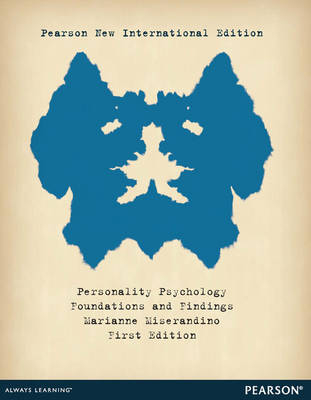
Personality Psychology: Pearson New International Edition
Pearson Education Limited (Verlag)
978-1-292-03917-6 (ISBN)
- Titel ist leider vergriffen;
keine Neuauflage - Artikel merken
Written with an approachable, story-telling style, Marianne Miserandino helps students understand how personality psychology applies to students' everyday lives. Pearsonality Psychology: Foundations and Findings presents an evidence-based text with integrated cultural references and the key building blocks of the subject matter (Foundations): traits, genetics, self and identity, neuroscience, intrapsychic aspects, regulations and motivation, and cognition as it applies to the human personality. Findings refers to the cutting edge research in each of these areas in which personality psychologists are actively engaged every day.
Miserandino is an APA-award winning teacher and has placed learning tools such as self-assessments within each chapter that guide students into a complete understanding throughout the text. Miserandino has also written the instructor's manual.
Learning Goals
Upon completing this book, readers should be able to:
Analyze both the foundations and findings of the research process
Learn about themselves, the people around them, and how personality psychology applies to their everyday lives
Understand and interpret new discoveries in psychology and related fields as they occur in the future
Click here to view a sample chapter! http://bit.ly/Miserandino
IN THIS SECTION:
1.) BRIEF
2.) COMPREHENSIVE
BRIEF TABLE OF CONTENTS:
CHAPTER 1: Who Am I? Understanding the Building Blocks of Personality
CHAPTER 2: Personality Traits: A Good Theory
CHAPTER 3: Personality Traits: Practical Matters
CHAPTER 4: Personality Assessment
CHAPTER 5: Self and Identity
CHAPTER 6: Genetics
CHAPTER 7: The Neuroscience of Personality
CHAPTER 8: Intrapsychic Foundations of Personality
CHAPTER 9: Regulation and Emotion: Self-Determination Theory
CHAPTER 10: Cognitive Foundations of Personality
CHAPTER 11: Gender and Personality
CHAPTER 12: Sexual Orientation: An Integrative Mini-Chapter
CHAPTER 13: Resilience: An Integrative Mini-Chapter
COMPREHENSIVE TABLE OF CONTENTS:
Chapter 1: Who Am I? Understanding the Building Blocks of Personality
What is Personality Psychology?
How do Psychologists Study Personality?
Research Methods Illustrated: A True Experiment
Then and Now: The Ethics of Research with People
Chapter 2: Personality Traits: A Good Theory
What is a Personality Trait?
What do we know about Personality From the Idiographic Approach?
What do we know about Personality from the Nomothetic Approach?
Research Methods Illustrated: Factory Analysis
The Great Nomothetic Search for Universal Principles of Personality
Then and Now: The Four Temperaments and the Five Factors
Chapter 3: Personality Traits: Practical Matters
What's Missing from the Five Factors?
The Five Factors in other cultures
Research Methods Illustrated: Triangulation and Types of Data
Expression of Traits in Everyday Life
The Personality of Everyday Life: What does your online presence say about your personality?
Personality Development Over the Life Span: Continuity, Change, and Coherence
Then and Now: The Grant Study of Harvard Graduates
Chapter 4: Personality Assessment
What makes a Good Personality Test?
Research Methods Illustrated: Is the Neo-Pi-R a Good Personality Test?
Personality Tests and Selection
The Personality of Everyday Life: What can they ask you on a job interview?
Then and Now: Personality Assessment and Matchmaking
Chapter 5: Self and Identity
Self-Concept
Then and Now: The Self
The Personality of Everday Life: Shooting Yourself in the Foot to Protect your Self-Esteem
Research Methods Illustrated: Qualitative Data and Content Analysis
Chapter 6: Genetics
Nature and Nurture as Allies
Genes and Environment as Co-Actors
Research Methods Illustrated: Correlational Designs I: The Logic of Adoption Studies and Twin Studies
Heritability of Common Personality Characteristics
Then and Now: The Science of Genetics
Genes and Environment: Adialectical Synthesis
The Personality of Everyday Life: What can Genetics do for us?
Chapter 7: The Neuroscience of Personality
What is neuroscience and how do we study it?
Research Methods Illustrated: Correlational Designs II: Scatterplots, Correlations, and the Alleged "Voodoo Science" of FMRI Studies
Neurological Theories of Personality
The Personality of Everday Life: Personality and the Guessing Penalty
Then and Now: Phrenology, the new Phrenology, and the Future of NeuroImaging for Personality and Beyond
Neurological Correlates of Personality
Chapter 8: Intrapsychic Foundations of Personality
Sigmund Freud and Psychoanalysis
Research Methods Illustrated: Case Study and Psychobiography
Psychobiography
Psychodynamic Theory Since Freud Attachment Theory
Chapter 9: Self-Determination Theory
Three Fundamental Psychological Needs
How Do We Satisfy These Needs?
Then and Now: Undermining Intrinsic Interest
Connections between Self-Determination Theory and Other Theories in Personality
Research Methods Illustrated: Path Analysis
What It Means to Be Self-Regulated
Self-Determination Theory Applied
Chapter 10: Cognitive Foundations of Personality
Locus of Control
Then and Now: Locus of Control
Learned Helplessness
Explanatory Style
Research Methods Illustrated: Field Studies and Natural Manipulations
Dispositional Optimism
Chapter 11: Gender and Personality
Beliefs about Personality Similarities and Differences between Men and Women
Research Methods Illustrated: Effect Size and Meta Analysis
Personality Differences between Men and Women: Fact or Fiction?
What Causes Gender Differences?
Gendered Beliefs about Personality: What Difference Does It Make?
Then and Now: Definition and Assessment of Gender
Chapter 12: Sexual Orientation: An Integrative Mini-Chapter
Myths and Misperceptions about Sexual Orientation
What is Sexual Orientation?
How Many People are Gay, Lesbian, Straight, or Bisexual?
What Determines Sexual Orientation?
Chapter 13: Resilience: An Integrative Mini-Chapter
What is Resilience?
Characteristics of Resilient People
The 7 Habits of Highly Resilient People
| Erscheint lt. Verlag | 1.11.2013 |
|---|---|
| Verlagsort | Harlow |
| Sprache | englisch |
| Maße | 274 x 215 mm |
| Gewicht | 902 g |
| Themenwelt | Schulbuch / Wörterbuch |
| Geisteswissenschaften ► Psychologie | |
| ISBN-10 | 1-292-03917-5 / 1292039175 |
| ISBN-13 | 978-1-292-03917-6 / 9781292039176 |
| Zustand | Neuware |
| Informationen gemäß Produktsicherheitsverordnung (GPSR) | |
| Haben Sie eine Frage zum Produkt? |
aus dem Bereich