


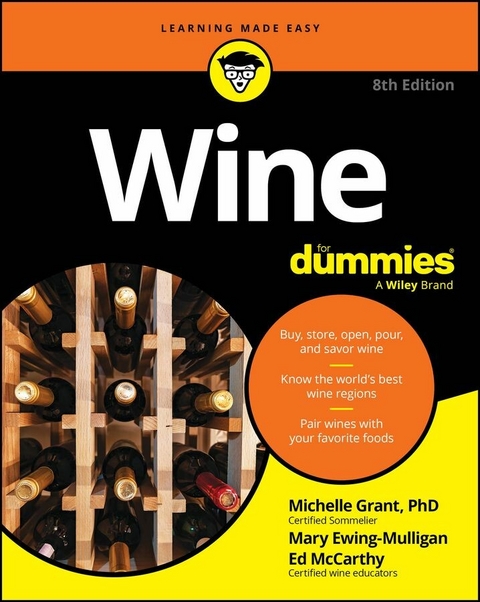
Wine For Dummies (eBook)
611 Seiten
For Dummies (Verlag)
978-1-394-32009-7 (ISBN)

Become a wine connoisseur with this fun guide to the complex world of wine
Wine For Dummies helps you explore everything there is to know about wine-the different regions, types, flavor profiles, pairing techniques, and beyond. This edition is updated with the latest, must-know wine varieties and styles, so you can start building your collection (or just know what to order when you're out at restaurants) and discover pro tips on how to sip, share, and store it. This fruitful reference includes a new section full of vocabulary you'll need to describe your wine, plus a guide to all the key wine regions around the world, including the U.S. You'll also discover how apps and social media can enhance your enjoyment of this popular beverage.
- Discover the basics of winemaking in the vineyard and in the cellar
- Choose the best wine for any occasion, budget, or food pairing
- Learn about buying, storing, and collecting wine-plus, considerations for building your own cellar
- Start serving wine like a sommelier by mastering temperatures, opening techniques, and glassware
- For beginning and intermediate wine enthusiasts seeking a down-to-earth book about all things wine, Wine For Dummies is the perfect choice.
Michelle Grant, PhD is a Court of Master Sommeliers (CMS)-certified sommelier and founder of Era Wine Bar in Mount Rainier, MD. She is a wine writer, wine educator, and food and wine pairing expert with a focus on international cuisines. Michelle is a CMS advanced sommelier candidate and certified Italian Wine Ambassador.
Mary Ewing-Mulligan is the first woman in America to become a Master of Wine.
Ed McCarthy was a Certified Wine Educator.
Become a wine connoisseur with this fun guide to the complex world of wine Wine For Dummies helps you explore everything there is to know about wine the different regions, types, flavor profiles, pairing techniques, and beyond. This edition is updated with the latest, must-know wine varieties and styles, so you can start building your collection (or just know what to order when you're out at restaurants) and discover pro tips on how to sip, share, and store it. This fruitful reference includes a new section full of vocabulary you'll need to describe your wine, plus a guide to all the key wine regions around the world, including the U.S. You'll also discover how apps and social media can enhance your enjoyment of this popular beverage. Discover the basics of winemaking in the vineyard and in the cellar Choose the best wine for any occasion, budget, or food pairing Learn about buying, storing, and collecting wine plus, considerations for building your own cellar Start serving wine like a sommelier by mastering temperatures, opening techniques, and glassware For beginning and intermediate wine enthusiasts seeking a down-to-earth book about all things wine, Wine For Dummies is the perfect choice.
Chapter 1
What Is Wine?
IN THIS CHAPTER
Discovering why grape variety is important
Understanding how grapes grow
Observing grape characteristics and performance in the vineyard
Learning who’s who in the worlds of white and red grapes
What is wine? Wine is an alcoholic beverage made from the fermented juice of grapes. While wine can be made from many other types of fruit, this book focuses on wine made specifically from the Vitis vinifera species of grapes.
Most wine marketing highlights the pleasurable, fun aspects of wine: the suspense of the first sip, the bonds strengthened with friends and loved ones over a good bottle, and the memories that connect us as people.
If you work in wine or know anyone who has ever made it, then you know that there are countless hours of blood, sweat, and (often) tears in every bottle. Behind the label, wine is in its most basic form an agricultural product. It is fermented grape juice, processed and packaged as a breathing link between the earth and its people.
In this chapter, we dive into the world of grapes, tracing a vine’s life cycle and highlighting key aspects of vineyard management that can impact a winemaker’s ability to harvest grapes and make different types of wine. We conclude the chapter with important facts about the most popular grapes to know and the wines they make.
Understanding the Importance of Varieties
Grapes are the starting point of every wine. The grapes that make a particular wine dictate the genetic structure of that wine and how it will respond to everything the winemaker does to it. Think back to the last wine you drank. What color was it? If it was white or amber, the odds are that it came from white grapes. If it was pink or red, the wine likely came from red grapes. Did it smell herbal or earthy or fruity? Whichever, those aromas came mainly from the grapes. Was it firm and tannic or soft and voluptuous? Most of what you will remember is due in large part to the grapes, with a nod to both mother nature and the winemaker.
The specific grapes that make any given wine are largely responsible for the sensory characteristics the wine offers — from its appearance to its aromas, flavors, alcohol, tannin (a substance that exists naturally in skins, seeds, and stems; refer to Chapter 4 for more details), and acid profile. How the grapes grow — the amount of sunshine and moisture they get, for example, and how ripe they are when they’re harvested — is also a factor and can emphasize certain grape characteristics over others. So can winemaking processes, such as oak aging. Each type or variety of grape reacts in its own way to the farming and winemaking techniques that it faces. By variety, we mean the fruit of a specific type of grapevine: the fruit of the cabernet sauvignon vine, for example, or of the chardonnay vine. Discover more about winemaking in Chapter 3, and about the different varieties later in this chapter. Parts 2 through 5 of this book reveal how different varieties thrive in different wine regions, and how some regions have become known as the best places for wines from those varieties.
The term variety has scientific meaning. A variety is a subdivision of a species. Most of the world’s wines are made from grape varieties that belong to the species vinifera — itself a subdivision of the genus Vitis. This species originated in Europe and western Asia. Other distinct species of Vitis are native to North America. You can find out more about Vitis vinifera and the spread of winemaking in Chapters 2 and 3.
Grapes of other species can also make wine. For example, the concord grape, which belongs to the native American species Vitis labrusca, makes concord wine and grape juice and jelly. Non-vinifera wines often receive less appreciation compared to wines made from Vitis vinifera grapes because they are typically perceived as having less complexity, more inconsistent quality, and a sweeter, fruitier flavor profile, which many wine connoisseurs associate with lower-tier wines, particularly due to the historical dominance of European Vitis vinifera grapes in the wine industry. However, there is a growing interest in exploring diverse grape varieties and high-quality non-vinifera wines produced by skilled winemakers.
A VARIETY OF VARIETIES
Snowflakes and fingerprints aren’t the only examples of nature’s infinite variety. Within the genus Vitis and the species vinifera, as many as 10,000 varieties of wine grapes exist. If wine from every one of these varieties were commercially available and you drank the wine of a different variety every single day, it would take you more than 27 years to experience them all!
Not that you would want to. Within those 10,000 varieties are grapes that can make extraordinary wine, grapes that tend to make very ordinary wine, and grapes that probably shouldn’t be turned into wine at all. Most varieties are obscure grapes whose wines rarely enter into international commerce.
An adventuresome grape nut who has plenty of free time to explore the back roads of Spain, Portugal, Italy, and Greece might be able to encounter only 2,000-plus different grape varieties (over five years’ worth of drinking) in their lifetime. The grape varieties you might encounter during your normal wine enjoyment probably number fewer than 50.
Living Life as a Vine
Most wine education focuses on winemaking in the cellar: fermentation vessels, different types of fermentations, yeasts, and so forth that can influence the final flavor profile, texture, and more in a wine (find out more about these in Chapter 3). Less attention is paid to what happens to grapes before they enter the cellar. Like any other plant, the grapevine has a life (and often mind) of its own.
The life cycle of a vine
The typical life cycle of a vine happens in phases according to the seasons of the year and location on the globe. See the color section of this book to discover the life cycle of a vine, which is described in more detail here:
- Winter pruning: Up to 90 percent of a vine’s previous growth can be removed to prepare it for the coming season. The goal of this step, carried out while the vines are in a dormant state, is to guide the vine’s future production, limiting the number of clusters (also known as thinning, which packs nutrients and energy into fewer grapes, thereby concentrating sugars and aromatic and phenolic compounds), maximizing sun exposure, and ensuring high-quality fruit.
- Spring bud break: After a winter of dormancy, small buds begin to swell and unfold, revealing the first signs of green growth. This critical step tells winemakers that fruit is on the way, but is in a fragile, not fully formed state. Frost and hailstorms can be serious threats during this phase, permanently damaging new shoots if temperatures are too extreme.
- Spring flowering: Surviving buds develop numerous small flowers, each with the potential to turn into an individual berry (since grapevines are also magical enough to self-pollinate).
- Summer fruit set: As the temperature increases, the tiny, pollinated flowers shed their petals and small, green berries (all grapes start out green, even if they may later become red, blue, or purple) form with seeds at the end of each stem. The fruit set stage gives the winemaker an early sign of potential crop yield. Mid-season, encouraged by the sun’s heat, the clusters of green berries begin to show pigmentation and develop more sugar and ripeness. Referred to as veraison, some clusters begin to turn red, purple, or bluish in color.
- Fall harvest: Sugar continues to increase (and acidity decreases, marking the importance of this inverse relationship in finished wines as well) as the grapes remain on the vine and exposed to sunlight. This is where the fun begins for winemakers as they taste and test the grapes for sugar content (referred to as brix), determining the exact day or moments when to pick grapes and transport them to the winery. Check out Chapter 3 for details of what happens when the grapes reach the winery.
Each vintage (growing season) has a different story to tell based on the conditions of the vine, the soil, the climate, and more. Leading up to the many decisions the winemaker will face at the time of harvest, the approach to vineyard management can play just as important of a role as the winemaking itself.
Pests and other vineyard concerns
If you think that humans are the only species that love grapes and the wines that come from them, then think again! Vineyards (and wineries) can be havens for a range of pests and diseases that can permanently damage if not eradicate entire plots if not identified and/or treated immediately. Some of the most common pests include:
- Grapevine moths: These can eat different parts of the plant, with larvae feeding on everything from flower buds, blossoms, and grapes.
- Leafhoppers: As the name implies, these hop from leaf to leaf, nibbling away as they go and leaving white and yellow patches that render the leaves incapable of achieving photosynthesis (the process by which plants, algae, and bacteria turn light energy into chemical energy...
| Erscheint lt. Verlag | 3.6.2025 |
|---|---|
| Sprache | englisch |
| Themenwelt | Sachbuch/Ratgeber ► Essen / Trinken ► Getränke |
| Schlagworte | books on wine • California Wine • cooking with wine • french wine • german wine • History of Wine • Italian Wine • Portuguese wine • Portuguese wine, German wine, California wine • Sommelier • Virginia wine • wine • wine book • wine books for sommeliers • wine connoisseur gifts • Wine regions |
| ISBN-10 | 1-394-32009-4 / 1394320094 |
| ISBN-13 | 978-1-394-32009-7 / 9781394320097 |
| Informationen gemäß Produktsicherheitsverordnung (GPSR) | |
| Haben Sie eine Frage zum Produkt? |
 EPUB (Adobe DRM)
Kopierschutz: Adobe-DRM
Adobe-DRM ist ein Kopierschutz, der das eBook vor Mißbrauch schützen soll. Dabei wird das eBook bereits beim Download auf Ihre persönliche Adobe-ID autorisiert. Lesen können Sie das eBook dann nur auf den Geräten, welche ebenfalls auf Ihre Adobe-ID registriert sind.
Details zum Adobe-DRM
Dateiformat: EPUB (Electronic Publication)
EPUB ist ein offener Standard für eBooks und eignet sich besonders zur Darstellung von Belletristik und Sachbüchern. Der Fließtext wird dynamisch an die Display- und Schriftgröße angepasst. Auch für mobile Lesegeräte ist EPUB daher gut geeignet.
Systemvoraussetzungen:
PC/Mac: Mit einem PC oder Mac können Sie dieses eBook lesen. Sie benötigen eine
eReader: Dieses eBook kann mit (fast) allen eBook-Readern gelesen werden. Mit dem amazon-Kindle ist es aber nicht kompatibel.
Smartphone/Tablet: Egal ob Apple oder Android, dieses eBook können Sie lesen. Sie benötigen eine
Geräteliste und zusätzliche Hinweise
Buying eBooks from abroad
For tax law reasons we can sell eBooks just within Germany and Switzerland. Regrettably we cannot fulfill eBook-orders from other countries.
aus dem Bereich


