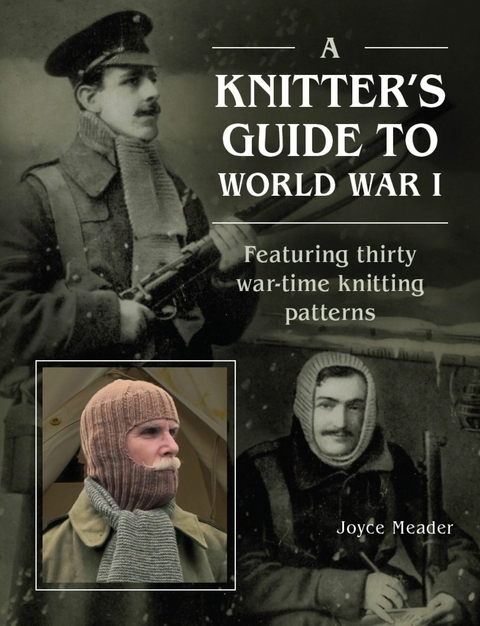
Knitter's Guide to World War 1 (eBook)
112 Seiten
The Crowood Press (Verlag)
978-0-7198-4456-0 (ISBN)

JOYCE MEADER knits vintage items for museums, reenactors and films. Most recently, her work has featured in the films 1917 and War Horse. She gives lectures on the history of knitting, particularly historical military knitting.
During World War I, thousands of garments and accessories were knitted for the men at the front to help with the war effort. This book brings together the genuine military knitting patterns of the day, taken from wool company booklets, needlework magazines and government pamphlets. The patterns are written in modern form, with useful advice on yarn choice and techniques for today's knitter.
CHAPTER 2
YARN AND PATTERN COMPANIES
‘Let’s go to the haberdashers’
After the success of ‘recipe’ or pattern booklets in the Boer War, wool producers saw a large potential for profits when World War I came along. The women at home were missing their men, who were on the front line or at sea, and flocked to the shops looking for wool in the correct colours (khaki, navy, blue, grey and off-white), along with the recommended patterns from the War Office.
As previously mentioned, wool producers were spinning wool for weaving companies and these threads were being used to produce cloth for making uniforms. It was only a small step to make balls or skeins with this wool and label it for sale to home knitters. The wool producers then produced their own patterns to go with their yarns.
At the beginning of World War I, patterns from the Boer War were reprinted, along with a small number of new ones. The mass production of new patterns soon followed, along with books of patterns for use in World War I. Patterns were not only out there, but were being bought in their thousands.
MAGAZINES
Women’s magazines also published patterns, and these were often different from those printed in the wool company booklets. Although the quarterly and monthly magazines continued to be published throughout the war years, most of the military patterns were not published after the end of 1916. It was thought that there were enough copies of the patterns in general circulation. Women would lend these patterns to friends, and comfort committees would have copies to give away. As women now had to replace men on the home front, access to a typewriter became much easier. The military items were replaced by patterns to make patriotic lace edgings, and embroidery patterns of ships, flags and medals, for decorating bags, cushions and tea cosies.
The Lady’s World magazine was published quarterly on the first of the month. It contained patterns for the home front, along with military ones.
Magazines were purchased from newsagents or by subscription, the two most popular being Needlework for All and The Lady’s World. Needlework for All could be purchased at a cost of 2d, with an additional charge of 1d if sent for by post. The Lady’s World was a shilling extra, added onto the magazine price, when it was bought by post.
An advertisement for a yarn company telling the reader where they could purchase their products.
The patterns gave you the weight of wool needed to make the garment. Those on a limited budget could buy some of the yarn and the shop would ‘lay-by’ or keep the rest of the yarn until the knitter in question could afford it.
Some wool companies gave the knitter the pattern for free if they purchased enough yarn to make a garment. The Scotch Wool & Hosiery Stores were one such company and continued this practice until 1945 (the end of the World War II).
An advertisement telling the knitter that yarn could be bought in bulk from the spinning mill.
There were also helpful hints on recycling items from the home and garments which had been gathered by the comfort committees. The comfort committees would recycle clothes of all types, along with everything on them. Fur collars were removed and kept to make garments for the men at the front. They were often stitched together to make waistcoats. Everything had a second or third use and was collected by children or boy scouts. Recycling is not a new initiative; we have just changed the type of items we collect and recycle.
A pattern book from Scotch Wool & Hosiery Stores. This edition contained useful patterns for socks, balaclavas and hospital items.
The Lady’s World was an independent magazine published quarterly on the first of the month. If you ordered it via your newsagent, he would have to buy it direct from the London head office in the Strand. It was also available to order from London by sending 1s 6d in advance. It could be paid for in unused British stamps or by postal order. This form of payment was well established and continued until well after the end of World War I.
The page shown overleaf from the Lady’s World Magazine, No.36, explains in detail how items were recycled. I have included this page because it is just so interesting and shows what materials could be used for recycling.
The price list for yarn from Hammond’s. You can see how the price increased during the War, where they have pencilled in new prices.
The front cover of The Needle-Worker magazine showing an Admiralty-recommended pattern.
The Expert’s request page. In answer to a letter, the ‘Expert’ says that patterns can be sent in Braille for blind knitters.
The Needle-Worker magazine War edition was published in two parts entitled ‘Comforts for Sailors and How to Make Them’. The Expert’s request page contains a letter from a reader who asks if a pattern can be sent to her blind friend. The editor offers to send a pattern in Braille if the reader sends her friend’s address to the magazine – everyone could do their bit!
PATTERN BOOKLETS
Pattern booklets were popular with women as the amount and quality of education had improved over the last 20 years, and so the level of literacy in women was now much higher than it had been in the past.
J. J. Baldwin published booklets under the name Beehive. These could be purchased for 2d, or 2½d by post. They were produced on a regular basis and patterns were adapted to suit the type of fighting that was taking place.
Annette Louise de Savile Foljambe (Lady Liverpool) was the wife of the governor of New Zealand, and when war was declared in 1914, she threw herself wholeheartedly into working for the soldiers and the navy. Two days after receiving notification of the war, she published an appeal to the women of New Zealand in many newspapers. She regarded them as the ‘citizen army’ and suggested that a network of committees should be established.
Her Excellency’s Knitting Book. A book of military patterns for both knitting and crochet from New Zealand.
Within days, women gathered to start knitting and sewing for the front line. In Dunedin a meeting of 800 women gathered to discuss establishing a Lady Liverpool Fund. This was the largest gathering of women ever held in the city. Lady Liverpool was the patroness of the Lady Liverpool’s and Mrs Pomare’s Maori Soldiers’ Fund, which started in 1915. They organised parcels for Maori contingent members overseas. These gifts included dried pipi, a spiced and dried beef that could be cooked in a stew or eaten cold, as well as muttonbird (a species of seabird).
An advertisement from a sponsor, within the book.
Her Excellency’s Knitting Book was published twice during World War I, and Lady Liverpool hoped it would be used to knit items for soldiers and the wounded, along with improving the proficiency of knitting throughout New Zealand.
When trench warfare became common, there was more need for jumpers and waistcoats. In the late 1915 copy of the pattern booklet, there was also a pattern for a ‘wither pad’. These pads were needed for horses’ comfort. When the saddle is made, it is fitted to the horse, as shoes are for people. As many horses were being killed on the front line, tailored saddles weren’t being made for each horse. These pads were used as a substitute to enhance and change the shape of previously used horse saddles. The addition of the pads allowed the saddles to be reused and reduced the risk of the horse getting sores. The War Office would request specific items and companies would direct their designers to write and test a pattern for those items. J & J Baldwin had their own designer, one Marjory Tillotson. Marjory always signed her patterns at the end with MT. After the end of the war, she went on to write educational booklets on needle crafts and knitting for schools and colleges.
Empire publishers produced booklets, the most famous of these being Her Excellency’s Knitting Book by the Countess of Liverpool. Each pattern page was sponsored by a company within New Zealand. The Countess was the wife of the Governor General of New Zealand and she carried out sterling work for the St John Ambulance and her own projects. The proceeds from the sales of this booklet were used to support the St John’s Base Hospital, but it does not say where this hospital is.
NEEDLEWORK BOOKS
Needlework books published during the war years often contained patterns for war garments. These books were mainly aimed at girls and young women. The editor of The Girl’s Own Paper and Woman’s Magazine, Flora Klickmann, was a prolific publisher who not only had these magazines in her portfolio, but also a set of books about all aspects of home needlework. They were The Home Art series and The Modern Knitting Book, which included sock and cardigan jacket patterns.
An advertisement from inside the book for Paton’s Knitting Yarns.
The Modern Knitting Book by Flora Klickmann, dated 1914–1915. This also contained military patterns.
The front cover of Leach’s pattern booklet.
Finally, Leach’s produced magazines solely for the knitting and crochet of military items. I have used some of their patterns in this book....
| Erscheint lt. Verlag | 14.1.2025 |
|---|---|
| Verlagsort | London |
| Sprache | englisch |
| Themenwelt | Sachbuch/Ratgeber ► Freizeit / Hobby ► Handarbeit / Textiles |
| Sachbuch/Ratgeber ► Freizeit / Hobby ► Heimwerken / Do it yourself | |
| Schlagworte | Balaclava • Cardigan • comfort committees • First World War • gloves • historical knitting • hospital comforts • Jumper • knit • Knitting • knitting pattern • knitwear • knitwear design • military knitting • military uniform • mittens • muffler • Needleworker. • Needlework for All • Socks • The Lady’s World • vest • Vintage • World War 1 • wwi |
| ISBN-10 | 0-7198-4456-8 / 0719844568 |
| ISBN-13 | 978-0-7198-4456-0 / 9780719844560 |
| Informationen gemäß Produktsicherheitsverordnung (GPSR) | |
| Haben Sie eine Frage zum Produkt? |
 EPUB (Wasserzeichen)
DRM: Digitales Wasserzeichen
Dieses eBook enthält ein digitales Wasserzeichen und ist damit für Sie personalisiert. Bei einer missbräuchlichen Weitergabe des eBooks an Dritte ist eine Rückverfolgung an die Quelle möglich.
Dateiformat: EPUB (Electronic Publication)
EPUB ist ein offener Standard für eBooks und eignet sich besonders zur Darstellung von Belletristik und Sachbüchern. Der Fließtext wird dynamisch an die Display- und Schriftgröße angepasst. Auch für mobile Lesegeräte ist EPUB daher gut geeignet.
Systemvoraussetzungen:
PC/Mac: Mit einem PC oder Mac können Sie dieses eBook lesen. Sie benötigen dafür die kostenlose Software Adobe Digital Editions.
eReader: Dieses eBook kann mit (fast) allen eBook-Readern gelesen werden. Mit dem amazon-Kindle ist es aber nicht kompatibel.
Smartphone/Tablet: Egal ob Apple oder Android, dieses eBook können Sie lesen. Sie benötigen dafür eine kostenlose App.
Geräteliste und zusätzliche Hinweise
Buying eBooks from abroad
For tax law reasons we can sell eBooks just within Germany and Switzerland. Regrettably we cannot fulfill eBook-orders from other countries.
aus dem Bereich