


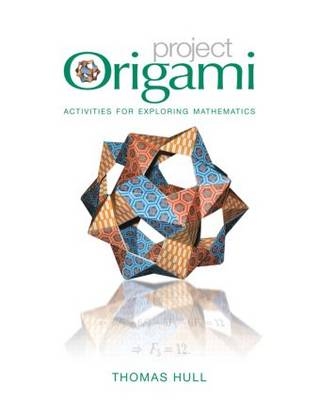
Project Origami
Activities for Exploring Mathematics
Seiten
2006
A K Peters (Verlag)
978-1-56881-258-8 (ISBN)
A K Peters (Verlag)
978-1-56881-258-8 (ISBN)
- Titel erscheint in neuer Auflage
- Artikel merken
Zu diesem Artikel existiert eine Nachauflage
The art and technique of origami provides a surprising range of tools for explaining complicated mathematical concepts. Origami teaches: dividing a length into equal nths, solving cubic equations; and more.This workbook that can be used in a variety of mathematics classes to visualize the solutions to mathematical problems.
When it comes to mathematics, paper isn't just for pen and pencil any more! Origami, the art and science of paper folding, can be used to explain concepts and solve problems in mathematics-and not just in the field of geometry. The origami activities collected here also relate to topics in calculus, abstract algebra, discrete mathematics, topology, and more. Using origami, learn about: - Solving Cubic Equations - Bucky Balls and PHiZZ units - Matrix models for folds - Gaussian Curvature and much more! These activities, which can enhance the classroom experience, also make great independent student projects and are perfect for math clubs or math circles. To provide readers of Project Origami with as much flexibility as possible, we have made all of the handouts in the book available online.
When it comes to mathematics, paper isn't just for pen and pencil any more! Origami, the art and science of paper folding, can be used to explain concepts and solve problems in mathematics-and not just in the field of geometry. The origami activities collected here also relate to topics in calculus, abstract algebra, discrete mathematics, topology, and more. Using origami, learn about: - Solving Cubic Equations - Bucky Balls and PHiZZ units - Matrix models for folds - Gaussian Curvature and much more! These activities, which can enhance the classroom experience, also make great independent student projects and are perfect for math clubs or math circles. To provide readers of Project Origami with as much flexibility as possible, we have made all of the handouts in the book available online.
Thomas Hull earned his PhD in Mathematics from the University of Rhode Island in 1977. He is currently an associate professor in the Department of Mathematics at Merrimack College in North Andover, MA. Recently, he was awarded the Murray Fellowship offered to educators who promote science and engineering research that will lead to enhanced effectiveness in classroom teaching.
| Erscheint lt. Verlag | 16.3.2006 |
|---|---|
| Verlagsort | Natick |
| Sprache | englisch |
| Maße | 203 x 254 mm |
| Gewicht | 658 g |
| Themenwelt | Sachbuch/Ratgeber ► Freizeit / Hobby ► Kreatives Gestalten |
| Mathematik / Informatik ► Mathematik | |
| ISBN-10 | 1-56881-258-2 / 1568812582 |
| ISBN-13 | 978-1-56881-258-8 / 9781568812588 |
| Zustand | Neuware |
| Informationen gemäß Produktsicherheitsverordnung (GPSR) | |
| Haben Sie eine Frage zum Produkt? |
Mehr entdecken
aus dem Bereich

aus dem Bereich
schöpferische Auszeiten für einen freien Kopf, mehr Selbstliebe und …
Buch | Softcover (2023)
Frech (Verlag)
CHF 27,90
Bastelprojekte & Ideen rund um die Wichteltür
Buch | Hardcover (2025)
Frech (Verlag)
CHF 24,90


