


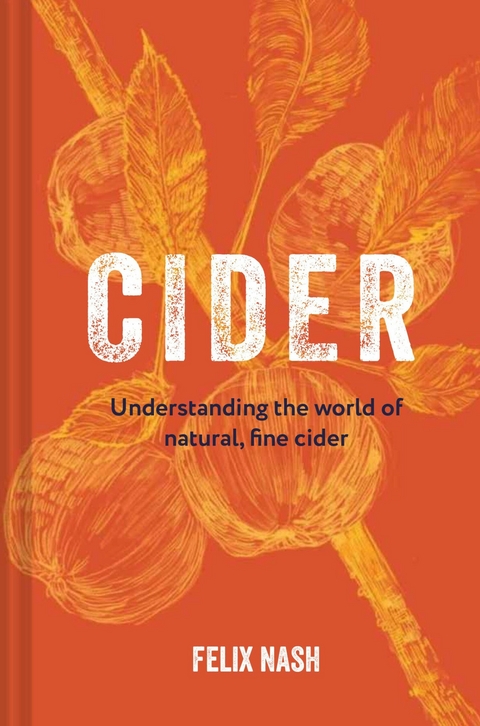
Cider (eBook)
244 Seiten
Ryland Peters & Small (Verlag)
978-1-912983-60-5 (ISBN)

Welcome to the cider revolution - explore the fine cider movement, and the people and producers behind it. Think you know about cider? Well, think again. It's not about the swill you guzzled as a student, or the so-called 'flavoured ciders' that don't actually contain any apples. The contemporary cider scene is an exciting place to spend some time, as passionate makers celebrate tradition and terroir while also embracing seasonality, innovation, and experimentation to produce characterful drinks that are quite remarkable. Cider is now a key player in the drinks industry, with a new breed of drink shops that take it just as seriously as wine. Cider looks at this modern cider movement, charting its beginnings and introducing some of the key players in fine-cider making, as well as guiding you through the characteristics of different apple varieties, the cider-producing regions around the world, the processes and techniques of cider production, how cider is an exceptional partner with food and, of course, recommending ciders you need to try.
We begin where I began—driving down the lacing lanes of the English county of Herefordshire. Situated in the middle of England, next to the Welsh border, it is a land of large, low valleys, and as you weave along its arteries you see patches of woodland, dense and dark, sat upon the hills above, with pointy pines among them. Smooth green fields rise to meet them and tuck up underneath the tree line, as though a tidal wave of trees has crested the hill and is descending toward you. Or the army in Macbeth, carrying trees to disguise itself, has encamped upon the hilltop, and single-file soldiers are marching down in hedgerows to the farms below.
It’s a wonderful place, yet it always seems to be a lesser-known land to most of the people I meet outside of the world of cider. I’ve come to feel that in spite of its relative sparseness, it has a clear imprint of history upon it and an air of bygone glory lying ingrained within its existence today. It is mostly thanks to the pull of this place that I’ve gained a glimpse of what cider’s true nature is, and all that it can be.
“All Herefordshire is become, in a manner, but one orchard,” the diarist John Evelyn wrote in 1662—a person we’ll come back to later. These apple trees, whose parade-ground patterns also dominate the landscape, still make up its many orchards. But today they are scattered, and pepper the view as you drive. As soon as you have an eye for an orchard, they make themselves visible everywhere; rising above or through a hedge, beyond the gap of a gate, running below a ridge, sinking into a valley. The old orchards, especially those of perry pears—the trees in which can be two or even three hundred years old—always give me a reminder of my shorter mortality as I drive by. Stood proud and ancient, versed in moss and cracking bark, they seem one of the most enduring things in the landscape.
In blossom season and when there are apples on the trees, no one can miss these orchards. Bedecked in pink and white blossom in spring, then adorned in green, yellow, and red baubles in the autumn, this landscape leaves me full of wanderlust, in wonder at all the other possible hidden pockets of the world. You can drive its lanes and bathe in its views, but it always seems to have parts that you cannot reach by road, and so holds something back from a faster pace of change.
We are here to visit Tom Oliver. Widely regarded as one of the great cider-makers of the world, he is a charming soul, so kind with his time and his belief. You find him at a farm down a short track in central Herefordshire. I have visited many times and the sensations of arriving are always the same: from the fast, smooth run of the main road you begin to slow and to indicate, with the traffic approaching behind you beginning to condense, you turn over the little lip that marks the start of the track, and your smooth and fast journey changes to wobbling and slow. Now moving sideways as well as forward, you descend the broken tarmac, avenued by young trees, toward the farm buildings at the base of the slope, sat proud among a moat of fields. I look forward to that change in texture. It signals that you have arrived at Oliver’s.
From the track, you spy across the rooftops and the structure of it all, and as you pass the Hereford cattle and the last of the lane hooks you to the right, you cross the threshold through the gate into the farm itself.
One of the barrel rooms at Tom Oliver's cidery.
There were hop kilns on the far side, dating from the time that Tom’s granddad majored in hop growing. This was part of the reason Tom set about making the cider he does, kindled by memories of cider in his youth and the desire to return such cider-making to the farm once more.
I remember the first time I saw Tom’s barrel rooms, the sharp-angled sun cutting its blades through slatted wooden sides, the breeze meandering in. Those dormant shapes of slumbering barrels, unmoved while they work, and working for years at a time. Row upon row of differing forms, different styles of barrel, from varying origins, formerly used for wine, rum, whisky, all sorts.
In this place you are aware that you are in something else’s territory. It is the kingdom of wild yeasts. It’s not a place made for people, but for process. Some magical, crypt-like chamber of monotone makeup, but with gold lying in its bowels. Held in a prison of steel strapping, their bulbous timber forms look built to burst, calling out to release the liquid these barrels contain and have its charms be known by the world. Or ready to take the strain and hold their burden longer, knowing the reward is worth it. Barrels are things of true tension and suspense, and yet all of this tension comes together to give a dormancy, a wait from which good things come.
Back outside, away from this slumbering room, the sun is not slatted but in full laminating form. It always seems to be sunny, or at least two steps more southern in weather in this immediate area, with a little pocket of blue sky in the clouds above, even when deep grays form a heavy roof to the surround. Perhaps my timing has just been lucky, or my memories have been altered by the cider. Either way, on this visit Tom and I pull a bench out into the sun; it is such a nice day that we wouldn’t have been giving life its due savor had we not.
The "first taste" at Tom Oliver's cider house.
The image on the right is from this moment, which for me marks an early stage in the discovery of this somewhat lost world, a point of no return, that pulled me wonderfully away from what I had thought cider to be. It is my knee to the right of the image, and my hand on the bottle being poured. Between pours and sips I was sat with the sun making my eyelids orange, my face angled in the direction of its nurture, neck extended, like a flower following the light. It’s a dusty track that runs through the farm, with hops growing on the hedge behind and a pear tree growing to the side of our seat. If you were to sit here, you would see red brick and timber-slatted buildings in front of you, the cider house itself.
I have come with a few blocks of cheese in my pocket, wrapped in wax paper, to soften and savor the moment of the business being done. We open and taste the first cider I ever sold. It was the first cider I produced with Tom; in fact it was the first I did with anyone—although I had no hand in its making, I simply helped choose it and the bottles it went in. But this was the first time we had tasted the end result together, and for me that was the start, sat in the sun, on that simple bench.
How to try and describe its taste? It’s not simply a case of describing it compared to other tastes of well-known foods and flavors. It’s hard to adequately do any justice by saying it had “notes of this, and that...” unless you’ve tasted much cider beyond that which fills the mass market. It had depth, and a character of its own not precisely like any other cider I have tasted since; while some might be similar, none has seemed the same. I had the whole experience there in front of me, that fullest pleasure of drinking a thing in the place of its making, with its maker, under the sun that saw its apples grow across the previous summer. Like some quiet corner in a grand cathedral, it was musky and smoky and vast, created by a craftsman in praise of a higher ideal.
MY FIRST CIDER-MAKING VENTURE
Tom Oliver lives and works in the joyously named hamlet of Ocle Pychard—a name that seems designed to entertain what few visitors it receives. But the names of the villages and hamlets en route to his cider house start to sound familiar as they crop up in the names of apple and pear varieties. The more varieties you come to know, the more connections you make. Aylton is 8 miles away, home of the Aylton Red pear. Another 8 miles away is Catley, home of the Catley Red. Less than 4 miles away is Eggleton, the birthplace of the Eggleton Styre, while 12 miles away in the village of Much Marcle is Gregg’s Pit, home to the Gregg’s Pit pear, with the mother tree—the first ever of the variety—still standing today, more than 200 years old, and under the care of the wonderful cider- and perry-maker, James Marsden. The same village holds a house called Hellens, one of the oldest dwellings in England and with three pear varieties that are apparently native to its driveway.
If such distances show the locality that apples and pears can have, and hint at just how varied they might be, so too do Tom’s ciders show the vibrancy and depth that cider itself can hold. And it was under his wing that I first learnt what the view looks like from up on the highest heights. Tom is a passioned man, one so very aware of reality and as such so very able to act as its steward. Working to the greatest complexities wild yeasts allow, his slowly fermenting subconscious pushes the boundaries, trialing, testing, and modeling steps forward in his mind.
Tom works with the most wonderful tools, as he walks the fine line afforded by wild yeasts (see page 128), between getting as much from that specific apple or blend or individual fermentation as possible, and letting the cider stray into undesired territory. For embracing wild yeasts holds greater risk; more avenues can open for faults to develop, but the rewards can also be greater: far more layered and far more vibrant.
While this was our first taste together, this was not the first taste of this specific cider for me; the first taste was a far less relaxing experience. Through the...
| Erscheint lt. Verlag | 14.3.2023 |
|---|---|
| Verlagsort | London |
| Sprache | englisch |
| Themenwelt | Sachbuch/Ratgeber ► Essen / Trinken ► Getränke |
| Schlagworte | Alcohol • Cider • Drinks • gag gift • mixologist |
| ISBN-10 | 1-912983-60-5 / 1912983605 |
| ISBN-13 | 978-1-912983-60-5 / 9781912983605 |
| Informationen gemäß Produktsicherheitsverordnung (GPSR) | |
| Haben Sie eine Frage zum Produkt? |
 EPUB (Adobe DRM)
Kopierschutz: Adobe-DRM
Adobe-DRM ist ein Kopierschutz, der das eBook vor Mißbrauch schützen soll. Dabei wird das eBook bereits beim Download auf Ihre persönliche Adobe-ID autorisiert. Lesen können Sie das eBook dann nur auf den Geräten, welche ebenfalls auf Ihre Adobe-ID registriert sind.
Details zum Adobe-DRM
Dateiformat: EPUB (Electronic Publication)
EPUB ist ein offener Standard für eBooks und eignet sich besonders zur Darstellung von Belletristik und Sachbüchern. Der Fließtext wird dynamisch an die Display- und Schriftgröße angepasst. Auch für mobile Lesegeräte ist EPUB daher gut geeignet.
Systemvoraussetzungen:
PC/Mac: Mit einem PC oder Mac können Sie dieses eBook lesen. Sie benötigen eine
eReader: Dieses eBook kann mit (fast) allen eBook-Readern gelesen werden. Mit dem amazon-Kindle ist es aber nicht kompatibel.
Smartphone/Tablet: Egal ob Apple oder Android, dieses eBook können Sie lesen. Sie benötigen eine
Geräteliste und zusätzliche Hinweise
Buying eBooks from abroad
For tax law reasons we can sell eBooks just within Germany and Switzerland. Regrettably we cannot fulfill eBook-orders from other countries.
aus dem Bereich


