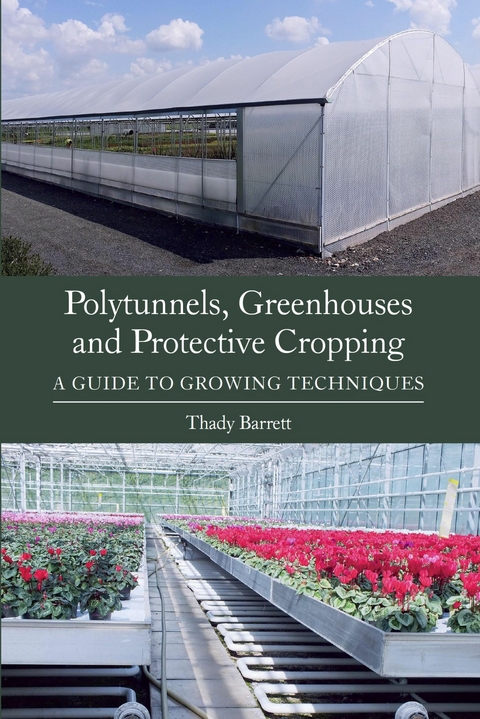
Polytunnels, Greenhouses and Protective Cropping (eBook)
301 Seiten
Crowood (Verlag)
978-1-78500-186-4 (ISBN)
Thady Barrett started his career at the former ADAS Experimental Horticulture Stations at Luddington and Lee Valley in the UK while studying horticulture at Writtle College in Essex. Subsequently, he gained the Royal Horticultural Society's NDH in Commercial Horticulture [now known as the MHort (RHA)] and an MHort degree. For many years Thady has been a member of the International Plant Producer's Society and has served as one of the Society's area secretaries. An expert in growing salad crops, ornamental plants and cut flowers, including chrysanthemums, for twenty years he was a senior lecturer in commercial horticulture at Writtle College. He is now a horticultural consultant and provides practical and technical advice to small and medium-sized ornamental plant nurseries.
This comprehensive book, written by an acknowledged expert, is packed with useful information and is an invaluable reference work that covers all aspects of protected horticulture. It discusses the appropriate siting for a greenhouse enterprise, and covers greenhouse design principles and commercial glasshouses. It also considers cladding materials, the development and use of polythene-clad tunnel structures, and greenhouse energy sources. The greenhouse environment, growing rooms, irrigation, composts and other growing media are examined as well as plant nutrients, fertilizers, pest and disease control, nursery hygiene and much more.
Thady Barrett started his career at the former ADAS Experimental Horticulture Stations at Luddington and Lee Valley in the UK while studying horticulture at Writtle College in Essex. Subsequently, he gained the Royal Horticultural Society's NDH in Commercial Horticulture [now known as the MHort (RHA)] and an MHort degree. For many years Thady has been a member of the International Plant Producer's Society and has served as one of the Society's area secretaries. An expert in growing salad crops, ornamental plants and cut flowers, including chrysanthemums, for twenty years he was a senior lecturer in commercial horticulture at Writtle College. He is now a horticultural consultant and provides practical and technical advice to small and medium-sized ornamental plant nurseries.
2
Commercial Glasshouses
A-FRAME GLASSHOUSES
Most glasshouse designs are based on the A frame as it is symmetrical and easily prefabricated before erection. However, in some climates growers may prefer a saw-tooth arrangement, and occasionally a lean-to, though the latter requires a back wall such as may be found in a traditional walled garden setting.
Whilst the following information is related to commercial horticultural enterprises raising crops, the needs of plant breeders and other research institutes are increasingly being recognized as having much higher standards of fittings and environmental control, often multi-compartmented with positive pressure atmospheres to keep out pests and diseases. Many greenhouse construction companies have experienced intense competition in the commercial greenhouse sector, so that tendering for specialist facilities such as for research, plant breeding, vertical farms projects, botanic gardens and garden centre buildings has become the norm. Also a wider view is taken, that the structure can be clad with anything that meets the client’s needs.
THE VENLO GREENHOUSE
The Venlo has a long history of providing a basic ‘standard’ greenhouse, widely adaptable and cheaper to build, resulting in it being the most popular model on which to base most greenhouse projects. The design has changed little, apart from, for example, widening the panes of glass further to reduce glazing bars and increase light interception.
The structure of the Venlo is multi-functional compared to conventional wide spans, mainly due to the trellis girder (lattice girder), which allows multiple spans based on the 3.2m width. The trellis girder allows easy installation of horizontal screens, suspended heating pipes, cropping gutters, spray booms and lighting. All the structure is made from galvanized steel. As so much of it can be prefabricated and hence standardized, the costs of production are kept very keen indeed and the same manufacturer will be supplying a number of greenhouse construction companies. Costs of steel do vary on the world market and of course may be subject to periods of volatile currency exchange rates: this needs to be considered in any agreement with the supplier.
Bay widths of 3.2m are standard, however some growers may wish to opt for 4m where maximum light levels are required. During the design stage it is important to determine the best width option to reflect the use of the greenhouse. Crop row layout and spacing or design of travelling benches, for example, need to be considered to ensure the optimum utilization of space. There can be up to four roof sections at a time supported using lattice girders between each row of load-bearing uprights, giving a working clear-floor area for crop culture using the 3.2m module of 6.4m (double span) through to 12.8m for the four-roof section.
Typical gutter height now starts at 3m, dependent on crop requirements. On newer projects an extended height on part of the facility – for example up to 7m in height – is used to accommodate centralized potting, grading and dispatch on the ground floor, along with an administrative office function and storage of packing materials on the upper floor. The higher the structure, the greater the wind factor that needs to be built in to the design specifications on loading.
Foundations consist of pre-sat concrete panels, block walls or concrete walls cast on site, typically 300mm high. Perimeter and internal upright posts are bolted on to concrete or steel foundation posts set into concrete.
New structure: the triple-bay Venlo being constructed.
Gutters are traditionally made of galvanized steel. However, gutters are increasingly made of aluminium because it allows complex profiles that, for example, accommodate a better seal for individual panes of glass, are more enclosed, and present a smoother profile, which further reduces heat loss from the structure. The modern gutter is quite complex in profile, and it is likely the grower will also want to specify a mechanism for collecting internal condensation, as well as directing rainwater into collecting vessels. With the increasing size of individual projects, rainfall patterns need to be considered in relation to the capacity of the guttering system to cope.
Ventilation consists of, typically, two or three pane ventilators fitted on one or both sides of the ridge, operated by motors using a push/pull mechanism. The layout of the vents allows independent opening on the windward and leeward sides of each ridge so that wind direction can be taken into consideration when ventilating. During installation these vents will alternate along the ridge, and may be further insect proofed with special netting.
For salad producers, live plant and associated hydroponic gulley loads need to be considered at the design stage, often associated with high-yielding crops such as tomatoes and cucumbers. For pot plant production there is now a need to incorporate mobile/travelling bench systems with the overhead capacity of being able to lift out individual benches when necessary.
Triple-span Venlo complete with travelling benches for seedling production.
Improvements in Venlo design over the years include better sealing of glass on to the glazing bars and overall structure in order to reduce heat loss. The lattice girder is a potential source of shadow, but other measures may be put in place to offset this, such as using diffuse glass, or by spacing aluminium glazing bars further apart and using wider panes of glass, or alternatively having a polythene clad roof system. Bridge Greenhouses in the UK now offer to run the lattice girder under the gutter (http://bridgegreenhouses.co.uk).
THE CABRIO GREENHOUSE
This style of greenhouse uses the Venlo dimensions and steel framework, but roof design is altered so that the entire roof opens to almost vertical from where it is hinged at the gutter. A continuous rack-and-pinion system is operated by axles supported by pillow block bearings, with each roof section having its own motor. Triple-strengthened glass is used to clad the roof, or alternatively polythene cladding can be used. The glass will be supported on all sides for maximum protection. This facility may be an option for growers who need to fully harden off their crop in situ.
As an alternative – though more for retail greenhouse environments – a one-in-three Cabrio may be considered, as this would lower costs and still provide good ventilation. A number of Dutch suppliers offer a range of alternatives (http://www.prinsgroup.co.uk).
WIDESPAN GREENHOUSE
An alternative double-skinned polythene greenhouse built by Vermako at Hill Brothers (UK), with a ventilation system that is hinged at the gutter and opens up to optimize ventilation.
Widespans of up to 16m are available, dependent on manufacturer and often used in retail where clutter-free floor space is considered to be of greater importance. Suppliers offer a range of cladding options from glass, composite cladding, polycarbonate and impact-resistant PVC. In climates where there is the risk of significant snow loading in winter months, this type of structure is popular as a single non-linked standalone facility that best avoids snow loads in any greenhouse valleys. They are often fitted with continuous roof-ridge ventilation on one or both sides, which uses a motor-driven rack-and-pinion opening system – traditionally this may have been a manual chain-and-drive wheel mechanism.
Traditional widespan with insect-proof side vents for fan ventilation in this research greenhouse.
Widespan with continuous ridge ventilation, and side ventilation via a rack-and-pinion system.
NEWER STRUCTURES
Curved Greenhouse Clad with Glass
There are a few examples where curved roof structures are clad with glass. The basis of the design consists of single roof sheets that extend from gutter to ridge, made from tempered glass that is ‘bent’ into position. Westbrook greenhouse systems in the USA have installed such a multi-bay, gutter-connected, commercial growing structure (http://westbrooksystems.com). In the UK, the Royal Horticultural Society (RHS) has also used large sheets of curved glass in their new display greenhouse.
The use of curved glass in this way adds strength to the structure. Large sheets improve light interception, and direct condensation to run down the inside towards the gutter, where it can be collected.
Fully Opening Structures
The current take-up for this type of greenhouse is mainly for areas of protected plant display in some of the larger garden centres, where the comfort of customers and the ability to continue shopping despite the weather appeals to plant area managers. Additional benefits include keeping the worst of the weather such as wind, rain and hail from damaging the instant impulse appeal/condition of plants. The heat-retaining ability is therefore not an issue in this environment, though frost protection is an option.
However, producers for hardy nursery crops, and even bedding plant growers who wish to harden off plants in situ, are taking an interest in these, recognizing the advantages they can have over a conventional glasshouse. For hardy perennial growth, the ability in the spring to bring on herbaceous perennials and alpines that have been overwintered under protection helps to kick-start the season earlier and maintain the quality of the new growth, as...
| Erscheint lt. Verlag | 21.12.2016 |
|---|---|
| Verlagsort | London |
| Sprache | englisch |
| Themenwelt | Sachbuch/Ratgeber ► Natur / Technik ► Garten |
| Naturwissenschaften ► Biologie | |
| Technik | |
| Weitere Fachgebiete ► Land- / Forstwirtschaft / Fischerei | |
| Schlagworte | floristry • horticulture • market gardening • viticulture |
| ISBN-10 | 1-78500-186-8 / 1785001868 |
| ISBN-13 | 978-1-78500-186-4 / 9781785001864 |
| Informationen gemäß Produktsicherheitsverordnung (GPSR) | |
| Haben Sie eine Frage zum Produkt? |
 EPUB (Adobe DRM)
Kopierschutz: Adobe-DRM
Adobe-DRM ist ein Kopierschutz, der das eBook vor Mißbrauch schützen soll. Dabei wird das eBook bereits beim Download auf Ihre persönliche Adobe-ID autorisiert. Lesen können Sie das eBook dann nur auf den Geräten, welche ebenfalls auf Ihre Adobe-ID registriert sind.
Details zum Adobe-DRM
Dateiformat: EPUB (Electronic Publication)
EPUB ist ein offener Standard für eBooks und eignet sich besonders zur Darstellung von Belletristik und Sachbüchern. Der Fließtext wird dynamisch an die Display- und Schriftgröße angepasst. Auch für mobile Lesegeräte ist EPUB daher gut geeignet.
Systemvoraussetzungen:
PC/Mac: Mit einem PC oder Mac können Sie dieses eBook lesen. Sie benötigen eine
eReader: Dieses eBook kann mit (fast) allen eBook-Readern gelesen werden. Mit dem amazon-Kindle ist es aber nicht kompatibel.
Smartphone/Tablet: Egal ob Apple oder Android, dieses eBook können Sie lesen. Sie benötigen eine
Geräteliste und zusätzliche Hinweise
Buying eBooks from abroad
For tax law reasons we can sell eBooks just within Germany and Switzerland. Regrettably we cannot fulfill eBook-orders from other countries.
aus dem Bereich