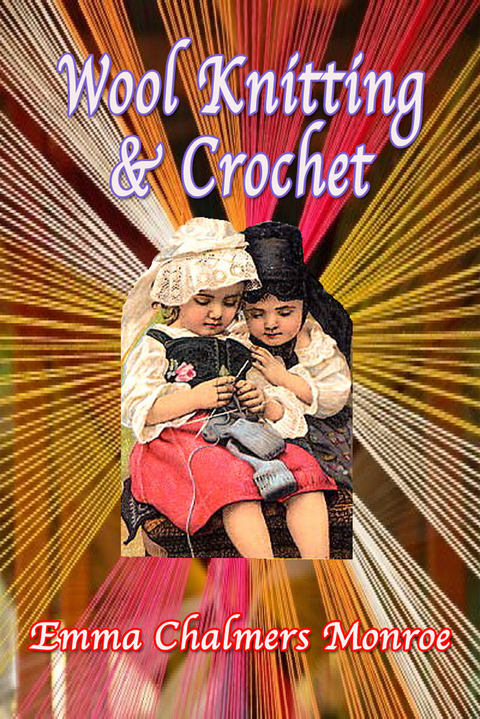
Wool Knitting & Crochet (eBook)
78 Seiten
Publishdrive (Verlag)
978-1-300-74131-2 (ISBN)
This book is equally appreciated by beginner or expert. It contains most valuable information and instructions for everyone who crochets or wishes to learn to do this beautiful work. It embodies a very careful selection of designs; and, from the simplest to the most ornate, every successive step is explained and illustrated so fully that perfect results are a certainty.
It describes the making of the newest designs for the ever popular use of crochet and gives instructions and patterns for Edgings, Borders, Scarf-Ends, Insertions, Yokes, Lunch-Sets, Doilies, etc.
A Lesson in Knitting
The first thing to be done in knitting is to cast on or, as it is sometimes called, to 'set up the foundation.' (Figure 1). There are several methods for this, the following being that preferred and generally used by the writer: Leave a spare end of thread, sufficient for the number of stitches you wish to cast on, lying toward the left, the spool or ball from which the working-thread is drawn being at the right. Lay the thread between the little finger and the third of the left hand; bring the working-thread across the palm of the hand, around the thumb and back between the forefinger and second finger; bend the forefinger over this thread (which passes between it and the second finger), pass it under the thread which crosses the palm of the hand, and then draw the forefinger back, or straighten it, which will give you a loop with crossed threads. Put the needle under the lower part of this loop, which draws from the ball, bring the working-thread (or ball-thread) around the point of needle from right to left, as in plain knitting, draw it back through the loop, slip off the latter, and draw up the left thread. Then proceed to make the crossed loop and knit it off in the same way for the next and following stitches. The whole operation is very simple, although the instructions seem long because explicit. Take your needle and yarn or thread and follow them through carefully, and you will very soon master the 'crossed casting on.'
Another method, preferred by many and practically the same in effect, except that the edge is not quite so firm, is as follows: Loop the thread around the left forefinger, holding the spare end between thumb and second finger, pass the needle upward through the loop, pass the thread around the point, draw back through the loop, slip off the latter and pull up the spare thread. By passing the needle under the loop, or lower thread, instead of through it, bringing it back through, and then knitting off, you will really get the crossed loop, and many find this method easier than the first. The thread used in casting on may be doubled, particularly for beginning a stocking, mitten, or any article where much wear comes.
Casting on may also be done with two needles, and many like this method when there are many stitches. Twist a loop around the needle held in the left hand, bring the end of thread, or spare thread, to the front, crossing the working-thread to hold it in place-or, if preferred, simply tie a slip-knot and put the loop on the left needle; insert the right needle through this loop from left to right, put thread around point of right needle and draw through the loop, bringing the right needle again in front of left. Thus far, the process is quite like that of plain knitting. Keeping the right needle still in the new stitch or loop, transfer the stitch to the left needle by bringing the latter in front and putting the point through the loop from front to back, leaving the right needle in place for the next stitch; the loops are not slipped off, as in knitting plain, but transferred, so that all are kept on the needle. A little practise will enable one to cast on thus very rapidly and evenly.
This book is equally appreciated by beginner or expert. It contains most valuable information and instructions for everyone who crochets or wishes to learn to do this beautiful work. It embodies a very careful selection of designs; and, from the simplest to the most ornate, every successive step is explained and illustrated so fully that perfect results are a certainty.It describes the making of the newest designs for the ever popular use of crochet and gives instructions and patterns for Edgings, Borders, Scarf-Ends, Insertions, Yokes, Lunch-Sets, Doilies, etc.A Lesson in KnittingThe first thing to be done in knitting is to cast on or, as it is sometimes called, to "e;set up the foundation."e; (Figure 1). There are several methods for this, the following being that preferred and generally used by the writer: Leave a spare end of thread, sufficient for the number of stitches you wish to cast on, lying toward the left, the spool or ball from which the working-thread is drawn being at the right. Lay the thread between the little finger and the third of the left hand; bring the working-thread across the palm of the hand, around the thumb and back between the forefinger and second finger; bend the forefinger over this thread (which passes between it and the second finger), pass it under the thread which crosses the palm of the hand, and then draw the forefinger back, or straighten it, which will give you a loop with crossed threads. Put the needle under the lower part of this loop, which draws from the ball, bring the working-thread (or ball-thread) around the point of needle from right to left, as in plain knitting, draw it back through the loop, slip off the latter, and draw up the left thread. Then proceed to make the crossed loop and knit it off in the same way for the next and following stitches. The whole operation is very simple, although the instructions seem long because explicit. Take your needle and yarn or thread and follow them through carefully, and you will very soon master the "e;crossed casting on."e;Another method, preferred by many and practically the same in effect, except that the edge is not quite so firm, is as follows: Loop the thread around the left forefinger, holding the spare end between thumb and second finger, pass the needle upward through the loop, pass the thread around the point, draw back through the loop, slip off the latter and pull up the spare thread. By passing the needle under the loop, or lower thread, instead of through it, bringing it back through, and then knitting off, you will really get the crossed loop, and many find this method easier than the first. The thread used in casting on may be doubled, particularly for beginning a stocking, mitten, or any article where much wear comes.Casting on may also be done with two needles, and many like this method when there are many stitches. Twist a loop around the needle held in the left hand, bring the end of thread, or spare thread, to the front, crossing the working-thread to hold it in place or, if preferred, simply tie a slip-knot and put the loop on the left needle; insert the right needle through this loop from left to right, put thread around point of right needle and draw through the loop, bringing the right needle again in front of left. Thus far, the process is quite like that of plain knitting. Keeping the right needle still in the new stitch or loop, transfer the stitch to the left needle by bringing the latter in front and putting the point through the loop from front to back, leaving the right needle in place for the next stitch; the loops are not slipped off, as in knitting plain, but transferred, so that all are kept on the needle. A little practise will enable one to cast on thus very rapidly and evenly.
| Erscheint lt. Verlag | 27.12.2016 |
|---|---|
| Sprache | englisch |
| Themenwelt | Sachbuch/Ratgeber ► Freizeit / Hobby ► Handarbeit / Textiles |
| Sachbuch/Ratgeber ► Freizeit / Hobby ► Heimwerken / Do it yourself | |
| Sachbuch/Ratgeber ► Freizeit / Hobby ► Kreatives Gestalten | |
| Schlagworte | Knitting • Wool |
| ISBN-10 | 1-300-74131-7 / 1300741317 |
| ISBN-13 | 978-1-300-74131-2 / 9781300741312 |
| Informationen gemäß Produktsicherheitsverordnung (GPSR) | |
| Haben Sie eine Frage zum Produkt? |
 EPUB (Ohne DRM)
Digital Rights Management: ohne DRM
Dieses eBook enthält kein DRM oder Kopierschutz. Eine Weitergabe an Dritte ist jedoch rechtlich nicht zulässig, weil Sie beim Kauf nur die Rechte an der persönlichen Nutzung erwerben.
Dateiformat: EPUB (Electronic Publication)
EPUB ist ein offener Standard für eBooks und eignet sich besonders zur Darstellung von Belletristik und Sachbüchern. Der Fließtext wird dynamisch an die Display- und Schriftgröße angepasst. Auch für mobile Lesegeräte ist EPUB daher gut geeignet.
Systemvoraussetzungen:
PC/Mac: Mit einem PC oder Mac können Sie dieses eBook lesen. Sie benötigen dafür die kostenlose Software Adobe Digital Editions.
eReader: Dieses eBook kann mit (fast) allen eBook-Readern gelesen werden. Mit dem amazon-Kindle ist es aber nicht kompatibel.
Smartphone/Tablet: Egal ob Apple oder Android, dieses eBook können Sie lesen. Sie benötigen dafür eine kostenlose App.
Geräteliste und zusätzliche Hinweise
Buying eBooks from abroad
For tax law reasons we can sell eBooks just within Germany and Switzerland. Regrettably we cannot fulfill eBook-orders from other countries.
aus dem Bereich