Positive Thinking (eBook)
John Wiley & Sons (Verlag)
978-0-85708-691-4 (ISBN)
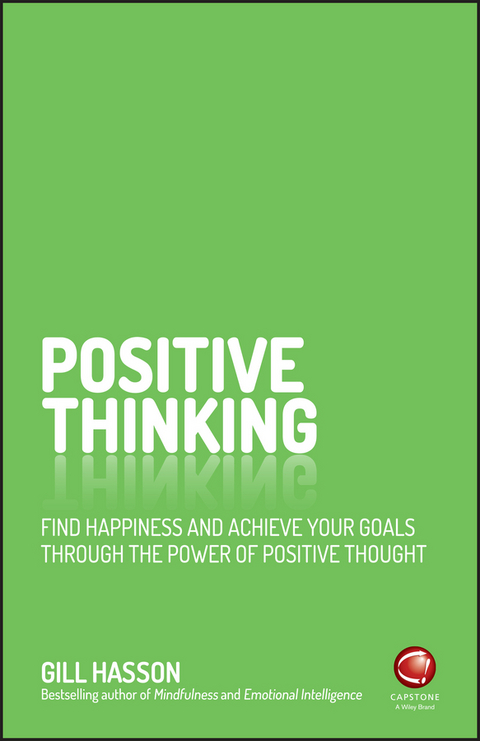
Are you stuck in a rut? Do you feel plagued by negative thoughts and emotions every day? Gill Hasson, the bestselling author of Mindfulness and Emotional Intelligence, is back to help you move on from those pesky negative emotions and focus on the positive instead, Gill's practical and reassuring approach to the benefits of positive thinking will have you applying it to your own life every day,
If you struggle to see past setbacks both at work and at home, it can be tricky not to let those negative emotions affect you in every area of your life, This book will give readers the tools to view life with a positive outlook and charge ahead in achieving goals that once seemed out of reach,
Learn how to:
- Identify the triggers for negative thoughts and understand how to turn them into positive ones
- Deal with setbacks and make the most out of negative situations
- Improve your happiness by accepting situations and learning how to move forward
- Understand how the power of positive thinking can help you achieve your goals
The power of positive thinking is not a new idea; it's been around long enough to become almost a cliché, but there's a reason behind its longevity: positivity works, This book shows you how to break through the clouds today, and start working toward the life you want,
Gill Hasson is a bestselling personal development author, whose reassuring approach has helped thousands of people develop and understand the skills they need to lead a more peaceful, stress-free life, She works with people from diverse backgrounds and situations, Her key motivation is her belief in the ability of people to positively change their way of thinking - about life, other people, and themselves, She works in adult education, is an associate tutor at the University of Sussex, and delivers training for QA, one of the UK's largest training providers, and Mumsnet, the UK's largest website for parents,
Gill is a freelance journalist and writes articles on personal development and?relationships for a variety of magazines, including Psychologies and Take A Break, and for a number of websites,
With Sue Hadfield she is the author of two books, How to be Assertive in Any Situation and Bounce: Use the Power of Resilience to Live the Life You Want, She is the sole author of Brilliant Communication Skills, Brilliant Emotional Intelligence (both published by Pearson), and with Capstone has published Mindfulness, Emotional Intelligence, How to Deal with Difficult Peopl, which reached the #3 spot in the Sunday Times Bestseller list, Mindfulness Pocketbook and Overcoming Anxiety,
Bestselling author Gill Hasson is back to help you learn how the power of positive thinking can change your life Are you stuck in a rut? Do you feel plagued by negative thoughts and emotions every day? Gill Hasson, the bestselling author of Mindfulness and Emotional Intelligence, is back to help you move on from those pesky negative emotions and focus on the positive instead. Gill's practical and reassuring approach to the benefits of positive thinking will have you applying it to your own life every day. If you struggle to see past setbacks both at work and at home, it can be tricky not to let those negative emotions affect you in every area of your life. This book will give readers the tools to view life with a positive outlook and charge ahead in achieving goals that once seemed out of reach. Learn how to: Identify the triggers for negative thoughts and understand how to turn them into positive ones Deal with setbacks and make the most out of negative situations Improve your happiness by accepting situations and learning how to move forward Understand how the power of positive thinking can help you achieve your goals The power of positive thinking is not a new idea; it's been around long enough to become almost a clich , but there's a reason behind its longevity: positivity works. This book shows you how to break through the clouds today, and start working toward the life you want.
Gill Hasson has 20 years' experience teaching and writing on a range of issues to do with personal and professional development, mental health and wellbeing. She is the author of more than 22 books; the bestselling 'Mindfulness', 'Mindfulness Pocketbook', 'Emotional Intelligence' 'Positive Thinking' the Sunday Times bestseller 'How to Deal with 'Difficult People', plus other books on the subjects of resilience, communication skills and assertiveness. Gill also writes books for children. She's written 8 books in the 'We Can Cope' series, including 'Put Your Worries Away.' You can contact Gill by email at gillhasson@btinternet.com.
Introduction 1
Part 1 Positive Thinking and Positive Action 9
1 You Are What You Think 11
2 Moving on from Negative Thinking 37
3 Taking Positive Action 55
Part 2 Developing and Maintaining Positive Thinking 75
4 Finding and Keeping Motivation 77
5 Creating a Positive Mindset 97
6 Building Your Self-Esteem and Confidence 119
Part 3 Positive Thinking for Difficult Situations 137
7 Dealing with Disappointments and Setbacks, Trauma and Tragedy 139
8 Managing a Fear of Failure, Perfectionism and Comparing Yourself with Others 169
Conclusion 187
Useful Websites 191
About the Author 193
Index 195
2
Moving on from Negative Thinking
Recognize negative self-talk
Happiness doesn't depend on how few negative thoughts you have, but on what you do with the ones you have.
Lisa Esile
Because the way you think is habitual, you usually don't even recognize the nature of your thoughts and reactions to events. In fact, your negative thoughts are so powerful because you rarely have conscious awareness or control over them. You simply accept your thoughts and respond accordingly.
The first step, then, in managing negative thinking is simply to become more aware of it; to identify the way you think and to recognize your ‘explanatory style’. Once you are more aware of your negative self-talk you can start to do something about it.
Chapter 1 will have given you an insight into the ways that you think. You can increase your awareness further by writing down some of your thoughts; thoughts about past, current or future events. Here are some ideas for how you could do that:
Past events
- Recall a couple of relatively unimportant events that were minor annoyances. For example, a travel delay, an event that got cancelled, something you lost. What thoughts went through your mind or could have been going through your mind? For example, if you missed the bus or train your thought may have been: ‘Why does this always happen to me?’ Write down what your thoughts and feelings were.
- Next think of bigger events – a job, a project at work, a holiday, a relationship or friendship where things didn't turn out well. What thoughts went through your mind or could have been going through your mind? How did you feel? Write it down.
Future events
- Think of an upcoming event that you're feeling unsure about; something you've got to do, somewhere you've got to go, someone you have to talk to, people you've got to meet. Whatever it is, what are your thoughts about it?
- Think of something good coming up; meeting up with friends, a holiday or a family celebration, for example. What thoughts and feelings do you have about it? Are they mostly positive or negative? Again, write them down.
- Think of something you would like to do in future – travel somewhere, follow an interest or hobby, change your career direction, leave a job or relationship – but haven't done yet. Write down your thoughts and feelings about it.
Present events
- Over the course of the next few days, write down your thoughts and feelings about situations and events. Either write down your thoughts on paper (keep a pen and paper handy) text or email them to yourself, or make use of an app such as the Thought Diary Pro (an app designed to help people record unhelpful thoughts and beliefs). You won't be aware of every single thought, but when you do notice a negative thought, write it down. Don't pass any judgement on yourself for having this thought. Just be aware of it and write it down.
- Ask someone who you like and trust – a friend, partner, family member – to point out, over the next week or so, when they think you've made a negative comment. Write each one down.
- Use your feelings to alert you to how you are thinking: whenever you are feeling worried, stressed, annoyed or upset, stop and become aware of your thoughts. Write down your thoughts.
As well as being more aware of individual negative thoughts, you may notice a pattern or theme emerging. You may realize that you're inclined to jump to conclusions or that you get caught up in tunnel thinking or catastrophizing. You may notice, too, what sort of events and experiences trigger your negative thoughts. Once you're more aware of your negative thoughts, you're in a better position to disempower them and to use them as a cue for positive action.
There are two approaches. The first approach involves challenging and replacing negative thinking. The second approach involves simply accepting negative thoughts and moving on to positive thoughts and actions.
Challenging and replacing negative thinking
Challenging negative thoughts can help you to see whether your view is reasonable and helpful. What you don't want to do, though, is to start arguing with yourself. Simply telling yourself you're ‘wrong’ to think the way you do won't work. You won't win! Your negative thoughts will probably win because they are so strongly established.
Instead, start by asking yourself ‘Are these thoughts helping me?’ Think about how your thinking is helping your situation.
For example, if, a few weeks before a driving test you think ‘I’m going to fail my driving test. I'll be hopeless', the answer to the question ‘Is this thought helping me?’ could actually be ‘Yes, it is helping me. It's making me realize I need to practise more.’ But if an hour before the test, you think ‘I’m going to fail my driving test. I'll be hopeless', then the thought is probably not helping you. Instead, it's overwhelming you and undermining your ability to think straight! It would be more helpful just to replace your negative thoughts with positive ones, such as, ‘I’ve been taught well. I'll do the best I can.'
Let's take another example: imagine that yesterday you stayed at work an hour late to complete a report for your manager. This morning she tells you she doesn't need it for the meeting any more.
You think: ‘She must know how much time I spent writing this up! I’ve done all that for nothing. Again. What a complete waste of time. She's obviously decided to wind me up.'
Ask yourself, ‘In what way are these thoughts helpful?’
When you ask yourself ‘Is this thought helpful?’ you are not disputing the accuracy of your thoughts – maybe it was a waste of time, maybe she is trying to wind you up – but right now, regardless of their accuracy, these thoughts probably aren't helping you. They're preventing you from coming up with any solutions.
Are you certain?
The next step is to confront the certainty with which you feel your thoughts are absolutely right. Remember, if you are in the habit of negative thinking, it has become your default position – your mind automatically takes and accepts a negative perspective without considering any other options.
So now you are challenging your mind's automatic negative perspective and recognize that there are other possibilities.
Here are some questions you could ask yourself:
- Am I positive that what I'm thinking is true?
- What evidence do I have for how I'm thinking about this situation?
- Do I know that for certain?
- Am I 100% sure?
Alternative perspectives
By challenging your automatic negative thoughts, by loosening your grip on what you are certain of, you free yourself to start thinking and responding in more positive ways.
Questions you could ask yourself next are:
- What is the evidence against the way I'm thinking about this situation/event?
- What other explanations are there for what happened, is happening or could happen?
- Is there anything positive and good about the situation?
In the example of the report that your manager no longer needed, it could be that the positive aspect of the situation was that you got more practice working on this kind of report. And, although your manager doesn't need the information now, it could be useful in future.
Recognizing that the way you're thinking doesn't make you feel good, or help you to get what you want, can prompt you to look at things from a different perspective.
So if, for example, you're forced to change your holiday plans and you think ‘Why does this always happen to me? My plans are all ruined’, ask yourself: ‘In what way is this thought helpful? (‘It's not helpful. It's just winding me up and making me feel sorry for myself.’) ‘Am I certain my plans are actually ruined?’ (‘Well no, they’re not completely ruined. I'll think of an alternative place to go.') ‘Is there anything positive about the situation?’ (‘Yes. I still have a week off work and my friend is still able to go with me.’)
As well as loosening your grip on what you think you're certain of, challenging your negative thoughts not only interrupts your thoughts but it also stops them from snowballing.
Replacing negative thinking with positive thinking
When you're in the habit of thinking and interpreting events in a negative way, it's not easy to say positive things to yourself. It's also not easy to say positive things to yourself when you're worried, stressed or upset. It's not easy but it is possible.
A few years ago, shortly after leaving university, Sam was offered a position in business administration at a large company in Manchester.
I used to get into a right state about attending...
| Erscheint lt. Verlag | 29.11.2016 |
|---|---|
| Sprache | englisch |
| Themenwelt | Sachbuch/Ratgeber ► Beruf / Finanzen / Recht / Wirtschaft ► Bewerbung / Karriere |
| Wirtschaft ► Betriebswirtschaft / Management ► Planung / Organisation | |
| Wirtschaft ► Betriebswirtschaft / Management ► Unternehmensführung / Management | |
| Schlagworte | acceptance • Achieving goals • becoming happier • Business & Management • Business Self-Help • confidence • finding happiness • gill hasson • goal fulfillment • How to be happy • moving on • Negative People • negativity triggers • optimism • overcoming setbacks • Personal development • Personal improvement • personal psychology • pop psychology • positive attitude • positive outlook • positive psychology • positive thinking • Positive Thinking Find happiness and contentment through the power of positive thought • positive thinking techniques • Positivity • positivity benefits • power of positive thinking • practical positivity • practising positivity • Ratgeber Wirtschaft • Reducing Anxiety • reducing stress • Resilience • Self-Help • self-improvement • Wirtschaft /Ratgeber • Wirtschaft u. Management |
| ISBN-10 | 0-85708-691-X / 085708691X |
| ISBN-13 | 978-0-85708-691-4 / 9780857086914 |
| Informationen gemäß Produktsicherheitsverordnung (GPSR) | |
| Haben Sie eine Frage zum Produkt? |
 EPUB (Adobe DRM)
Kopierschutz: Adobe-DRM
Adobe-DRM ist ein Kopierschutz, der das eBook vor Mißbrauch schützen soll. Dabei wird das eBook bereits beim Download auf Ihre persönliche Adobe-ID autorisiert. Lesen können Sie das eBook dann nur auf den Geräten, welche ebenfalls auf Ihre Adobe-ID registriert sind.
Details zum Adobe-DRM
Dateiformat: EPUB (Electronic Publication)
EPUB ist ein offener Standard für eBooks und eignet sich besonders zur Darstellung von Belletristik und Sachbüchern. Der Fließtext wird dynamisch an die Display- und Schriftgröße angepasst. Auch für mobile Lesegeräte ist EPUB daher gut geeignet.
Systemvoraussetzungen:
PC/Mac: Mit einem PC oder Mac können Sie dieses eBook lesen. Sie benötigen eine
eReader: Dieses eBook kann mit (fast) allen eBook-Readern gelesen werden. Mit dem amazon-Kindle ist es aber nicht kompatibel.
Smartphone/Tablet: Egal ob Apple oder Android, dieses eBook können Sie lesen. Sie benötigen eine
Geräteliste und zusätzliche Hinweise
Buying eBooks from abroad
For tax law reasons we can sell eBooks just within Germany and Switzerland. Regrettably we cannot fulfill eBook-orders from other countries.
aus dem Bereich