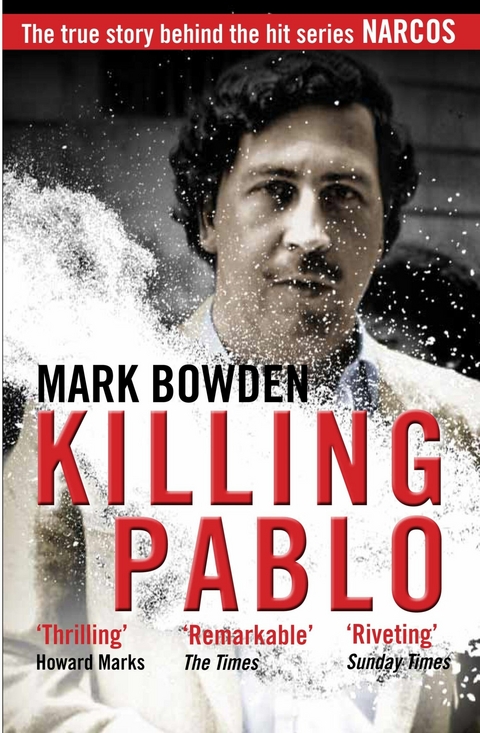
Killing Pablo (eBook)
400 Seiten
Atlantic Books (Verlag)
978-1-84887-267-7 (ISBN)
Mark Bowden is the bestselling author of Killing Pablo (Atlantic 2002), Finders Keepers (Atlantic 2003), Guests of the Ayatollah (Atlantic 2006) and Black Hawk Down, which was made into a successful film by Ridley Scott. Guests of the Ayatollah is his latest book. He is a national correspondent for the Atlantic Monthly.
The bestselling blockbusting story of how American Special Forces hunted down and assassinated the head of the world's biggest cocaine cartel. Killing Pablo charts the rise and spectacular fall of the Columbian drug lord, Pablo Escobar, the richest and most powerful criminal in history. The book exposes the massive illegal operation by covert US Special Forces and intelligence services to hunt down and assassinate Escobar. Killing Pablo combines the heart-stopping energy of a Tom Clancy techno-thriller and the stunning detail of award-winning investigative journalism. It is the most dramatic and detailed and account ever published of America's dirtiest clandestine war.
Mark Bowden is the author of eleven books, including the #1 New York Times bestseller Black Hawk Down. He reported at The Philadelphia Inquirer for twenty years and now writes for Vanity Fair, The Atlantic and other magazines. His most recent book is The Finish: The Killing of Osama bin Laden.
1
In time, no one in Colombia knew Pablo Escobar better than Colonel Hugo Martinez of La Policía Nacional de Colombia (PNC), even though the two men had never met. The tall, taciturn man who was nicknamed “Flaco” (Skinny) knew Pablo better than even the drug boss’s closest family members and henchmen, because there were things he would say and do before his associates that he would not before his family, and there was a side of him that his family saw that he showed to no one else. The colonel saw it all. He knew Pablo intimately. He recognized his voice, knew his habits, when he slept, when and how he moved, what he liked to eat, what his favorite music was, how it was that criticism written or broadcast against him infuriated him but how he delighted in any political cartoon that portrayed him, no matter how crudely. The colonel knew what kind of shoes Pablo wore (white Nikes), what kind of sheets he liked on his bed, the preferred age of his sexual partners (girls of fourteen or fifteen, usually), his taste in art, his handwriting, the pet name he had for his wife (“Tata”), even what kind of toilet he preferred to use—since he had new facilities installed in all of his hideouts, and they were always the same. The colonel felt he understood Pablo, could see the world through his eyes, how he felt unjustly hounded and persecuted (mostly, nowadays, by the colonel). Martinez understood this last part so well he could sympathize with it, at times. There was truth even in the worldview of a monster, and the colonel believed he was chasing a monster. He never grew to hate Pablo, although he did fear him.
On August 18,1989, the same day that Pablo’s sicarios killed front-running presidential candidate Luis Galán, another group of his hit men killed PNC colonel Waldemar Franklin, chief of the Antioquian police. Franklin and Colonel Martinez had been friends. They had come up together through the ranks. When Franklin was assigned to Antioquia, Martinez and the other top officers in the PNC knew there would be trouble for the Medellín cartel. Franklin couldn’t be bought or bullied. He had steered the raid that rousted Pablo in his underpants from the mansion outside Medellín that spring, one of his closest calls yet, and Franklin’s men had recently raided a cartel laboratory and seized four metric tons of cocaine. This was bad enough, but Franklin sealed his fate when his men stopped Pablo’s wife, Maria Victoria, and his children, Juan Pablo and Manuela, at a road block. The drug boss’s family was taken to police headquarters in Medellín, where they were held for hours before Pablo’s lawyers negotiated their release. Pablo would later complain to Roberto Uribe that Maria Victoria had been refused permission to give Manuela a bottle of milk. Pablo had always denied ordering the murder of Galán, but to Uribe he admitted that he had ordered Franklin killed over that bottle of milk.
Galán’s killing had the anticipated effect. President Barco launched an all-out war against the cartel. He suspended habeas corpus, which meant people could be arrested and detained without being charged with a crime, and once again he authorized army and police to seize the cartel leaders’ luxurious fincas. Shadow ownership of property was declared a crime, which made it harder for Pablo and the other narcos to disguise their holdings. But the biggest step Barco took was to invite further American help in this growing fight.
The narcos could see the United States government closing in on them. The kingpins had all been indicted by the U.S. Justice Department, most of them, like Pablo, more than once. They knew the DEA had been active in the country for years. Having long since compromised the Colombian police and military, they were holding their own at home, but President Bush had campaigned in 1988 saying he favored taking direct military action against traffickers in other countries. It was clear which “other country” he had in mind. Colombia was the source of nearly 80 percent of the cocaine making its way to the United States. In April 1986 President Reagan had signed a classified National Security Decision Directive that declared the flow of drugs across U.S. borders to be a “national security threat,” which opened the door to U.S. military involvement Bush had headed a cabinet-level task force against drugs as vice president. As president, he declared war on drugs. Just weeks after Galán’s murder, Bush signed National Security Directive 18, calling for more than $250 million worth of military, law enforcement, and intelligence assistance to fight the Andean drug cartels over five years. A week later he authorized another $65 million in emergency military aid to Colombia alone, and he authorized sending a small number of U.S. Special Forces troops to Colombia to train its police and military in rapid-strike tactics. He followed that a month later with his Andean Initiative, which called for “a major reduction in the supply of cocaine.” Bush told reporters, “The rules have changed. When requested, we will for the first time make available the appropriate resources of America’s armed forces.” Bush had always pledged that military action would depend on the approval of the host country, but even that caveat had begun to erode. In June 1989, the newly appointed U.S. drug czar, William J. Bennett, had all but advocated sending U.S. military hit squads to kill the infamous narcos. “We should do to the drug barons what our forces in the Persian Gulf did to Iran’s navy,” he had said. Stories from Washington, all of them read carefully at the breakfast tables of narcos in Colombia, revealed that senior U.S. officials were weighing such steps, and that the U.S. Justice Department was working on an opinion that would approve unilateral U.S. military action against narcos and terrorists in other countries, with or without the approval of host governments.
Indeed, in August of that year the army’s counterterrorism unit, Delta Force, had prepared to raid a house in Panama where Pablo was reported to be staying. The plan called for Delta to seize him and then turn him over to DEA agents, who would arrive after the drug boss was in custody. The raid was called off when agents discovered that the reports were false; Pablo had not left Colombia. Nevertheless, the aborted mission showed how much the rules had changed under Bush. Over the next five years, the United States would basically underwrite a secret war in Colombia. U.S. spending for international antidrug efforts would grow from less than $300 million in 1989 to more than $700 million by 1991—and those dollars didn’t even reflect the sums spent on the secret military and spy units deployed. The U.S. might have been considering acting unilaterally, if necessary, but Bush clearly preferred cooperation from Colombia. Barco had resisted opening that door until Galán’s murder. That had changed everything.
In the four months after Galán’s death, Barco’s government shipped more than twenty suspected drug traffickers to the United States for trial. And with the new bonanza of American assistance, Barco created special police units, one of which was based in Medellín and was dedicated to hunting down José Rodríguez Gacha, the Ochoa brothers, and Pablo Escobar. It was called the Bloque de Búsqueda, or Search Bloc. This was the command given to Colonel Martinez. It was a position he’d neither sought nor desired. Nobody wanted it. It was considered so dangerous that the PNC decided the command would be rotated monthly, like a hot potato.
There was, of course, a great flourish of official encouragement and praise when it was announced that Martinez was to be awarded the post first. With his wry sense of humor and practical bent, the colonel saw this for what it was and accepted the task grimly. He wasn’t an obvious choice. There were better commanders, men with more field experience who had already distinguished themselves in combat against narcos or guerrillas. There were better investigators, men with impressive records tracking down fugitives. But these were all men who, because of their successful careers, had sufficient clout to duck an unwanted assignment. The colonel was quiet and bookish, with an aloof manner that seemed ill suited to leading men in the field. Tall and fair-skinned, he looked more European than Colombian. He was forty-eight, at a point in life where a man feels it is now or never for his life’s goals. He was from Mosquera, a pretty little mountain village a few hours east of Bogotá, a place out of some timeless story of Colombian legend. Flowers cascaded down steep cultivated slopes to a central market and park, where on evenings, weekends, and holidays townspeople congregated and strolled. The colonel was the son of a local businessman who ran a cafeteria and worked in a store. He had joined the police force right out of high school. One of his older school buddies, José Serrano, had gone to the academy a year before, and seeing him return home in his cadet’s uniform excited Martinez, prompting him to enlist. When he completed his courses at the academy in Bogotá, he was given a variety of postings, including station commander in the small town of Perreda, where he was promoted to chief of investigations. He went to law school at night during those years, and when he finished, the department sent him to Spain for a course in criminology. He married, and his wife bore him three sons and a daughter. In the years that followed, through most...
| Erscheint lt. Verlag | 1.10.2009 |
|---|---|
| Zusatzinfo | 1x8pp b/w plates |
| Verlagsort | London |
| Sprache | englisch |
| Themenwelt | Literatur ► Biografien / Erfahrungsberichte |
| Literatur ► Romane / Erzählungen | |
| Sachbuch/Ratgeber ► Geschichte / Politik | |
| Sachbuch/Ratgeber ► Gesundheit / Leben / Psychologie ► Esoterik / Spiritualität | |
| Recht / Steuern ► Strafrecht ► Kriminologie | |
| Sozialwissenschaften ► Politik / Verwaltung | |
| Schlagworte | Cocaine • Colombia • drug smuggling • Escobar • House of Cards • Law enforcement • medellin cartel • Narcos • police procedure • robert mazur • Secret Service • the infiltrator • True Crime |
| ISBN-10 | 1-84887-267-4 / 1848872674 |
| ISBN-13 | 978-1-84887-267-7 / 9781848872677 |
| Informationen gemäß Produktsicherheitsverordnung (GPSR) | |
| Haben Sie eine Frage zum Produkt? |
 EPUB (Wasserzeichen)
DRM: Digitales Wasserzeichen
Dieses eBook enthält ein digitales Wasserzeichen und ist damit für Sie personalisiert. Bei einer missbräuchlichen Weitergabe des eBooks an Dritte ist eine Rückverfolgung an die Quelle möglich.
Dateiformat: EPUB (Electronic Publication)
EPUB ist ein offener Standard für eBooks und eignet sich besonders zur Darstellung von Belletristik und Sachbüchern. Der Fließtext wird dynamisch an die Display- und Schriftgröße angepasst. Auch für mobile Lesegeräte ist EPUB daher gut geeignet.
Systemvoraussetzungen:
PC/Mac: Mit einem PC oder Mac können Sie dieses eBook lesen. Sie benötigen dafür die kostenlose Software Adobe Digital Editions.
eReader: Dieses eBook kann mit (fast) allen eBook-Readern gelesen werden. Mit dem amazon-Kindle ist es aber nicht kompatibel.
Smartphone/Tablet: Egal ob Apple oder Android, dieses eBook können Sie lesen. Sie benötigen dafür eine kostenlose App.
Geräteliste und zusätzliche Hinweise
Buying eBooks from abroad
For tax law reasons we can sell eBooks just within Germany and Switzerland. Regrettably we cannot fulfill eBook-orders from other countries.
aus dem Bereich