


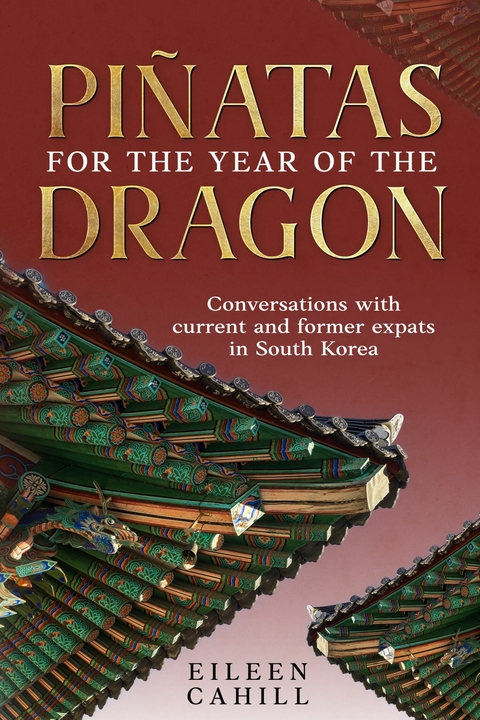
Piñatas for the Year of the Dragon (eBook)
150 Seiten
Publishdrive (Verlag)
978-0-00-104050-2 (ISBN)
For Christine, landing at Incheon Airport made it all real. She was on her own.
'What if I freak out and get super lonely and need to run back home?' she thought. 'What are my friends and family going to say?'
Christine is one of 13 non-Koreans who talked to Eileen Cahill for 'Piñatas for the Year of the Dragon: Conversations With Current and Former Expats in South Korea.'
Others include Elaine, who came here to escape New York City after struggling in the recession and found a career in journalism, and Sonia, who wanted to try something new before settling down in the United States but got disillusioned when she finally went 'home.'
There's also Ron, who made a midlife pivot after 11 years as a full-time Hare Krishna devotee in Florida, and Adam, who wasn't sure he was 'goofy' enough to be a good teacher.
Two chapters take a closer look at social issues that Korea watchers will want to be aware of. Mario, a Japanese photographer and nonprofit worker, discusses his work to support the South Korean survivors of Japanese military sexual slavery in their fight to correct the historical record. And Yiombi Thona, a well-known refugee activist and human rights educator from the Democratic Republic of the Congo, shares his perspective on discrimination, multiculturalism, raising a Congolese family in South Korea, and why the country's refugee system still needs improvement despite having made progress 'on paper.'
Find out why one reviewer gave 'Piñatas for the Year of the Dragon' five stars, calling it a 'must read' and 'a deeply human mosaic - a book that lingers in the mind long after the final interview ends.'
a coming of age
Becoming a journalist in South Korea
Five years after leaving South Korea for good, Elaine Ramirez flew to Seoul for a blockchain conference. The place still felt like home.
“And I just plopped in and started telling people I was in town,” she said a few months later in December 2023. “And, I don’t know, I just felt very much like I could just pick up where I left off. I would be doing myself a disservice by doing that, but it would be very easy to just go back to the way things were.”
Elaine originally moved to South Korea to teach English but found opportunities to transition into journalism and tech writing. From a Mexican coffee shop, she connected with me on Zoom to talk about the years she spent in this country and how they shaped her life.
Escaping to South Korea
“Well,” she said when I asked her about her experiences, “my career narrative is a coming of age, I guess. It was my 20s, and I finally found my footing in my career and then used Korea as a jump-off.”
After graduating in 2009, she was struggling in the recession and her New York apartment got burglarized.
“And that was when I decided that it was no longer worth it to be in New York,” she said.
A friend had taught English in South Korea, and the idea appealed to Elaine, who’d already studied abroad. It felt like “the perfect escape.”
She started out at a tiny elementary school in Paju, Gyeonggi Province, not far from the demilitarized zone that separates the two Koreas. She used to see soldiers in the morning on her way to school.
Eventually she changed schools to get closer to Seoul. Then, after a year and a half, she got a job as a copy editor at the Korea Herald, one of South Korea’s major English-language newspapers.
Growing as a journalist
Elaine started at the Herald in 2012 and began volunteering for Groove Korea magazine around the same time.
At the Herald she learned about South Korean politics and social issues, as well as regional politics. She also flew to Brazil to cover the World Cup soccer tournament — not a typical assignment for one of the paper’s copy editors.
“I basically threatened to quit if I didn’t go to the World Cup in Brazil,” she said. “And so they said, ‘Don’t quit.’”
Under a compromise with the management, Elaine used vacation time to attend the World Cup and write stories for the paper.
“But it was a ‘very, very special case,’” she said. “They liked to remind me of that. But it was a once-in-a-lifetime opportunity, so it was very cool.”
Groove Korea provided even bigger opportunities to grow as a journalist. Elaine started out as an associate editor, then took over as editorial director when a colleague left the country.
She looked back with pride on a themed issue about anti-Black racism in South Korea that took four or five months to produce.
“I think that was really impactful because that story had never really been told before,” she said.
For a different issue of the magazine, she wrote a 12,000-word cover story detailing the failures of the country’s English language education system.
“So those were some of our hard hitters,” she said. “We also did a really fun one, which was ‘Itaewon Freedom,’ which — we mimicked the cover of the ‘Itaewon Freedom’ song album, and we got three locals to pose for it.”
That cover story showed how Seoul’s Itaewon area had changed over the decades, gradually losing its reputation as a hotbed for prostitution and criminality and developing a vibrant nightlife and restaurant scene. Published about three years after Park Jin-young’s 2011 hit drew mainstream attention to Itaewon by portraying it as a fun party district, the article concluded on a cynical note. Deploring the trend toward gentrification and the influx of big brands, the author warned of a future where the neighborhood loses its international character and becomes a soulless hangout for rich South Koreans.
“It was very well researched and really fun to read,” Elaine said.
The January 2015 issue featured a sex worker on the cover along with the headline “I sell sex and I have rights, too.” The article drew criticism on social media, but when I asked her about it, Elaine held her ground.
“I still think all in all the story was fair, well researched and put a light on the situation, and I don’t think it exaggerated anything,” she said. “So I still stand by what we published.”
Making a difference
It was the February 2015 issue of Groove that really stood out in Elaine’s memory. It was the magazine’s 100th issue, and it celebrated the achievements of 100 expats who’d made a difference in South Korea.
It took six months to produce, and the editorial team put everything into it. Writers and photographers who’d previously been involved with Groove were invited to contribute, and former staff members were asked to send in a paragraph or two.
The tagline on the cover read, “No matter where you’re from, you can change the world you’re in.”
“I think that encapsulated the stories that we were trying to tell at Groove,” Elaine said. “Those people who were doing remarkable things despite their circumstances, or trying to make a home out of Korea, or trying to contribute to Korea.”
It was also the end of her tenure as Groove’s editorial director. She decided the 100th issue was “a good time to put some closure on the story. A good, nice round number.”
Elaine’s last message to a largely expat readership carried the headline “You can make a difference, too.”
Going freelance
After three years with the Herald, Elaine wanted to expand her role. She was interested in helping the paper digitize its newsroom, but that would have meant working closely with non-English-speaking staff members, and the language barrier was a dealbreaker for the management.
“So I quit,” she said.
Then Groove’s 100th issue came out, and Elaine “didn’t really care too much what was going to happen next.” She went traveling through South America, then came back and got a job-hunting visa. For a while, she supported herself as an Airbnb host in South Korea.
She also started freelancing for Forbes, Bloomberg and the Guardian. Blockchain technology and the Ethereum cryptocurrency were becoming mainstream in South Korea at the time and making headlines, she said.
“And so I was the only person really writing that in English. And so basically any global outlet that wanted a story on Korean blockchain or crypto knew I was the person.”
Elaine learned the subject on her own by reporting on it and asking questions. Her freelance career took off.
“I had assistants and everything,” she said. “And it was really lucrative. I was making more money than I was as a copy editor at the Korea Herald.”
Elaine was still looking for a new direction for her career. Through the Seoul chapter of the Asian American Journalists Association, she attended an executive leadership program in New York for a week in 2018.
At the end, she said, “I was pretty sure that I knew that I had to leave Korea to be able to get to the next step, because I was never going to be happy with the career limitations in Korea. So although it was very, you know, sad to leave everything in Korea, it felt right.”
Taking the next step
Elaine got into the Medill School of Journalism at Northwestern University in Chicago, and within two months she had to drop everything in Seoul and move.
After grad school she served as head of audience development at CoinDesk, a cryptocurrency website. A connection from the 2018 journalism program in New York introduced her to the company.
“And we both rode that wave, and we actually both just left this year,” she said. “So that was a very epic time.”
Elaine has traveled extensively over the past few years for vacations and cryptocurrency conferences. Along the way she’s had to overcome language barriers in Spanish-speaking environments such as Mexico.
“I wouldn’t say that I’m fluent,” she said. “But I can get by in any situation.”
I asked what her next step was and she said, “Probably do the thing that I do and don’t make a decision and go travel the world. I have a pattern.”
Having just left CoinDesk, she said she’d probably spend about two months backpacking in India.
“I also started an online MBA program,” she said. “So, still doing that. And somewhere along the line I will” — Elaine paused to think for a second — “come out of it and run a global media empire.”
She said her ideas were “not quite percolated yet,” but centered on “helping people understand technology so they can live better lives or do better business, or — something.”
The work she did in Asia and Latin America gave her the background she needed to help others bridge information gaps and technology gaps, she added.
“So we’ll see where this leads.”
At peace with leaving
If Elaine could have found a way to stay in South...
| Erscheint lt. Verlag | 1.11.2025 |
|---|---|
| Sprache | englisch |
| Themenwelt | Reisen |
| ISBN-10 | 0-00-104050-2 / 0001040502 |
| ISBN-13 | 978-0-00-104050-2 / 9780001040502 |
| Informationen gemäß Produktsicherheitsverordnung (GPSR) | |
| Haben Sie eine Frage zum Produkt? |
 EPUB (Adobe DRM)
Größe: 3,6 MB
Kopierschutz: Adobe-DRM
Adobe-DRM ist ein Kopierschutz, der das eBook vor Mißbrauch schützen soll. Dabei wird das eBook bereits beim Download auf Ihre persönliche Adobe-ID autorisiert. Lesen können Sie das eBook dann nur auf den Geräten, welche ebenfalls auf Ihre Adobe-ID registriert sind.
Details zum Adobe-DRM
Dateiformat: EPUB (Electronic Publication)
EPUB ist ein offener Standard für eBooks und eignet sich besonders zur Darstellung von Belletristik und Sachbüchern. Der Fließtext wird dynamisch an die Display- und Schriftgröße angepasst. Auch für mobile Lesegeräte ist EPUB daher gut geeignet.
Systemvoraussetzungen:
PC/Mac: Mit einem PC oder Mac können Sie dieses eBook lesen. Sie benötigen eine
eReader: Dieses eBook kann mit (fast) allen eBook-Readern gelesen werden. Mit dem amazon-Kindle ist es aber nicht kompatibel.
Smartphone/Tablet: Egal ob Apple oder Android, dieses eBook können Sie lesen. Sie benötigen eine
Geräteliste und zusätzliche Hinweise
Buying eBooks from abroad
For tax law reasons we can sell eBooks just within Germany and Switzerland. Regrettably we cannot fulfill eBook-orders from other countries.
aus dem Bereich


