


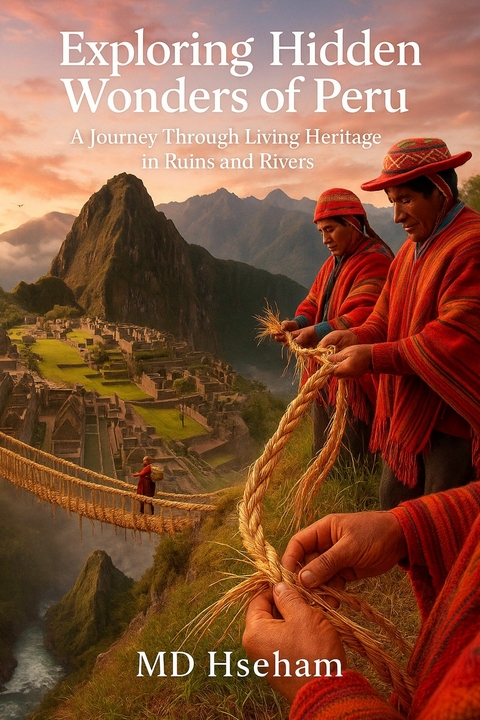
Exploring Hidden Wonders of Peru (eBook)
200 Seiten
Publishdrive (Verlag)
978-0-00-095655-2 (ISBN)
This book invites readers on a vivid journey through 28 extraordinary wonders of Peru, far beyond its most famous landmarks. Written in simple, engaging language for curious readers of all ages, it combines cultural storytelling with natural exploration. From cloud forests and volcanic pyramids to living rope bridges and ancient Inca terraces, each chapter reveals the history, features, wildlife, and traditions of remarkable places. You'll meet locals who preserve age-old crafts, guides who lead treks to turquoise lakes, and communities who protect these fragile wonders. The book weaves together folklore, archaeology, science, and practical travel tips to both inspire and inform. Through sensory-rich storytelling, readers feel the high-altitude wind, taste jungle stews, and walk beside guardians of cultural heritage. Whether you're planning a trip or exploring from home, this book offers a deep, respectful look at Peru's untold stories and landscapes, and urges readers to help protect them for generations to come.
1. Machu Picchu
Perched high on a mountain ridge above the Urubamba River valley, Machu Picchu greets visitors with a blend of awe and wonder that few places on earth can match. This ancient Inca citadel sits at an altitude of about 7,970 feet, where steep green slopes tumble into deep canyons and towering peaks reach into ever-shifting clouds. The Incas built this site in the mid-15th century, during the reign of Emperor Pachacuti, and they designed it to serve as both a royal estate and a sacred spiritual center. Its location in the eastern Andes allowed the builders to harness natural features—sunlight, water, and terrain—to symbolize the connection between people, earth, and sky. Today, travelers from around the world come here to experience its terraced fields, temples, and intricate stone walls that stand as a testament to human creativity and devotion.
Climbing the sunlit terraces feels like stepping into a living painting. The Incas carved thousands of steps into the mountain, using packed earth and stone to create a series of flat platforms that rise one above the other. Farmers once planted maize, potatoes, and quinoa on these terraces, capitalizing on the unique microclimates at varying heights. Modern guides highlight how the builders carefully shaped each layer to capture rainwater and channel it into underground aqueducts. These channels still move crystal-clear water, tracing invisible lines behind the walls and through niches carved into the living rock. As you walk the terraced slopes, you sense the ingenuity that went into every detail.
Among the most striking features stands the Temple of the Sun, where the Incas honored Inti, the sun god. The temple’s semi-circular wall encloses a huge boulder, and windows align with key points on the horizon, allowing sunlight to beam through them at the summer solstice. Nearby, the Royal Tomb lies in a natural cave, its rough-hewn chambers framed by precisely cut stones. Archaeologists continue to debate whether the tomb served as a burial site or a venue for important ceremonies. Each stone here fits so tightly that no mortar stands between them, reflecting the Inca mastery of masonry that allowed structures to withstand earthquakes over centuries.
Wandering through the site, visitors encounter the Intihuatana, often referred to as the “hitching post of the sun.” This carved stone pillar rises from a polished boulder, casting shadows that shift throughout the day. Local guides explain how priests used it to mark solstices and equinoxes, guiding agricultural cycles. Scholars also note that Intihuatana aligns with the cardinal points, reinforcing its role as a cosmological tool. Despite its sophisticated purpose, people often pause here to marvel at the quiet, spiritual energy that seems to pulse through the stone under their fingertips.
Beyond these spiritual centers, Machu Picchu reveals neighborhoods once occupied by noble families, with dozens of finely crafted houses, workshops, and storerooms. Stone stairways lead to higher terraces, where broad plazas once hosted public gatherings and events. In dusty corners, fragments of pottery and tools remind us of daily life here—farmers bringing harvests, weavers crafting textiles, and priests chanting prayers to the sun. In one area, a small complex of rooms features niches carved into the rock to store ceremonial offerings, such as maize and coca leaves. These discoveries shed light on the rituals and traditions that made this citadel both a center of power and a place of deep faith.
Visitors often arrive by the famous Inca Trail, a four-day hike that winds through cloud forests and past ancient ruins. Along the way, hikers spot orchids, bromeliads, and ferns clinging to mossy trunks. Colorful birds dart through misty valleys, and occasionally, shy spectacled bears cross the trail at dawn. The hike ascends through a series of checkpoints—Warmi Wañusqa, known as Dead Woman’s Pass, rises above the tree line at nearly 13,800 feet. Each morning, the sun breaks over the peaks, casting golden light onto ruins that predate Machu Picchu. On the final approach, hikers descend into a narrow valley and catch a glimpse of the steep, green terraces just beyond the cloud line. At sunrise, they pass through the stone gate of Intipunku, the Sun Gate, and suddenly the whole city of Machu Picchu unfurls below, bathed in rosy dawn light.
For those who prefer a more leisurely journey, trains run from Cusco and the Sacred Valley. The route follows the Urubamba River deep into the Andes, offering panoramic views of snow-capped peaks and terraced hillsides. Many trains feature glass-enclosed observation cars, letting travelers spot Andean condors soaring above rocky crags. Shuttle buses then wind up a narrow mountain road to the citadel entrance. From that point, visitors can explore at their own pace, accompanied by local guides or audio tours that share legends and scientific insights.
Machu Picchu holds a place in many travelers’ hearts not only for its architectural marvels but also for its rich biodiversity. The surrounding region forms part of the Vilcabamba mountain range, where cloud forests harbor a multitude of plant and animal species. Orchids cover mossy branches in a riot of colors, and bromeliads collect raindrops in cup-shaped leaves. Hidden among these ferns and vines, quetzal birds flash their emerald feathers as they dart from branch to branch. High above, condors ride thermal updrafts, their wings spanning more than ten feet, as they glide in perfect silence. At lower elevations, travelers might spot the rare Andean cock-of-the-rock, whose bright red-orange plumage and head crest make it one of the world’s most unusual birds.
Mammals also populate these forests. The spectacled bear, South America’s only bear species, forages among the bromeliads for fruits and honey. Tiny marsupials like the yellow-tailed woolly mouse opossum scurry across tree trunks at night, searching for insects to eat. In streams that run through narrow canyons, trout and native char swim in clear water. Botanists praise the area for its rich variety of ferns, mosses, and shrubs, each adapted to the high humidity and dappled light of the cloud forest. When mist swirls around your feet and sunlight filters through emerald leaves, you feel a deep sense of living connection between earth and sky.
Machu Picchu’s global fame began in 1911, when American explorer Hiram Bingham led an expedition to the site. Local farmers guided him through dense brush to uncovered terraces and walls that lay hidden for centuries. Bingham published his findings, and the world soon heard tales of this “Lost City of the Incas.” Tourism grew steadily, and in 1983, UNESCO declared Machu Picchu a World Heritage Site, recognizing its value as both a cultural monument and a natural treasure. Today, more than a million people visit each year, making it one of South America’s top tourist destinations. Authorities limit daily visitors to protect fragile trails and structures, and they encourage travelers to respect local customs and leave no trace behind.
Local communities benefit from Machu Picchu in many ways. Nearby villages, such as Aguas Calientes, offer lodging, restaurants, and artisan markets where visitors can purchase handwoven textiles, silver jewelry, and traditional ceramics. Guides share stories passed down through generations, blending Inca legends with personal memories of growing up in these mountains. Families who once eked out a living farming on steep slopes now earn incomes hosting guests and teaching them about the land. Many support conservation projects that plant native trees and monitor wildlife, ensuring the cloud forest thrives for future generations.
Machu Picchu also challenges researchers to unravel new mysteries. In recent years, archaeologists have used ground-penetrating radar to detect hidden structures buried beneath modern pathways. They discovered that the city extends beyond the core tourist area, with more terraces and buildings waiting to reveal their secrets. Botanists and zoologists survey the cloud forest for new species, and each year they catalog orchids and insects that have never been previously recorded in the scientific literature. Geologists map earthquake faults that run beneath the mountain, helping planners protect ancient walls from tremors. At every turn, Machu Picchu surprises scholars as much as it delights travelers.
One of the lesser-known features is located near the top of the site: a cluster of small agricultural terraces known as the Urban Garden, where gardeners once cultivated exotic flowers and medicinal plants. Local historians believe these terraces supplied the royal court with fresh herbs used in ceremonies and healing rituals. Another hidden gem stands behind heavy vegetation: the Temple of the Three Windows. Its trapezoidal window frames overlook the valley, framing the sacred peak of Huayna Picchu in the distance. When the morning sun strikes its stone lintels, the windows glow like lanterns, creating a magical effect that few travelers witness without a guide’s help.
Visitors also discover the bird garden, a serene patch of forest where parrots and tanagers flock to feed on the fruit of trees. Naturalists lead morning walks here, pointing out how particular species pollinate orchids or spread seeds across the mountain slopes. Along the same trail, you can trace the steps of 16th-century Spanish chroniclers who described these forests in letters sent back to Europe. Though the conquistadors never found Machu Picchu itself, they wrote of mountains “so high that they seemed to touch heaven” and forests “dense with beasts and birds beyond count.” Today, hiking those same paths, you sense both the history and the power of the...
| Erscheint lt. Verlag | 1.7.2025 |
|---|---|
| Sprache | englisch |
| Themenwelt | Reisen |
| ISBN-10 | 0-00-095655-4 / 0000956554 |
| ISBN-13 | 978-0-00-095655-2 / 9780000956552 |
| Informationen gemäß Produktsicherheitsverordnung (GPSR) | |
| Haben Sie eine Frage zum Produkt? |
 EPUB (Adobe DRM)
Kopierschutz: Adobe-DRM
Adobe-DRM ist ein Kopierschutz, der das eBook vor Mißbrauch schützen soll. Dabei wird das eBook bereits beim Download auf Ihre persönliche Adobe-ID autorisiert. Lesen können Sie das eBook dann nur auf den Geräten, welche ebenfalls auf Ihre Adobe-ID registriert sind.
Details zum Adobe-DRM
Dateiformat: EPUB (Electronic Publication)
EPUB ist ein offener Standard für eBooks und eignet sich besonders zur Darstellung von Belletristik und Sachbüchern. Der Fließtext wird dynamisch an die Display- und Schriftgröße angepasst. Auch für mobile Lesegeräte ist EPUB daher gut geeignet.
Systemvoraussetzungen:
PC/Mac: Mit einem PC oder Mac können Sie dieses eBook lesen. Sie benötigen eine
eReader: Dieses eBook kann mit (fast) allen eBook-Readern gelesen werden. Mit dem amazon-Kindle ist es aber nicht kompatibel.
Smartphone/Tablet: Egal ob Apple oder Android, dieses eBook können Sie lesen. Sie benötigen eine
Geräteliste und zusätzliche Hinweise
Buying eBooks from abroad
For tax law reasons we can sell eBooks just within Germany and Switzerland. Regrettably we cannot fulfill eBook-orders from other countries.
aus dem Bereich


