


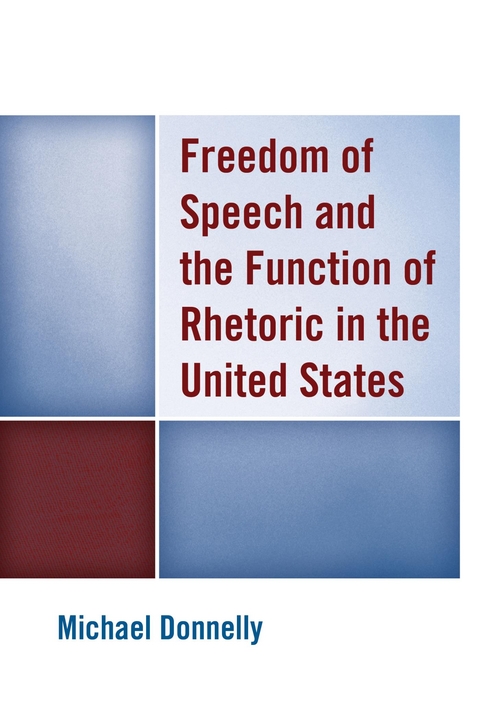
Freedom of Speech and the Function of Rhetoric in the United States (eBook)
120 Seiten
Lexington Books (Verlag)
978-1-4985-1356-2 (ISBN)

This book is about Freedom of Speech and public discourse in the United States. Freedom of Speech is a major component of the cultural context in which we live, think, work, and write, generally revered as the foundation of true democracy. But the issue has a great deal more to do with social norms rooted in a web of cultural assumptions about the function of rhetoric in social organization generally, and in a democratic society specifically. The dominant, liberal notion of free speech in the United States, assumed to be self-evidently true, is, in fact, a particular historical and cultural formation, rooted in Enlightenment philosophies and dependent on a collection of false narratives about the founding of the country, the role of speech and media in its development, and the relationship between capitalism and democracy. Most importantly, this notion of freedom of speech relies on a warped sense of the function of rhetoric in democratic social organization. By privileging individual expression, at the expense of democratic deliberation, the liberal notion of free speech functions largely to suppress rather than promote meaningful public discussion and debate, and works to sustain unequal relations of power. The presumed democratization of the public sphere, via the Internet, raises more questions than it answers-who has access and who doesn't, who commands attention and why, and what sorts of effects such expression actually has. We need to think a great deal more carefully about the values subsumed and ignored in an uncritical attachment to a particular version of the public sphere. This book seeks to illuminate the ways in which cultural framing diminishes the complexity of free speech and sublimates a range of value-choices. A more fully democratic society requires a more critical view of freedom of speech.
Michael D. Donnelly is associate professor of English at Ball State University.
Publicness and Models of the Public SphereChapter 3: Parrhesia and/in the Democratic StateChapter 4: Freedom of Speech in the Twentieth CenturyChapter 5: Free Speech and Hate Speech in the Age of the InternetConclusion
| Erscheint lt. Verlag | 30.11.2016 |
|---|---|
| Sprache | englisch |
| Themenwelt | Geisteswissenschaften ► Sprach- / Literaturwissenschaft ► Sprachwissenschaft |
| Recht / Steuern ► EU / Internationales Recht | |
| Recht / Steuern ► Öffentliches Recht | |
| Sozialwissenschaften ► Politik / Verwaltung | |
| Sozialwissenschaften ► Soziologie | |
| Schlagworte | Deliberative Democracy • First Amendment • freedom of speech • Free Speech • Public discourse • rhetoric • the public sphere |
| ISBN-10 | 1-4985-1356-5 / 1498513565 |
| ISBN-13 | 978-1-4985-1356-2 / 9781498513562 |
| Informationen gemäß Produktsicherheitsverordnung (GPSR) | |
| Haben Sie eine Frage zum Produkt? |
 EPUB (Adobe DRM)
Kopierschutz: Adobe-DRM
Adobe-DRM ist ein Kopierschutz, der das eBook vor Mißbrauch schützen soll. Dabei wird das eBook bereits beim Download auf Ihre persönliche Adobe-ID autorisiert. Lesen können Sie das eBook dann nur auf den Geräten, welche ebenfalls auf Ihre Adobe-ID registriert sind.
Details zum Adobe-DRM
Dateiformat: EPUB (Electronic Publication)
EPUB ist ein offener Standard für eBooks und eignet sich besonders zur Darstellung von Belletristik und Sachbüchern. Der Fließtext wird dynamisch an die Display- und Schriftgröße angepasst. Auch für mobile Lesegeräte ist EPUB daher gut geeignet.
Systemvoraussetzungen:
PC/Mac: Mit einem PC oder Mac können Sie dieses eBook lesen. Sie benötigen eine
eReader: Dieses eBook kann mit (fast) allen eBook-Readern gelesen werden. Mit dem amazon-Kindle ist es aber nicht kompatibel.
Smartphone/Tablet: Egal ob Apple oder Android, dieses eBook können Sie lesen. Sie benötigen eine
Geräteliste und zusätzliche Hinweise
Buying eBooks from abroad
For tax law reasons we can sell eBooks just within Germany and Switzerland. Regrettably we cannot fulfill eBook-orders from other countries.
aus dem Bereich


