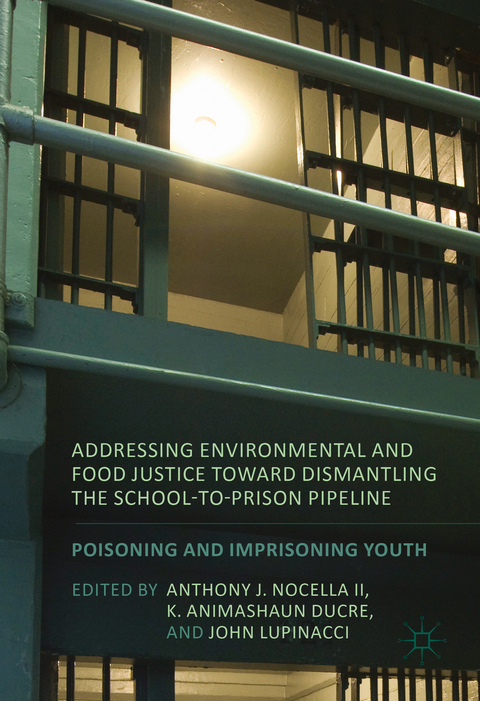
Addressing Environmental and Food Justice toward Dismantling the School-to-Prison Pipeline (eBook)
199 Seiten
Palgrave Macmillan US (Verlag)
978-1-137-50822-5 (ISBN)
This cutting-edge collection of essays presents to the reader leading voices within food justice, environmental justice, and school to prison pipeline movements. While many schools, community organizers, professors, politicians, unions, teachers, parents, youth, social workers, and youth advocates are focusing on curriculum, discipline policies, policing practices, incarceration demographics, and diversity of staff, the authors of this book argue that even if all those issues are addressed, healthy food and living environment are fundamental to the emancipation of youth. This book is for anyone who wants to truly understand the school to prison pipeline as well as those interested in peace, social justice, environmentalism, racial justice, youth advocacy, transformative justice, food, veganism, and economic justice.
Anthony J. Nocella II is Assistant Professor of Sociology and Criminology at Fort Lewis College, USA; Executive Director of the Institute for Critical Animal Studies; Editor of the Peace Studies Journal; and National Co-Coordinator of Save the Kids.
This cutting-edge collection of essays presents to the reader leading voices within food justice, environmental justice, and school to prison pipeline movements. While many schools, community organizers, professors, politicians, unions, teachers, parents, youth, social workers, and youth advocates are focusing on curriculum, discipline policies, policing practices, incarceration demographics, and diversity of staff, the authors of this book argue that even if all those issues are addressed, healthy food and living environment are fundamental to the emancipation of youth. This book is for anyone who wants to truly understand the school to prison pipeline as well as those interested in peace, social justice, environmentalism, racial justice, youth advocacy, transformative justice, food, veganism, and economic justice.
Anthony J. Nocella II is Assistant Professor of Sociology and Criminology at Fort Lewis College, USA; Executive Director of the Institute for Critical Animal Studies; Editor of the Peace Studies Journal; and National Co-Coordinator of Save the Kids. K. Animashaun Ducre is Associate Professor and Chair of the Department of African American Studies at Syracuse University, USA and author of A Place We Call Home: Gender, Race, and Justice in Syracuse (2012). She also served as 2011 Fulbright Scholar in Trinidad and Tobago. John Lupinacci teaches pre-service teachers and graduate students in the Cultural Studies and Social Thought in Education program at Washington State University, USA. He has taught at the secondary level in Detroit and is co-author of the book EcoJustice Education: Toward Diverse, Democratic, and Sustainable Communities (2011).
Foreword David Pellow
Preface lauren Ornelas
Acknowledgements
Introduction: From Addressing the Problems to the Solutions of the School-to-Prison Pipeline through a Food and Environmental Justice Perspective
Anthony J. Nocella II, K. Animashaun Ducre, and John Lupinacci
PART ONE TRANSFORMING THE SCHOOL SYSTEM
1. They Got Me Trapped: Structural Inequality and Racism in Space and Place within Urban School System Design
Travis T. Harris and Daniel White Hodge
2. The Rochester River School: Humane Education to Confront Educational Injustice and the School-to-Prison Pipeline in Rochester, New York Joel Helfrich 3. Where We Live, Play and Study: Assessing Multiple Adverse Impacts of Schools near Environmental Hazards
K. Animashaun Ducre 4. School Yards, Gardens, and Community Parks Carol Mendoza Fisher
5. Education that Supports all Students: Food Sovereignty and Urban Education in Detroit
John Lupinacci
PART TWO TRANSFORMING THE CRIMINAL JUSTICE SYSTEM
6. An Environmental Justice Critique of Carceral Anti-Ecology
Shamelle Richards and Devon G. Peña
7. Industrialized Bodies: Women, Food, and Environmental Justice in the Criminal Justice System
Caitlin Watkins
8. Mothers, Toxicity, and the School-to-Prison Pipeline
Sarah Conrad
9. Hip Hop, Food Justice, and Environmental Justice
Anthony J. Nocella II, Priya Parmar, Don C. Sawyer III, and Michael Cermak
Afterword Frank Hernandez
| Erscheint lt. Verlag | 10.11.2016 |
|---|---|
| Zusatzinfo | XXV, 199 p. 1 illus. in color. |
| Verlagsort | New York |
| Sprache | englisch |
| Themenwelt | Geisteswissenschaften |
| Recht / Steuern ► Strafrecht ► Kriminologie | |
| Sozialwissenschaften ► Pädagogik ► Bildungstheorie | |
| Sozialwissenschaften ► Soziologie | |
| Schlagworte | Ecopedagogy • Environment • Food Justice • race and ethnicity • School-to-prison pipeline • Social Justice Education • urban studies • Youth Culture |
| ISBN-10 | 1-137-50822-1 / 1137508221 |
| ISBN-13 | 978-1-137-50822-5 / 9781137508225 |
| Informationen gemäß Produktsicherheitsverordnung (GPSR) | |
| Haben Sie eine Frage zum Produkt? |
 PDF (Wasserzeichen)
DRM: Digitales Wasserzeichen
Dieses eBook enthält ein digitales Wasserzeichen und ist damit für Sie personalisiert. Bei einer missbräuchlichen Weitergabe des eBooks an Dritte ist eine Rückverfolgung an die Quelle möglich.
Dateiformat: PDF (Portable Document Format)
Mit einem festen Seitenlayout eignet sich die PDF besonders für Fachbücher mit Spalten, Tabellen und Abbildungen. Eine PDF kann auf fast allen Geräten angezeigt werden, ist aber für kleine Displays (Smartphone, eReader) nur eingeschränkt geeignet.
Systemvoraussetzungen:
PC/Mac: Mit einem PC oder Mac können Sie dieses eBook lesen. Sie benötigen dafür einen PDF-Viewer - z.B. den Adobe Reader oder Adobe Digital Editions.
eReader: Dieses eBook kann mit (fast) allen eBook-Readern gelesen werden. Mit dem amazon-Kindle ist es aber nicht kompatibel.
Smartphone/Tablet: Egal ob Apple oder Android, dieses eBook können Sie lesen. Sie benötigen dafür einen PDF-Viewer - z.B. die kostenlose Adobe Digital Editions-App.
Buying eBooks from abroad
For tax law reasons we can sell eBooks just within Germany and Switzerland. Regrettably we cannot fulfill eBook-orders from other countries.
aus dem Bereich