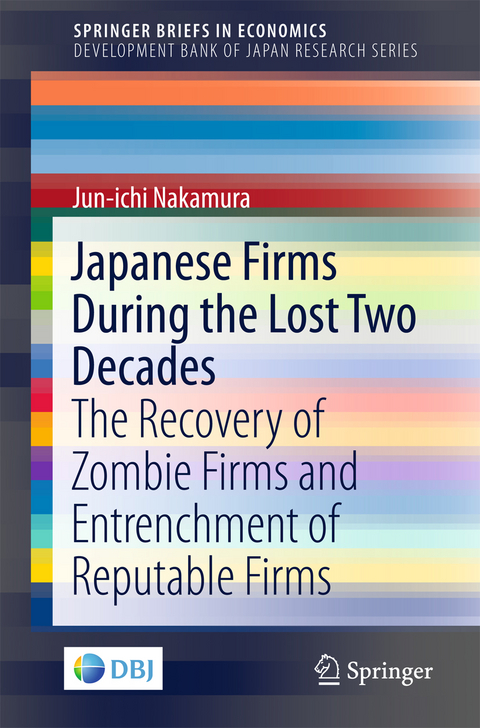
Japanese Firms During the Lost Two Decades (eBook)
VIII, 73 Seiten
Springer Tokyo (Verlag)
978-4-431-55918-4 (ISBN)
Why has Japan's lost decade become the lost two decades? This book attempts to provide a novel perspective on causes of stagnant productivity growth of the Japanese corporate sector during the lost two decades. Exploiting the corporate financial dataset compiled by the Development Bank of Japan, it shows empirical evidence that an excessive conservative financial policy of firms in good standing were responsible for sluggish reallocation of productive resources after the recovery of "e;zombie"e; firms. The questions taken up in the book include: How can "e;zombie"e; firms be properly identified only on the basis of financial data? Why did a majority of "e;zombie"e; firms eventually recover? Why did the productivity and profitability of the corporate sector as a whole remain low even after the recovery of "e;zombie"e; firms? Why did firms in good standing stick to an excessive conservative financial policy and seem reluctant to invest for innovation? What can be the effective prescription to revitalize these firms in good standing? Supported by both in-depth data analyses and rich anecdotal evidence, this book is highly recommended to readers who seek a convincing and comprehensive explanation of Japan's lost two decades from the financial and corporate behavioral points of view.
Acknowledgments 6
Contents 7
1 Introduction 9
Abstract 9
1.1 The Lost Two Decades of the Japanese Economy: Still a Puzzle 9
1.2 Zombie Firm Hypothesis and Its Limitations 10
1.3 Purpose and Outline of the Book 12
References 14
2 Evolution and Recovery of Zombie Firms: Japan’s Experience 15
Abstract 15
2.1 Background on the Controversy over Evergreen Lending and Secular Stagnation 15
2.2 Identification of Zombie Firms 17
2.2.1 Conceptual Framework and Methodology 17
2.2.2 Features of the Modified Criteria and Exclusion of “One Shot Zombie Firms” 20
2.3 Evolution and Recovery of Zombie Firms by Three Categories of Financial Support 22
2.4 Empirical Framework to Analyze How Zombie Firms Recovered 25
2.4.1 Multinomial Logistic Model 25
2.4.2 List of Explanatory Variables 26
2.5 Descriptive Statistics 29
2.6 Estimation Results for the Entire Sample Period 29
2.7 Estimation for the Sub-periods 33
2.7.1 Importance of the Sub-period Analyses 33
2.7.2 The First Sub-period (Escalating Phase) 35
2.7.3 The Second Sub-period (Resolution Phase) 35
2.8 Estimation of the Sub-periods by Industry 36
2.9 Concluding Remarks 43
References 44
3 Sluggish Reallocation of Productive Resources After the Recovery of Zombie Firms 45
Abstract 45
3.1 Framework of the Decomposition Analyses of Changes in Aggregated ROA 45
3.2 Result of the Decomposition Analyses of Changes in Aggregated ROA 47
3.3 Weak Demand of Productive Resources from Healthy Firms 48
3.4 Concluding Remarks 51
Reference 52
4 Investment Behavior of Reputable Firms After the Recovery of Zombie Firms: “Conservatism” and the “Pseudo Financial Constraint Effect” 53
Abstract 53
4.1 Introduction 54
4.2 Literature Review 55
4.3 Methodology 56
4.4 Explanatory Variables 58
4.4.1 Data Construction 58
4.4.2 List of Explanatory Variables 59
4.5 Descriptive Statistics 62
4.6 Estimation Results and Interpretation 64
4.6.1 Baseline Estimation for 2005–2010 64
4.6.2 Long-Run Changes in Investment Behavior from 1995 to 2010 68
4.7 Concluding Remarks 72
References 76
5 Final Remarks 77
Abstract 77
5.1 Main Findings of the Book: Unified View for the Lost Two Decades of Japan 77
5.2 Policy Implications and Remaining Issues 79
References 81
| Erscheint lt. Verlag | 2.8.2016 |
|---|---|
| Reihe/Serie | Development Bank of Japan Research Series |
| Development Bank of Japan Research Series | |
| Development Bank of Japan Research Series | |
| SpringerBriefs in Economics | SpringerBriefs in Economics |
| Zusatzinfo | VIII, 73 p. 14 illus. in color. |
| Verlagsort | Tokyo |
| Sprache | englisch |
| Themenwelt | Recht / Steuern ► Wirtschaftsrecht |
| Wirtschaft ► Betriebswirtschaft / Management ► Finanzierung | |
| Wirtschaft ► Betriebswirtschaft / Management ► Unternehmensführung / Management | |
| Schlagworte | entrenchment • Investment–cash flow sensitivity • Japanese economy • Lost two decades • Zero leveage • “Zombie” firms |
| ISBN-10 | 4-431-55918-3 / 4431559183 |
| ISBN-13 | 978-4-431-55918-4 / 9784431559184 |
| Informationen gemäß Produktsicherheitsverordnung (GPSR) | |
| Haben Sie eine Frage zum Produkt? |
 PDF (Wasserzeichen)
DRM: Digitales Wasserzeichen
Dieses eBook enthält ein digitales Wasserzeichen und ist damit für Sie personalisiert. Bei einer missbräuchlichen Weitergabe des eBooks an Dritte ist eine Rückverfolgung an die Quelle möglich.
Dateiformat: PDF (Portable Document Format)
Mit einem festen Seitenlayout eignet sich die PDF besonders für Fachbücher mit Spalten, Tabellen und Abbildungen. Eine PDF kann auf fast allen Geräten angezeigt werden, ist aber für kleine Displays (Smartphone, eReader) nur eingeschränkt geeignet.
Systemvoraussetzungen:
PC/Mac: Mit einem PC oder Mac können Sie dieses eBook lesen. Sie benötigen dafür einen PDF-Viewer - z.B. den Adobe Reader oder Adobe Digital Editions.
eReader: Dieses eBook kann mit (fast) allen eBook-Readern gelesen werden. Mit dem amazon-Kindle ist es aber nicht kompatibel.
Smartphone/Tablet: Egal ob Apple oder Android, dieses eBook können Sie lesen. Sie benötigen dafür einen PDF-Viewer - z.B. die kostenlose Adobe Digital Editions-App.
Buying eBooks from abroad
For tax law reasons we can sell eBooks just within Germany and Switzerland. Regrettably we cannot fulfill eBook-orders from other countries.
aus dem Bereich