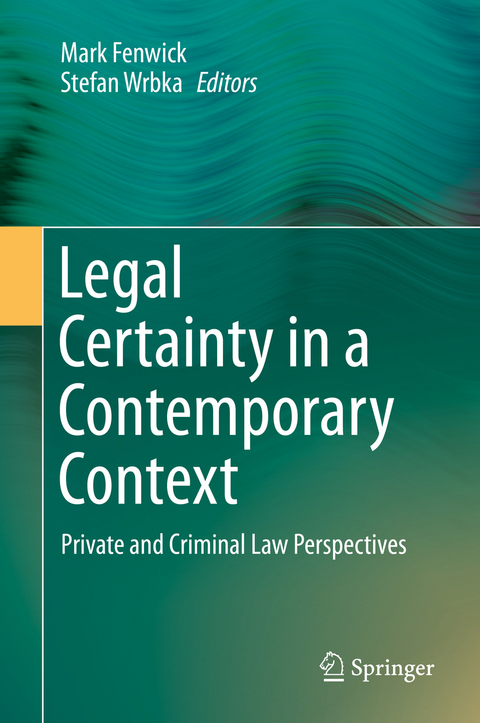
Legal Certainty in a Contemporary Context (eBook)
VII, 194 Seiten
Springer Singapore (Verlag)
978-981-10-0114-7 (ISBN)
This book addresses issues concerning the shifting contemporary meaning of legal certainty. The book focuses on exploring the emerging tensions that exist between the demand for legal certainty and the challenges of regulating complex, late modern societies. The book is divided into two parts: the first part focusing on debates around legal certainty at the national level, with a primary emphasis on criminal law; and the second part focusing on debates at the transnational level, with a primary emphasis on the regulation of transnational commercial transactions.
In the context of legal modernity, the principle of legal certainty-the idea that the law must be sufficiently clear to provide those subject to legal norms with the means to regulate their own conduct and to protect against the arbitrary use of public power-has operated as a foundational rule of law value. Even though it has not always been fully realized, legal certainty has functioned as a core value and aspiration that has structured normative debates throughout political modernity, both at a national and international level.
In recent decades, however, legal certainty has come under increasing pressure from a number of competing demands that are made of contemporary law, in particular the demand that the law be more flexible and responsive to a social environment characterized by rapid social and technological change. The expectation that the law operates in new transnational contexts and regulates every widening sphere of social life has created a new degree of uncertainty, and this change raises difficult questions regarding both the possibility and desirability of legal certainty.
This book compiles, in one edited volume, research from a range of substantive areas of civil and criminal law that shares a common interest in understanding the multi-layered challenges of defining legal certainty in a late modern society. The book will be of interest both to lawyers interested in understanding the transformation of core rule of law values in the context of contemporary social change and to political scientists and social theorists.
Mark Fenwick Associate Professor, Faculty of Law, Kyushu University, Japan
Stefan Wrbka Associate Professor, Faculty of Law, Kyushu University, Japan
Thisbook addresses issues concerning the shifting contemporary meaning of legalcertainty. The book focuses on exploring the emerging tensions that existbetween the demand for legal certainty and the challenges of regulatingcomplex, late modern societies. The book is divided into two parts: the firstpart focusing on debates around legal certainty at the national level, with aprimary emphasis on criminal law; and the second part focusing on debates atthe transnational level, with a primary emphasis on the regulation oftransnational commercial transactions.Inthe context of legal modernity, the principle of legal certainty the idea thatthe law must be sufficiently clear to provide those subject to legal norms withthe means to regulate their own conduct and to protect against the arbitraryuse of public power has operated as a foundational rule of law value. Eventhough it has not always been fully realized, legal certainty has functioned asa core value and aspiration that has structured normative debates throughoutpolitical modernity, both at a national and international level.Inrecent decades, however, legal certainty has come under increasing pressurefrom a number of competing demands that are made of contemporary law, inparticular the demand that the law be more flexible and responsive to a socialenvironment characterized by rapid social and technological change. Theexpectation that the law operates in new transnational contexts and regulatesevery widening sphere of social life has created a new degree of uncertainty,and this change raises difficult questions regarding both the possibility anddesirability of legal certainty.This book compiles, in one edited volume, research from a range ofsubstantive areas of civil and criminal law that shares a common interest inunderstanding the multi-layered challenges of defining legal certainty in alate modern society. The book will be of interest both to lawyers interested inunderstanding the transformation of core rule of law values in the context ofcontemporary social change and to political scientists and social theorists.
Mark Fenwick Associate Professor, Faculty of Law, Kyushu University, Japan Stefan Wrbka Associate Professor, Faculty of Law, Kyushu University, Japan
The Shifting Meaning of Legal Certainty (Mark Fenwick and Stefan Wrbka).- Part I – Perspectives from Private Law.- Comments on Legal Certainty from the Perspective of European, Austrian and Japanese Private Law (Stefan Wrbka).- Intellectual Property, Private Ordering and Legal Certainty(Branislav Hazucha).- Considerations on the Transnationality of International Commercial Arbitration Awards in the Context of the Demand for Legal Certainty (Jason D. Hitch).- The Notion of Consumer under EU Legislation and EU Case Law: Between the Poles of Legal Certainty and Flexibility (Jakob Søren Hedegaard and Stefan Wrbka).- Legal Certainty and Trusts in China (Zhen Meng).- Part II – Perspectives from Criminal Law.- Multilingual Norms in European Criminal Law (Georg C. Langheld).- Empirical Judgement in Criminal Proceedings (Sebastian Stehle).- The Multiple Uncertainties of the Corporate Criminal Law (Mark Fenwick).- Types of offenders – A Criminological Perspective in Historical Contexts (Kathrin Höffler).- International Criminal Law as a Means to Fight the ‘Hostes Humani Generis’? – On the Dangers of the Concept of Enemy Criminal Law (Andreas Werkmeister).
| Erscheint lt. Verlag | 2.4.2016 |
|---|---|
| Zusatzinfo | VII, 194 p. |
| Verlagsort | Singapore |
| Sprache | englisch |
| Themenwelt | Recht / Steuern ► Allgemeines / Lexika |
| Recht / Steuern ► EU / Internationales Recht | |
| Schlagworte | Constitutionalism • Legal certainty • legal theory • Postmodern law • Rule of Law |
| ISBN-10 | 981-10-0114-6 / 9811001146 |
| ISBN-13 | 978-981-10-0114-7 / 9789811001147 |
| Informationen gemäß Produktsicherheitsverordnung (GPSR) | |
| Haben Sie eine Frage zum Produkt? |
 PDF (Wasserzeichen)
DRM: Digitales Wasserzeichen
Dieses eBook enthält ein digitales Wasserzeichen und ist damit für Sie personalisiert. Bei einer missbräuchlichen Weitergabe des eBooks an Dritte ist eine Rückverfolgung an die Quelle möglich.
Dateiformat: PDF (Portable Document Format)
Mit einem festen Seitenlayout eignet sich die PDF besonders für Fachbücher mit Spalten, Tabellen und Abbildungen. Eine PDF kann auf fast allen Geräten angezeigt werden, ist aber für kleine Displays (Smartphone, eReader) nur eingeschränkt geeignet.
Systemvoraussetzungen:
PC/Mac: Mit einem PC oder Mac können Sie dieses eBook lesen. Sie benötigen dafür einen PDF-Viewer - z.B. den Adobe Reader oder Adobe Digital Editions.
eReader: Dieses eBook kann mit (fast) allen eBook-Readern gelesen werden. Mit dem amazon-Kindle ist es aber nicht kompatibel.
Smartphone/Tablet: Egal ob Apple oder Android, dieses eBook können Sie lesen. Sie benötigen dafür einen PDF-Viewer - z.B. die kostenlose Adobe Digital Editions-App.
Buying eBooks from abroad
For tax law reasons we can sell eBooks just within Germany and Switzerland. Regrettably we cannot fulfill eBook-orders from other countries.
aus dem Bereich