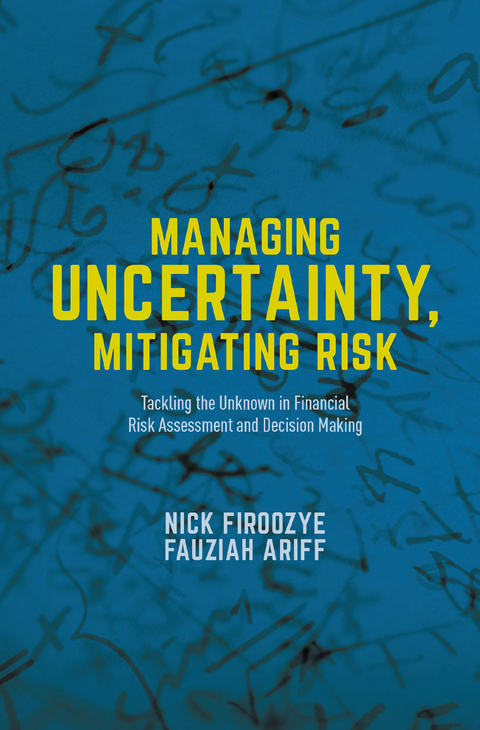
Managing Uncertainty, Mitigating Risk (eBook)
XIX, 265 Seiten
Palgrave Macmillan UK (Verlag)
978-1-137-33454-1 (ISBN)
Nick Firoozye is a Managing Director at Nomura International and heads a global team in cross-product derivatives research. He has many years of experience in a variety of research and trading roles in both buy-side and sell-side firms including Goldman Sachs, Deutsche Bank, Citadel, Sanford Bernstein and Lehman Brothers. Known for his work in Quantitative Strategy, Nick's area of expertise ranges from asset allocation models and macro-financial forecasting to systematic and RV trading. Previously, he was Head of European Rates Strategy, and covered the Eurozone crisis, rescue packages and possible break-up, working closely with the risk management and legal teams. Dr Firoozye was an Assistant Professor at the University of Illinois, and holds a PhD in Applied Mathematics from Courant Institute, New York University. He speaks and writes frequently on financial markets and economics issues. His team was recently awarded Global Capital's Derivatives Research House of 2015, and he was co-author of one of five papers shortlisted for the 2012 Wolfson Economics Prize on the breakup of the Eurozone.
Fauziah Ariff has extensive experience in management consulting and business strategy, with a career encompassing KPMG, Ernst and Young, and American Express, together with investment management in a private equity firm. In both her consulting and corporate roles, she conducted industry studies, performed market and financial assessments and worked on the development, negotiation and set-up of several new business ventures, including projects involving knowledge and process management. As a Director in American Express's Interactive Enterprise Development and Technology divisions, she invented several business method patents which employ and correlate multiple information types across a number of data sources. Fauziah holds a Graduate Diploma in Law, a Master of Business Administration from Northeastern University, and a Bachelor of Arts in Economics from University of Southern California.
Managing Uncertainty, Mitigating Risk proposes that financial risk management broaden its approach, maintaining quantification where possible, but incorporating uncertainty. The author shows that by using broad quantification techniques, and using reason as the guiding principle, practitioners can see a more holistic and complete picture.
Nick Firoozye is a Managing Director at Nomura International and heads a global team in cross-product derivatives research. He has many years of experience in a variety of research and trading roles in both buy-side and sell-side firms including Goldman Sachs, Deutsche Bank, Citadel, Sanford Bernstein and Lehman Brothers. Known for his work in Quantitative Strategy, Nick's area of expertise ranges from asset allocation models and macro-financial forecasting to systematic and RV trading. Previously, he was Head of European Rates Strategy, and covered the Eurozone crisis, rescue packages and possible break-up, working closely with the risk management and legal teams. Dr Firoozye was an Assistant Professor at the University of Illinois, and holds a PhD in Applied Mathematics from Courant Institute, New York University. He speaks and writes frequently on financial markets and economics issues. His team was recently awarded Global Capital's Derivatives Research House of 2015, and he was co-author of one of five papers shortlisted for the 2012 Wolfson Economics Prize on the breakup of the Eurozone. Fauziah Ariff has extensive experience in management consulting and business strategy, with a career encompassing KPMG, Ernst and Young, and American Express, together with investment management in a private equity firm. In both her consulting and corporate roles, she conducted industry studies, performed market and financial assessments and worked on the development, negotiation and set-up of several new business ventures, including projects involving knowledge and process management. As a Director in American Express's Interactive Enterprise Development and Technology divisions, she invented several business method patents which employ and correlate multiple information types across a number of data sources. Fauziah holds a Graduate Diploma in Law, a Master of Business Administration from Northeastern University, and a Bachelor of Arts in Economics from University of Southern California.
Cover 1
Half-Title 2
Title 4
Copyright 5
Dedication 6
Contents 8
List of Boxes 11
List of Figures 12
List of Tables 14
Preface 15
Acknowledgements 20
1 Introduction 21
Background 21
Objectives 24
Scope of the book 24
Outline of the book 26
Part I Setting the Landscape 28
2 The Backdrop 29
Historical perspective – risk managed, uncertainty sidelined 30
Risk and Uncertainty in classical economics 32
The birth of modern finance and economics and the death of Uncertainty 35
Risk and Uncertainty in practice: probability rules 38
Post-crisis innovation – ‘Uncertainty Light’ 46
The renaissance of Uncertainty in academic thought 50
3 Managing Uncertainty: A Modern Necessity 53
Importance of managing uncertainty 53
Uncertainty not managed 57
Current tools are insufficient 59
Lessons learned outside financial risk management 65
A positive note: signs of uncertainty management in banking 71
4 Probability: The Building Blocks 73
Probability in practice:what are the odds? 74
Approaches to probability: Bayesian vs Frequentist 76
Mathematics of probability: a review 78
Limitations of probability: the Ellsberg paradox 96
5 Probability Applied 99
Probability and statistics in mean-variance optimisation 100
Probability and statistics in CAPM 106
Probability and SDEs in Black-Scholes and continuous time finance 107
Value-at-risk 113
Pushing the boundaries – moving towards uncertainty 119
Part II Managing Uncertainty: The Essentials 121
6 Classification of Unknowns and Risk Scenarios 122
Risk 124
Uncertainty and ambiguity 125
Complexity and chaos 129
Unknown unknowns, black swans and ignorance 132
Classification of risk scenarios 133
Mapping classes of Unknowns 137
7 Knowledge and Information: An Unrestricted View 140
Knowledge: a quick look 141
Applications in Finance 144
Sources of modelling information: Bayesian methods 151
Scientific evidence and Bayesian priors 154
A case for broadening and enriching historical data 157
Final Remarks 161
8 Building on Probability: Uncertainty and UVaR 163
Mathematics of uncertainty: imprecise probability 164
Second-order probability 173
Credal nets 174
Tackling Uncertainty –UVaR 180
The case for UVaR 184
Part III Framework,Methodology and Case Studies 190
9 Framework for Addressing Uncertainty 191
Managing Uncertainty: a new approach 192
The framework 193
10 Methodology and Applications of UVaR 203
Categorising the Unknown 203
Determination of key risk scenarios, drivers, events and event trees 206
Defining UVaR 209
Scenario development and scripting 215
Final thoughts 219
11 Case Study: European Sovereign Debt Crisis 220
UVaR application:Greek exit 220
Additional case material 231
Lessons Learned 241
12 Final Thoughts 242
Appendix: Model Uncertainty 245
Notes 250
Index 277
| Erscheint lt. Verlag | 20.4.2016 |
|---|---|
| Zusatzinfo | XIX, 265 p. |
| Verlagsort | London |
| Sprache | englisch |
| Themenwelt | Recht / Steuern ► Wirtschaftsrecht |
| Wirtschaft ► Betriebswirtschaft / Management ► Finanzierung | |
| Wirtschaft ► Betriebswirtschaft / Management ► Unternehmensführung / Management | |
| Schlagworte | Decision Making • financial risk management • Mitigation • risk assessment • Risk Management |
| ISBN-10 | 1-137-33454-1 / 1137334541 |
| ISBN-13 | 978-1-137-33454-1 / 9781137334541 |
| Informationen gemäß Produktsicherheitsverordnung (GPSR) | |
| Haben Sie eine Frage zum Produkt? |
 PDF (Wasserzeichen)
DRM: Digitales Wasserzeichen
Dieses eBook enthält ein digitales Wasserzeichen und ist damit für Sie personalisiert. Bei einer missbräuchlichen Weitergabe des eBooks an Dritte ist eine Rückverfolgung an die Quelle möglich.
Dateiformat: PDF (Portable Document Format)
Mit einem festen Seitenlayout eignet sich die PDF besonders für Fachbücher mit Spalten, Tabellen und Abbildungen. Eine PDF kann auf fast allen Geräten angezeigt werden, ist aber für kleine Displays (Smartphone, eReader) nur eingeschränkt geeignet.
Systemvoraussetzungen:
PC/Mac: Mit einem PC oder Mac können Sie dieses eBook lesen. Sie benötigen dafür einen PDF-Viewer - z.B. den Adobe Reader oder Adobe Digital Editions.
eReader: Dieses eBook kann mit (fast) allen eBook-Readern gelesen werden. Mit dem amazon-Kindle ist es aber nicht kompatibel.
Smartphone/Tablet: Egal ob Apple oder Android, dieses eBook können Sie lesen. Sie benötigen dafür einen PDF-Viewer - z.B. die kostenlose Adobe Digital Editions-App.
Buying eBooks from abroad
For tax law reasons we can sell eBooks just within Germany and Switzerland. Regrettably we cannot fulfill eBook-orders from other countries.
aus dem Bereich