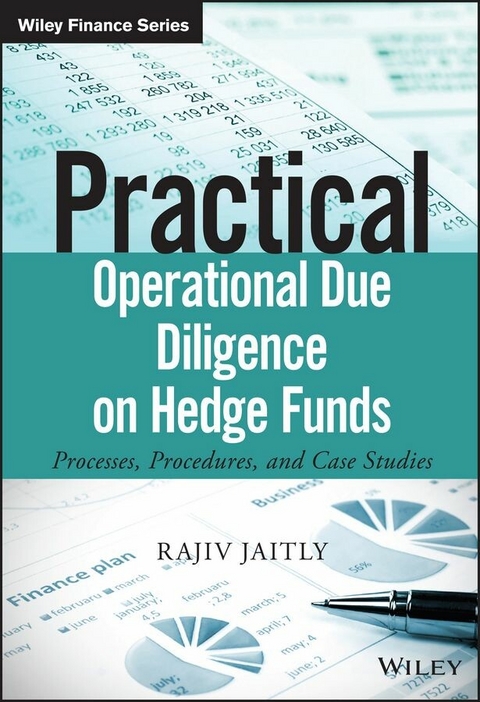
Practical Operational Due Diligence on Hedge Funds (eBook)
John Wiley & Sons (Verlag)
978-1-119-01874-2 (ISBN)
Practical Operational Due Diligence on Hedge Funds is an encyclopaedic, comprehensive reference, written from the perspective of an experienced practitioner. Accompanied by a useful archive of factual material on different hedge fund issues, including failures, fines, and closures, this book focuses on the areas due diligence professionals should address, and explains why they're important. Extensive discussion of publicised cases identifies the manager entities and actual fund vehicles involved, and provides commentary on what could have been done differently in each case, backed by actual regulatory materials, such as SEC complaints, that recreate the events that took place. Readers gain a deeper understanding of the many facets of due diligence and the many possible pitfalls, learning how standardise processes and avoid major errors and oversights.
The amount of money managed by hedge funds has almost doubled from the $1 trillion under management at the time of the financial crisis. Hedge funds can be extremely risky, but can be extremely profitable - as money increasingly flows back in, due diligence on these alternative investments becomes more and more critical. This book provides complete guidance toward the due diligence process, with plentiful real-world examples.
- Identify the areas of due diligence and what can go wrong
- Create procedures and checklists to minimise errors
- Learn what publicised cases could have done differently
- Gain a deeper understanding of massive failures and successes
Proper due diligence can be a massive undertaking, but thoroughness is essential when the price of failure is so high. Practical Operational Due Diligence on Hedge Funds provides the details professionals need to be on point every time.
Tighten due diligence procedures for more successful hedge fund investment Practical Operational Due Diligence on Hedge Funds is an encyclopaedic, comprehensive reference, written from the perspective of an experienced practitioner. Accompanied by a useful archive of factual material on different hedge fund issues, including failures, fines, and closures, this book focuses on the areas due diligence professionals should address, and explains why they're important. Extensive discussion of publicised cases identifies the manager entities and actual fund vehicles involved, and provides commentary on what could have been done differently in each case, backed by actual regulatory materials, such as SEC complaints, that recreate the events that took place. Readers gain a deeper understanding of the many facets of due diligence and the many possible pitfalls, learning how standardise processes and avoid major errors and oversights. The amount of money managed by hedge funds has almost doubled from the $1 trillion under management at the time of the financial crisis. Hedge funds can be extremely risky, but can be extremely profitable as money increasingly flows back in, due diligence on these alternative investments becomes more and more critical. This book provides complete guidance toward the due diligence process, with plentiful real-world examples. Identify the areas of due diligence and what can go wrong Create procedures and checklists to minimise errors Learn what publicised cases could have done differently Gain a deeper understanding of massive failures and successes Proper due diligence can be a massive undertaking, but thoroughness is essential when the price of failure is so high. Practical Operational Due Diligence on Hedge Funds provides the details professionals need to be on point every time.
RAJIV JAITLY is the managing partner at Jaitly LLP, a risk consultancy that provides independent risk, fund governance and operational due diligence services to global alternative investment clients. He set up and managed due diligence and investment management operations for the alternative investment asset businesses of major companies such as UBS, Santander and AXA. Jaitly has also advised the Regulatory Policy team of the U.K. Pensions Regulator, was appointed an expert by the UK Office of Fair Trading for its market study into the UK defined contributions pensions market and was commissioned by the UK Financial Services Consumer Panel to write a report on Fund Costs and their implications. He has also held appointments as a non-executive director of funds.
Preface xIiii
Acknowledgments xIvii
About the Author xIix
Disclaimer Ii
PART I Processes and Procedures
CHAPTER 1 What is a Hedge Fund? 3
CHAPTER 2 Defining Operational Issues 7
CHAPTER 3 Structures for Investment in Alternatives 15
CHAPTER 4 Is the Fund for Real? Establishing the Basics 25
CHAPTER 5 Understanding Fund Operations and Controls 61
CHAPTER 6 Governance - Managing Risk Through a Non-Executive Board 65
CHAPTER 7 Reporting to Members and Statutory Reporting 75
CHAPTER 8 The Curse of Leverage (Fund Liabilities) 87
CHAPTER 9 Fund Assets 103
CHAPTER 10 Fraud 129
CHAPTER 11 Fees: the Essence of Hedge Funds 137
CHAPTER 12 Regulatory Actions, Politics and Market Confidence 149
CHAPTER 13 Key Man Risk, Disaster Recovery and Business Continuity 175
CHAPTER 14 Negotiating Terms and Exercising Rights 181
CHAPTER 15 Risk Ratings and Scoring 195
CHAPTER 16 Marketing to Investors 229
PART II Case Studies
CHAPTER 17 Case Studies Pre-2000 239
CHAPTER 18 Case Studies 2000 275
CHAPTER 19 Case Studies 2001 285
CHAPTER 20 Case Studies 2002 289
CHAPTER 21 Case Studies 2003 297
CHAPTER 22 Case Studies 2004 313
CHAPTER 23 Case Studies 2005 319
CHAPTER 24 Case Studies 2006 359
CHAPTER 25 Cases Studies 2007 401
CHAPTER 26 Case Studies 2008 475
CHAPTER 27 Case Studies 2009 601
CHAPTER 28 Case Studies 2010 677
CHAPTER 29 Case Studies 2011 717
CHAPTER 30 Case Studies 2012 773
APPENDIX A Index of Case Studies by Investment Manager 785
APPENDIX B UK Serious Fraud Office Hedge Fund Investor Questionnaire 793
INDEX 795
LIST OF FUNDS 800
LIST OF FUND MANAGERS 805
Chapter 2
Defining Operational Issues
It's fine to celebrate success but it is more important to heed the lessons of failure.
– Bill Gates
Whenever an investor asks an investment manager if they have been involved in a failure or “blow-up” you can palpably sense the eyes glazing over. I have heard of some interesting justifications as to why the existence of a particular fund in a portfolio or a particular matter did not constitute a blow-up and therefore did not require disclosure to an investor or adviser asking the question. The problem in part is created by the vagueness of the term itself – everyone thinks they know what a blow-up is and generally it is never something they have been involved in!
Vagueness can be a problem in due diligence. It often means that the question and answer relate to different interpretations. Precision is boring but necessary to ensure that the right question has been asked in order to get the required accurate answer.
A CRS Report for Congress on Hedge Fund Failures in December 20061 cited a study which classified hedge fund failures into three broad categories:
- financial issues;
- operational issues; and
- fraud.
But a blow-up from an investor's perspective is usually two-dimensional – it is either because the investor has suffered an investment loss or is unable to get their money out of a fund when they want to, having suffered such a loss. The reasons for this may be investment-related or operational. This book primarily deals with those issues that would be operational. I say primarily, because of the overlaps that inevitably exist.
The analysis needs to be about whether an investor has done enough to address the probabilities of these two dimensions arising prior to making an investment. If they have not, then it is my contention that in a number of (but not all) cases they are unlikely to have covered all the areas that are the subject matter of this book in making an investment decision or have ignored the signs that the work may have uncovered. These are the real issues this book addresses – the funds themselves simply present the symptoms to study.
How these two dimensions play out is a function of some more nuances. For our purposes let us try to tie this down.
2.1 CLASSIFYING PROBLEMS AND FAILURES
Operational issues in a hedge fund context arise in respect of these two dimensions from circumstances such as:
- accusations of fraud;
- insolvency and winding up proceedings;
- investment losses that exceed the fund's “normal” “volatility range”;
- operational problems and structural issues including fund defaults and material breaches of contract, leading to significant investor withdrawals, imposition of gates, suspension of redemptions or fund closure (which could be from a failure to raise capital or the loss of a key man); and
- regulatory intervention resulting in a settlement or fine or fund closure.
Significant withdrawals of funds by investors mean different things to different people – whether it should be defined depends on the effect those withdrawals have.
It is perhaps worth making one statement as an overarching principle for all due diligence – whatever kind it may be and in whatever context it is applied to in this book:
If it sounds too good to be true, it generally is.
2.2 FRAUD
Fraud is a type of criminal activity, defined as “intentional deception to obtain an advantage, avoid an obligation or cause loss to another person or company”.
– Serious Fraud Office website, United Kingdom
Perhaps the most damning finding of the survey is that initial red flags are now raised more frequently than ever before, yet responses to these early warning signs have fallen significantly. Every ignored red flag is potentially a missed opportunity to stop fraud.– KPMG Survey June 2011, Who is the typical fraudster?
Fraud is not as simple as it may first sound, as it can take a number of forms, for example:
- deception in the provision of information and results – misrepresentation;
- deception in the purpose for which funds are used – misappropriation;
- failure to disclose information; and
- abuse of position.
The United Kingdom Serious Fraud Office (SFO) have developed an interesting taxonomy of fraud which splits fraud into seven areas.2 This taxonomy can be adapted to analyse the types of fraud that we see in the world of hedge funds by reducing it to three broad areas – fraud linked to an individual, fraud through a corporate shell conducted by a group of people acting together and market abuse. Each of these can be further categorised depending on the nature of the fraud in order to assist analysis (Table 2.1). Where the founder of an organisation has had allegations of fraud levelled at them resulting in the demise of the fund, this would be classified as corporate fraud even though there may be a number of innocent employees, because the corporate structure can facilitate the fraud.
Table 2.1 A taxonomy of fraud in alternative investments
| 1. Individual Fraud committed by an individual |
|
| 2. Corporate Fraud committed by a group of individuals acting together using a corporate structure as the basis for the fraud |
| 3. Market Abuse |
|
Adapted from: The Taxonomy of Fraud published by the Serious Fraud Office in the UK
Based on the above classification it will be obvious to many that blow-ups relating to market abuse will not necessarily have resulted in funds and managers having to close down – indeed, in the US, the market timing issues which were pursued by the then New York Attorney General Eliot Spitzer and the SEC resulted in fines and investor withdrawals but investors were generally quite forgiving to managers who were investigated for these issues, for example on the basis that views on accepted market practice had changed.
In the UK and US contexts there is one other aspect that is important to consider and that is the impact of the Bribery Act 2010 and the Racketeer Influenced and Corrupt Organizations Act (known as RICO) and the US Foreign Corrupt Practices Act (the “FCPA”).
It is never possible to entirely eliminate the possibility of fraud where someone is determined to commit it. But it should be possible at least to mitigate its occurrence with a reasonable amount of independent control and transparency over processes.
I have seen far too many managers with their compliance manuals composed by consultants gathering dust on shelves. It is the culture around process and control that goes a long way toward preventing such occurrences. This, in my view, is one of the reasons why there is a significant difference in the frequency of reported fraud arising between US and European managers, as there has been a greater culture in Europe of having independent checks on processes such as through the use of third-party administrators.
2.3 INSOLVENCY AND WINDING UP
The most commonly used definition of insolvency is the inability of an individual or company to pay debts when they become due.
– A Guide for Creditors, Insolvency Service, United Kingdom
A fund entering into insolvency proceedings is almost certainly a blow-up. But I have included voluntary winding up as well because funds will often be quietly closed when heavy losses have been incurred. The fund is not technically insolvent, but the process of entering into winding up procedures is an operational issue – the investors will more often than not have suffered losses and the fund ceases to exist.
These closures can also skew industry analysis because the reported results of hedge fund performance then have an implicit survivorship bias as managers no longer report information on funds that have closed.
2.4 INVESTMENT LOSSES OUTSIDE THE FUND'S STATED VOLATILITY RANGE
While an investment loss is a phenomenon that just about every investor experiences at one time or another, the event is rarely viewed in a positive light.
– WiseGeek – What is an investment loss?
A drawdown of 20% or even 50% of the value of the fund may well constitute a blow-up. Clearly such a drawdown outside the stated volatility range of a manager will be of concern to an investor. It could result in redemptions by the investors from that fund, which does have serious knock-on consequences which may or may not result in a fund closure. Some funds have survived such events, learnt their lesson and gone on to provide returns for their investors – for others it has been too much of a leap of faith and the fund has not survived.
2.5 OPERATIONAL PROBLEMS, FUND DEFAULTS AND MATERIAL BREACHES...
| Erscheint lt. Verlag | 5.2.2016 |
|---|---|
| Reihe/Serie | The Wiley Finance Series |
| Wiley Finance Series | Wiley Finance Series |
| Sprache | englisch |
| Themenwelt | Recht / Steuern ► Wirtschaftsrecht |
| Wirtschaft ► Betriebswirtschaft / Management ► Finanzierung | |
| Schlagworte | areas of due diligence • avoiding hedge fund failure • due diligence case studies • due diligence checklists • due diligence failures • due diligence guide • due diligence mistakes • due diligence pitfalls • due diligence procedures • due diligence reference • Finance & Investments • Finanz- u. Anlagewesen • Finanzwesen • Hedge Fund • hedge fund analysis • hedge fund closures • hedge fund investing • importance of due diligence • investment research • Jaitly LLP • Operational Due Diligence • Practical Operational Due Diligence on Hedge Funds: Processes, Procedures, and Case Studies • Rajiv Jaitly • standardised due diligence • thorough due diligence |
| ISBN-10 | 1-119-01874-9 / 1119018749 |
| ISBN-13 | 978-1-119-01874-2 / 9781119018742 |
| Informationen gemäß Produktsicherheitsverordnung (GPSR) | |
| Haben Sie eine Frage zum Produkt? |
 EPUB (Adobe DRM)
Kopierschutz: Adobe-DRM
Adobe-DRM ist ein Kopierschutz, der das eBook vor Mißbrauch schützen soll. Dabei wird das eBook bereits beim Download auf Ihre persönliche Adobe-ID autorisiert. Lesen können Sie das eBook dann nur auf den Geräten, welche ebenfalls auf Ihre Adobe-ID registriert sind.
Details zum Adobe-DRM
Dateiformat: EPUB (Electronic Publication)
EPUB ist ein offener Standard für eBooks und eignet sich besonders zur Darstellung von Belletristik und Sachbüchern. Der Fließtext wird dynamisch an die Display- und Schriftgröße angepasst. Auch für mobile Lesegeräte ist EPUB daher gut geeignet.
Systemvoraussetzungen:
PC/Mac: Mit einem PC oder Mac können Sie dieses eBook lesen. Sie benötigen eine
eReader: Dieses eBook kann mit (fast) allen eBook-Readern gelesen werden. Mit dem amazon-Kindle ist es aber nicht kompatibel.
Smartphone/Tablet: Egal ob Apple oder Android, dieses eBook können Sie lesen. Sie benötigen eine
Geräteliste und zusätzliche Hinweise
Buying eBooks from abroad
For tax law reasons we can sell eBooks just within Germany and Switzerland. Regrettably we cannot fulfill eBook-orders from other countries.
aus dem Bereich