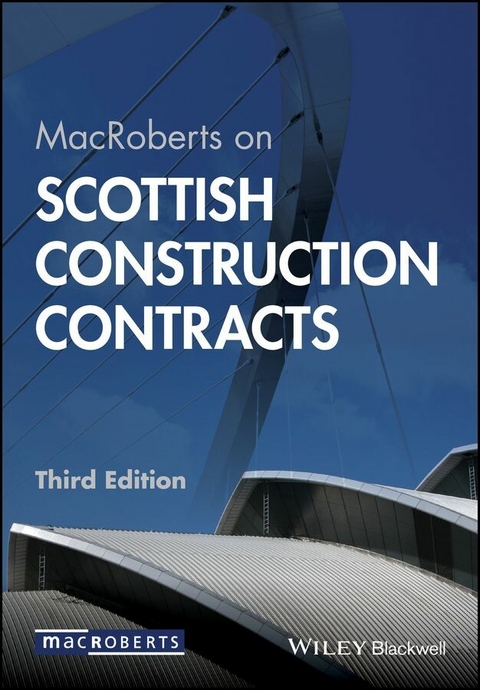
MacRoberts on Scottish Construction Contracts (eBook)
John Wiley & Sons (Verlag)
978-1-118-27343-2 (ISBN)
Provides a guide to the general principles of Scottish law relevant to construction contracts and the main provisions of the standard forms of construction contract used in Scotland including:
- the obligations of employers and contractors
- certification
- payment
- ending a construction contract
- remedies
- subcontracts
- collateral warranties
- insurance
- dispute resolution
- regulatory matters
The new edition has been substantially updated and expanded to take account of the latest editions of the Scottish Standard Building Contracts and recent case law. Specific updates have been driven by the following changes to legislation and standard contracts
- Local Democracy Economic Development and Construction Act 2009 and the relative Scheme for Construction Contracts
- Arbitration (Scotland) Act 2010
- Recognising the significant increase in use of NEC3 standard forms of contract, references to NEC3 provisions have been introduced throughout the relevant chapters so that each now covers the common law, the SBCC provisions and the NEC3 provisions.
It also features new chapters on: litigation; competition; the Bribery Act 2010; and guarantees and bonds.
From reviews of previous editions:
- ‘very approachable and readable… I would particularly recommend this book to non-legal construction professionals’ – Construction & Engineering Law
- ‘an informative textbook for the practitioner… [a] significant contribution to knowledge’ – Arbitration
- ‘a highly competent… textbook which would be of value for industry professionals with no legal background’ – Construction Law
MacRoberts LLP is a full-service commercial law firm, working from offices in Edinburgh, Glasgow and Dundee. The MacRoberts Construction Group is one of the largest in Scotland, with clients including public sector bodies, private developers, contractors, sub-contractors and professionals in all areas of the construction industry. MacRoberts is recognised as leaders in all aspects of Construction law with specialist lawyers able to provide advice covering the full range of construction law issues, across all parts of the construction process, from advice on appropriate forms of procurement, contract assembly and negotiation through to dispute management and resolution, including mediation, adjudication, arbitration and court.
Provides a guide to the general principles of Scottish law relevant to construction contracts and the main provisions of the standard forms of construction contract used in Scotland including: the obligations of employers and contractors certification payment ending a construction contract remedies subcontracts collateral warranties insurance dispute resolution regulatory matters The new edition has been substantially updated and expanded to take account of the latest editions of the Scottish Standard Building Contracts and recent case law. Specific updates have been driven by the following changes to legislation and standard contracts Local Democracy Economic Development and Construction Act 2009 and the relative Scheme for Construction Contracts Arbitration (Scotland) Act 2010 Recognising the significant increase in use of NEC3 standard forms of contract, references to NEC3 provisions have been introduced throughout the relevant chapters so that each now covers the common law, the SBCC provisions and the NEC3 provisions. It also features new chapters on: litigation; competition; the Bribery Act 2010; and guarantees and bonds. From reviews of previous editions: very approachable and readable I would particularly recommend this book to non-legal construction professionals Construction & Engineering Law an informative textbook for the practitioner [a] significant contribution to knowledge Arbitration a highly competent textbook which would be of value for industry professionals with no legal background Construction Law
MacRoberts LLP is a full-service commercial law firm, working from offices in Edinburgh, Glasgow and Dundee. The MacRoberts Construction Group is one of the largest in Scotland, with clients including public sector bodies, private developers, contractors, sub-contractors and professionals in all areas of the construction industry. MacRoberts is recognised as leaders in all aspects of Construction law with specialist lawyers able to provide advice covering the full range of construction law issues, across all parts of the construction process, from advice on appropriate forms of procurement, contract assembly and negotiation through to dispute management and resolution, including mediation, adjudication, arbitration and court.
Chapter 1
Construction Contracts in General
1.1 Introduction
Numerous books have been written on the subject of construction contracts. However, many of those are of a specialist nature and most are written from the perspective of English law. The aim of this book is to provide a practical guide to construction contracts governed by the law of Scotland.
There is no doubt that the construction industry not only in Scotland, but throughout the UK, is currently being presented with continuing challenges of an almost unprecedented nature. In the first quarter of 2013, the construction industry suffered a contraction of 2.5% compared with the same period in the previous year, despite a growth in overall Scottish gross domestic product (GDP) of 1.2%. While some major public sector infrastructure projects have lessened the impact of the economic downturn on the Scottish construction sector, the lack of external funding has been a major factor in the sharp reduction in the number of new private commercial development projects.
However, the very size of the construction industry means that it is of huge significance to the economy. According to figures contained in the report by Construction Scotland, Building for the Future: The Scottish Construction Industry's Strategy, 2013–2016, the construction industry generates £27.4 billion (GDP) to the Scottish economy every year, contributing 10% of Scotland's total economic output, and 170,000 people work in construction in Scotland, around 10% of the total Scottish jobs.
1.2 Definition of a construction contract
1.2.1 General
The definition of a construction contract is not straightforward. The construction industry encompasses building and engineering projects which differ enormously in nature, size and complexity. The terms ‘building contract’ and ‘construction contract’ are often used interchangeably. The term ‘construction contract’ was given a statutory meaning for the first time by section 104 of the Housing Grants, Construction and Regeneration Act 1996 (‘the 1996 Act’) and the breadth of the definition illustrates the wide-ranging nature of construction contracts. The 1996 Act has been amended by the Local Democracy, Economic Development and Construction Act 2009 in relation to contracts entered into in England and Wales from 1 October 2011 and in Scotland from 1 November 2011. One of the key amendments was the repeal of the requirement that a construction contract for the purposes of the 1996 Act must be in writing. The following sections summarize the principal requirements of the statutory definition of ‘construction contract’. However, it is important to bear in mind that this statutory definition is relevant only for the purposes of the 1996 Act and for determining whether the provisions of Part II the 1996 Act, such as adjudication and payment requirements, will apply to a particular contract. The fact that a contract is not a ‘construction contract’ for the purposes of the 1996 Act does not mean that it may not be a construction contract in the commonly understood sense of the term, and indeed some contracts falling with the statutory definition, such as for architectural services, would not be described as a construction contract in everyday terms. An English court has recently held that a collateral warranty may, depending on its terms, be a construction contract for the purposes of the 1996 Act and thus subject to the statutory adjudication provisions, see Parkwood Leisure Ltd v. Laing O'Rourke Wales and West Ltd (2013) and the discussion of this case in Section 13.4. The 1996 Act has no relevance in determining whether a contract exists in the first place since this will be determined by a matter of law and evidence; putting it at its simplest, whether there was sufficient consensus as to the essential terms and sufficient proof of such consensus.
It should also be noted that the Scottish Government's legislative programme for 2013–2014 includes the Conclusion of Contracts, etc. Bill, which is intended to allow contracts to be concluded by email and to provide a simpler process for formal execution (signing) of contracts.
1.2.2 Construction contracts under the 1996 Act
Part II of the 1996 Act applies to ‘construction contracts’, being agreements in relation to ‘construction operations’. These terms are defined respectively by sections 104 and 105.
Section 104 provides as follows:
- In this Part a ‘construction contract’ means an agreement with a person for any of the following –
- the carrying out of construction operations;
- arranging for the carrying out of construction operations by others, whether under sub-contract to him or otherwise;
- providing his own labour, or the labour of others, for the carrying out of construction operations.
- References in this Part to a construction contract include an agreement –
- to do architectural, design or surveying work, or
- to provide advice on building, engineering, interior or exterior decoration or on the laying-out of landscape, in relation to construction operations.
- References in this Part to a construction contract do not include a contract of employment (within the meaning of the Employment Rights Act 1996).
- The Secretary of State may by order add to, amend or repeal any of the provisions of subsection (1), (2) or (3) as to the agreements which are construction contracts for the purposes of this Part or are to be taken or not to be taken as included in references to such contracts …
It will be noted that the 1996 Act applies to matters beyond the carrying out of building works. It applies to architectural, design and surveying works and to advising on building, engineering, interior or exterior decoration or on the laying-out of landscape in relation to construction operations.
The definition of ‘construction operations’ is central to Part II. This term is defined by section 105(1) which provides as follows:
- In this Part ‘construction operations’ means, subject as follows, operations of any of the following descriptions –
- construction, alteration, repair, maintenance, extension, demolition or dismantling of buildings, or structures forming, or to form, part of the land (whether permanent or not);
- construction, alteration, repair, maintenance, extension, demolition or dismantling of any works forming, or to form, part of the land, including (without prejudice to the foregoing) walls, roadworks, power-lines, electronic communications apparatus, aircraft runways, docks and harbours, railways, inland waterways, pipe-lines, reservoirs, water-mains, wells, sewers, industrial plant and installations for purposes of land drainage, coast protection or defence;
- installation in any building or structure of fittings forming part of the land, including (without prejudice to the foregoing) systems of heating, lighting, air-conditioning, ventilation, power supply, drainage, sanitation, water supply or fire protection, or security or communications systems;
- external or internal cleaning of buildings and structures, so far as carried out in the course of their construction, alteration, repair, extension or restoration;
- operations which form an integral part of, or are preparatory to, or are for rendering complete, such operations as are previously described in this subsection, including site clearance, earthmoving, excavation, tunnelling and boring, laying of foundations, erection, maintenance or dismantling of scaffolding, site restoration, landscaping and the provision of roadways and other access works;
- painting or decorating the internal or external surfaces of any building or structure.
Section 105(2) details a number of operations that are not construction operations for the purposes of Part II. The exceptions relate to oil and gas and mining, both underground and opencast; certain specified operations on a site where the primary purpose is nuclear processing, power generation, water or effluent treatment or the production, transmission, processing or bulk storage (other than warehousing) of chemicals, pharmaceuticals, oil, gas, steel or food and drink; the manufacture or delivery to site of components or equipment where the contract does not also provide for their installation; and the making, installation and repair of wholly artistic works. The scope of excluded operations insofar as applicable to works at power stations was considered in the case of North Midland Construction plc v. AE & E Lentjes UK Ltd (2009).
1.2.3 Excluded contracts
Section 106 provides that contracts with residential occupiers are excluded from the operation of Part II of the 1996 Act, as is any other description of construction contract excluded by order of the Secretary of State (or in Scotland, the Scottish Ministers).
A construction contract with a residential occupier is one which principally relates to operations on a dwelling which one of the parties to the contract occupies, or intends to occupy, as his residence.
The term ‘dwelling’ means a dwelling-house or a flat; and for s.106(2) ‘dwelling-house’ does not include a building...
| Erscheint lt. Verlag | 29.9.2014 |
|---|---|
| Sprache | englisch |
| Themenwelt | Recht / Steuern ► EU / Internationales Recht |
| Technik ► Bauwesen | |
| Schlagworte | Bauingenieur- u. Bauwesen • Baurecht • changes • Chapters • Civil Engineering & Construction • Common • construction law • Contracts • Democracy • following • General • Gewerbe- u. Technikrecht • Guide • Law • Litigation • Local • main provisions • Principles • Provisions • Rechtswissenschaft • References • relevant • sbcc provisions • Schottland /Recht • Scottish • specific • Standard • Trade & Technology Law • Updates |
| ISBN-10 | 1-118-27343-5 / 1118273435 |
| ISBN-13 | 978-1-118-27343-2 / 9781118273432 |
| Informationen gemäß Produktsicherheitsverordnung (GPSR) | |
| Haben Sie eine Frage zum Produkt? |
 EPUB (Adobe DRM)
Kopierschutz: Adobe-DRM
Adobe-DRM ist ein Kopierschutz, der das eBook vor Mißbrauch schützen soll. Dabei wird das eBook bereits beim Download auf Ihre persönliche Adobe-ID autorisiert. Lesen können Sie das eBook dann nur auf den Geräten, welche ebenfalls auf Ihre Adobe-ID registriert sind.
Details zum Adobe-DRM
Dateiformat: EPUB (Electronic Publication)
EPUB ist ein offener Standard für eBooks und eignet sich besonders zur Darstellung von Belletristik und Sachbüchern. Der Fließtext wird dynamisch an die Display- und Schriftgröße angepasst. Auch für mobile Lesegeräte ist EPUB daher gut geeignet.
Systemvoraussetzungen:
PC/Mac: Mit einem PC oder Mac können Sie dieses eBook lesen. Sie benötigen eine
eReader: Dieses eBook kann mit (fast) allen eBook-Readern gelesen werden. Mit dem amazon-Kindle ist es aber nicht kompatibel.
Smartphone/Tablet: Egal ob Apple oder Android, dieses eBook können Sie lesen. Sie benötigen eine
Geräteliste und zusätzliche Hinweise
Buying eBooks from abroad
For tax law reasons we can sell eBooks just within Germany and Switzerland. Regrettably we cannot fulfill eBook-orders from other countries.
aus dem Bereich