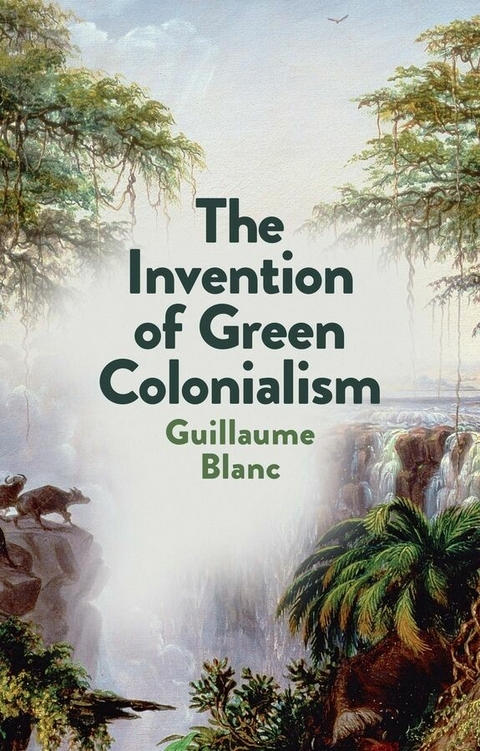
The Invention of Green Colonialism (eBook)
John Wiley & Sons (Verlag)
978-1-5095-5090-6 (ISBN)
The story begins with a dream – the dream of Africa. Virgin forests, majestic mountains surrounded by savannas, vast plains punctuated with the rhythms of animal life where lions, elephants and giraffes reign as lords of nature, far from civilization – all of us carry such images in our heads, imagining Africa as a timeless Eden untouched by the ravages of modernity.
But this Africa has never existed. The more we destroy nature here, the more we fantasize about it in Africa. Along with UNESCO, the WWF and other organizations, we convince ourselves that the African national parks are protecting the last vestiges of a world once untouched and wild. In reality, argues Guillaume Blanc, these organizations are responsible for naturalizing large tracts of the African continent, turning territories into parks and forcibly evicting thousands of people from the lands where they have lived for centuries. Making use of archives and oral histories, Blanc investigates this battle for a phantom Africa and the contradictory claims of nations who destroy nature at home while believing that they are protecting the natural world abroad. In so doing, they enact a new type of colonialism: green colonialism.
Guillaume Blanc is a Lecturer in Contemporary History at Rennes 2 University. He is a junior member of the Institut universitaire de France.
The story begins with a dream the dream of Africa. Virgin forests, majestic mountains surrounded by savannas, vast plains punctuated with the rhythms of animal life where lions, elephants and giraffes reign as lords of nature, far from civilization all of us carry such images in our heads, imagining Africa as a timeless Eden untouched by the ravages of modernity. But this Africa has never existed. The more we destroy nature here, the more we fantasize about it in Africa. Along with UNESCO, the WWF and other organizations, we convince ourselves that the African national parks are protecting the last vestiges of a world once untouched and wild. In reality, argues Guillaume Blanc, these organizations are responsible for naturalizing large tracts of the African continent, turning territories into parks and forcibly evicting thousands of people from the lands where they have lived for centuries. Making use of archives and oral histories, Blanc investigates this battle for a phantom Africa and the contradictory claims of nations who destroy nature at home while believing that they are protecting the natural world abroad. In so doing, they enact a new type of colonialism: green colonialism.
Guillaume Blanc is a Lecturer in Contemporary History at Rennes 2 University. He is a junior member of the Institut universitaire de France.
Acknowledgements
History as a Starting Point: Preface to the English Edition
Introduction
Chapter 1: Deconstructing our Beliefs, (Re)-thinking Nature
Chapter 2: Turning Africa into Parkland (1850-1960
Chapter 3: A Special Project for Africa (1960-1965)
Chapter 4: The Expert and the Emperor (1965-1970)
Chapter 5: Violence Below the Surface of Nature (1970-1978)
Chapter 6: The Sustainable Development Trap (1978-1996)
Chapter 7: The Fiction of the Community Approach (1996-2009)
Chapter 8: The Roots of Injustice (2009-2019)
Conclusion
Looking Ahead: Afterword
Notes
Index
'Blanc has created a masterpiece in contrasts that has much to teach us about nature conservation, "sustainable development", power and equity on a global scale. This book deserves a spot on the shelves of every major library, a large number of policymakers' desks and the bedside tables of many ordinary folks interested in Africa, nature conservation, social justice or the sustainable development of our planet.'
Diana K. Davis, author of The Arid Lands: History, Power, Knowledge
'Guillaume Blanc, with passion as well as thorough research, pushes his readers to think anew about the relationship between humans and animals in Africa. This book is both a valuable contribution to environmental history and an argument that needs to be taken seriously about the misconceptions that often shape international interventions in that continent.'
Frederick Cooper, author of Africa since 1940: The Past of the Present
"Blistering"
The Financial Times
"Absorbing"
The Daily Maverick
"[A] book that will challenge much of what the reader understands about conservation."
Sally Hayden, The Irish Times
"The book challenges some otherwise comfortably held opinions, and is, at times, a harrowing and often controversial read. Recommended."
Morning Star
"a searing critique of wildlife conservation in Africa"
The Inquisitive Biologist
"Scathing."
Foreign Affairs
Preface to the English Edition
History as a Starting Point
The Invention of Green Colonialism. By virtue of its title, as soon as it was published, this book was associated with postcolonial studies, even with ‘decolonial’ thinking. These fields of study have of course influenced my work, but what I wanted first and foremost was to write a book focusing on environmental history. With this discipline, ‘we can create a more usable past, one more relevant to the everyday lives of people today’, as Ted Steinberg puts it. And to do that, the American historian tells us, we need to re-establish ‘the way power operates through and across landscape’.1
Still in North America, this time in Canada, Stéphane Castonguay explains how we can achieve this. There is no point in trying to distinguish between the natural and the cultural, given that in the world around us, everything is hybrid. However, Castonguay explains, the environmental historian can decipher the mechanisms which result in a landscape ending up being defined in one place as ‘natural’ and in another as ‘cultural’. And for that to be achieved, nature needs to be regarded as a battleground: the institutional battle over how a territory is controlled, the cultural battle to establish an image of the environment in the public domain and the material battle over the exploitation of a resource.2 In this book, these three dimensions of social relationships with nature are a constant presence.
Let us begin with the institutional aspect. For many environmental historians, confining nature within a park represents a double act of appropriation and of disappropriation. This is the case everywhere and perhaps particularly in Africa. Under colonial rule, the colonists first set about creating hunting reserves as a way of demonstrating their capacity to dominate nature and space.3 Next it was the turn of European administrations to use the national parks as a means to better control, manage and suppress populations.4 Then, once the postcolonial period had begun, the international conservation institutions continued to impose coercive models for the protection of nature, models which involved displacing local people, restricting right of access to resources and criminalizing use of the land.5 The majority of those African states called upon to put these programmes in place took advantage of the situation to impose tighter controls over their citizens.6 And the latter therefore found themselves seeking out any available gaps which would enable them to get round the conservation rules, and even to use them to exercise political advantage over their neighbours and their communities.7 Put differently, for all the actors involved in the institutionalization of the environment, protecting nature always involves the exercise of power.
However, if it is to be effective, this power to define the ‘good’ and ‘bad’ use of nature needs to be underpinned by a certain number of specific perceptions – of the ‘good’ images of nature, to put it briefly. Environmental historians have long clashed over this issue, wondering whether the way we think about nature might or might not affect the way we conserve it. William Cronon, a major theoretician of the American wilderness, made a positive contribution to this debate by demonstrating that ‘pristine’ nature was never a reality but, primarily, ‘the reflection of our own unexamined longings and desires’.8 And no matter how elitist they are, ‘ideas do matter’, as Cronon reminds us.9 Here too, the argument is particularly relevant to contemporary African societies. By linking the field of perceptions of nature with that of political action, many historians have shown the determining nature of the European and, later, western vision of Africa. A steadily increasing media coverage in the form of travel journals, novels, guidebooks, wildlife documentaries or animated films has, over the course of more than a century, portrayed Africa as a supremely natural landscape, sadly damaged by its inhabitants. Yet perceiving African ecologies as ‘wild things’10 implies wanting to experience them as such and, consequently, needing to protect them as such. This is why it is crucial always to link conservation norms to the emotions and affects which govern their definition. If we wish to understand why conservationists are still determined to make the African national parks wild spaces, we need to ask how it was that they came to believe that ‘good’ African nature is always uninhabited.
Finding an answer to this question also means considering the material dimension underlying social relationships with nature. The British historian Richard Grove was the first person to throw light on the links between ecologism and capitalism. The more Europeans cultivated, exploited and damaged the soil and the wildlife of the tropics, the more determined they were to protect the environment from this destruction. Except that, in order to do so, they restricted the rights of ‘local indigenous people’, accused of destroying nature and therefore needing to be removed.11 And since that time, this dual concept of predation/protection has continued to shape global policies for nature in Africa. The imperatives of the capitalist economy cause ever more damage, ecological demands result in the creation of a growing number of protected zones, and farmers and shepherds are once again seen as those largely responsible for the massive deterioration of the environment.12 Many environmental historians have turned their attention to this anti-rural ethic. Yet, very often, one question remains unresolved: what is it that these famous ‘indigenous people’, constantly singled out, but then ignored, by the conservationists, actually do? For the majority of them, as Ramachandra Guha and Madhav Gadgil demonstrated in India as early as 1992, ecologism only serves to exacerbate their poverty.13 That said, since farmers and shepherds continue to exploit the land, they also fall into the category of ‘environmental banditry’, as Karl Jacoby points out with reference to the United States.14 And since the 1980s, in Africa, in Asia or in Latin America, given that those who live in the natural world are also trying to earn a living from the new community conservation, this can result in confrontations, divisions and conflicts between them. It is one of the main consequences of ‘the tyranny’ of participation in that once nature becomes monetized, there will inevitably be both losers and winners.15
Consequently, inside the national parks, everyone finds themselves caught up in the struggle to control, represent and exploit nature. This principle lies at the heart of environmental history, and is central to this book. However, the book also draws on at least three other fields of study.
In the first place, postcolonial studies allow us to simultaneously observe global conservation and the form it takes locally: that is to say, the system and the individuals, from the top to the bottom. The work of Edward Said16 helps us, for example, to have a better understanding of the injustice of global policies which, in Africa, involve criminalizing those who live off and in the natural world. What kind of discourse could have succeeded in convincing western conservationists of the radical otherness of African peasants? What discursive practices could ever have justified this approach to the Other (‘the African’), an attitude which would, moreover, be morally unacceptable in western societies? As for this ‘Other’, the difficulty lies in being able to identify him or her, not just as a passive subject, but as a fully participating actor. The work of Gayatri Chakravorty Spivak sets us on the right track here. By formulating the famous question ‘Can the subaltern speak?’ the literary theorist urges us to restore a voice to those whom power has silenced. It is a process which requires work on a personal level – trying to see the world through the eyes of others – as well as on a historical one – tracking down, in the sources produced by the dominant, the actions of the dominated.17 In this book, by mixing archives and real-life stories, I have therefore tried always to keep in mind the fact that nature was shaped just as much by those at the top as by those at the bottom, each having a role to play in the invention of green colonialism.
Because they are produced by authors who fluctuate between a scholarly position and a militant stance, these postcolonial theories can sometimes end up being as useful as they are misleading. So, for example, orientalism as defined by Said can easily edge us towards occidentalism. Just as there is no single Africa but instead many African societies, we cannot refer to a single western conservation system: there are the international institutions, who negotiate their norms with the African states responsible for applying them. As for the famous ‘subaltern’ whom so many postcolonial theorists seek to defend, there too the trap of essentialism is never far away. It is an indisputable fact that, in the eyes of the experts and the leaders who judge and govern them, the sub-Saharan African peasants are all too often only a ‘third something’, this ‘tertium quid’ defined by W.E.B. Du Bois to describe the condition of black people in America in the early...
| Erscheint lt. Verlag | 8.6.2022 |
|---|---|
| Übersetzer | Helen Morrison |
| Sprache | englisch |
| Themenwelt | Naturwissenschaften ► Biologie ► Ökologie / Naturschutz |
| Sozialwissenschaften ► Politik / Verwaltung | |
| Sozialwissenschaften ► Soziologie ► Allgemeine Soziologie | |
| Schlagworte | environmental, destruction, resettlement, eviction, colonialism, decolonisation, UNSECO, WWF, NGO, nature, Africa, Ethiopia, Benin, Tanzania, DRC, national parks, wilderness, biodiversity, World Heritage Site, agro-pastoralist, sustainability, social injustice • Environmental Studies • Environmental Studies Special Topics • Gesellschaftstheorie • Grüner Kolonialismus • Political Issues & Behavior • Political Science • Politikwissenschaft • Politische Fragen u. politisches Verhalten • Social Theory • Sociology • Soziologie • Spezialthemen Umweltforschung • Umweltforschung |
| ISBN-10 | 1-5095-5090-9 / 1509550909 |
| ISBN-13 | 978-1-5095-5090-6 / 9781509550906 |
| Informationen gemäß Produktsicherheitsverordnung (GPSR) | |
| Haben Sie eine Frage zum Produkt? |
 EPUB (Adobe DRM)
Kopierschutz: Adobe-DRM
Adobe-DRM ist ein Kopierschutz, der das eBook vor Mißbrauch schützen soll. Dabei wird das eBook bereits beim Download auf Ihre persönliche Adobe-ID autorisiert. Lesen können Sie das eBook dann nur auf den Geräten, welche ebenfalls auf Ihre Adobe-ID registriert sind.
Details zum Adobe-DRM
Dateiformat: EPUB (Electronic Publication)
EPUB ist ein offener Standard für eBooks und eignet sich besonders zur Darstellung von Belletristik und Sachbüchern. Der Fließtext wird dynamisch an die Display- und Schriftgröße angepasst. Auch für mobile Lesegeräte ist EPUB daher gut geeignet.
Systemvoraussetzungen:
PC/Mac: Mit einem PC oder Mac können Sie dieses eBook lesen. Sie benötigen eine
eReader: Dieses eBook kann mit (fast) allen eBook-Readern gelesen werden. Mit dem amazon-Kindle ist es aber nicht kompatibel.
Smartphone/Tablet: Egal ob Apple oder Android, dieses eBook können Sie lesen. Sie benötigen eine
Geräteliste und zusätzliche Hinweise
Buying eBooks from abroad
For tax law reasons we can sell eBooks just within Germany and Switzerland. Regrettably we cannot fulfill eBook-orders from other countries.
aus dem Bereich