


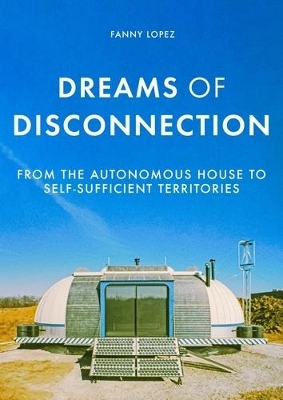
Dreams of Disconnection
From the Autonomous House to Self-Sufficient Territories
Seiten
2021
Manchester University Press (Verlag)
978-1-5261-4689-2 (ISBN)
Manchester University Press (Verlag)
978-1-5261-4689-2 (ISBN)
This book offers a history of energy autonomy and small infrastructures in the field of architecture and urbanism from the end of the 19th century to the present day. -- .
Why do we live in homes and communities built around the century-old industrial model of large service networks that use polluting resources? For more than a century, creative architects and planners have dreamed of decentralisation and self-sufficient living, not to cut themselves off from society, but to invent new modes of consumption and to rethink collective public services around common environmental values.
In a time of climate crisis, changing society means changing energy infrastructures. Dreams of disconnection tells the story of this strand of design and planning, from its pioneers in the late nineteenth century to those applying similar ideas to tomorrow’s technology two hundred years later. Lopez takes in many a utopian visionary in her tour of dreamers of disconnection, from theorists and architects to industrialists and engineers. Technology and design are the centrepieces for these projects, and their complexity, particularly around sustainable supplies of energy, food and water, so often find solutions in aesthetics.
Whether these models were based around single homes or whole cities, Dreams of disconnection reveals that there is much to be learnt and marvelled at in the history of self-sufficient design.
This book is relevant to both United Nations Sustainable Development Goals 7 and 11, Affordable and clean energy and Sustainable cities and communities -- .
Why do we live in homes and communities built around the century-old industrial model of large service networks that use polluting resources? For more than a century, creative architects and planners have dreamed of decentralisation and self-sufficient living, not to cut themselves off from society, but to invent new modes of consumption and to rethink collective public services around common environmental values.
In a time of climate crisis, changing society means changing energy infrastructures. Dreams of disconnection tells the story of this strand of design and planning, from its pioneers in the late nineteenth century to those applying similar ideas to tomorrow’s technology two hundred years later. Lopez takes in many a utopian visionary in her tour of dreamers of disconnection, from theorists and architects to industrialists and engineers. Technology and design are the centrepieces for these projects, and their complexity, particularly around sustainable supplies of energy, food and water, so often find solutions in aesthetics.
Whether these models were based around single homes or whole cities, Dreams of disconnection reveals that there is much to be learnt and marvelled at in the history of self-sufficient design.
This book is relevant to both United Nations Sustainable Development Goals 7 and 11, Affordable and clean energy and Sustainable cities and communities -- .
Fanny Lopez is Associate Professor of the History of Architecture and Technology at the School of Architecture Paris-Est, University Gustave Eiffel -- .
Introduction
Part I: Connection versus disconnection
1 Capturing territories through energy distribution
2 Being disconnected: genesis of a new technical utopia
3 Toward energy emancipation
Part II: The energy autonomy movement, 1970–80
4 Counterculture radicalism
5 Alexander Pike and the Autonomous Housing Project, 1971–79
6 The self-sufficient city
7 Critical technology: a problematic development
8 Electricity micro-networks: a tool for the energy transition?
Bibliography
Index -- .
| Erscheinungsdatum | 25.06.2021 |
|---|---|
| Reihe/Serie | Manchester University Press |
| Zusatzinfo | 170 colour illustrations |
| Verlagsort | Manchester |
| Sprache | englisch |
| Maße | 170 x 240 mm |
| Gewicht | 744 g |
| Themenwelt | Naturwissenschaften ► Geowissenschaften ► Geografie / Kartografie |
| Technik ► Architektur | |
| ISBN-10 | 1-5261-4689-4 / 1526146894 |
| ISBN-13 | 978-1-5261-4689-2 / 9781526146892 |
| Zustand | Neuware |
| Informationen gemäß Produktsicherheitsverordnung (GPSR) | |
| Haben Sie eine Frage zum Produkt? |
Mehr entdecken
aus dem Bereich


aus dem Bereich
Buch | Hardcover (2024)
Schweizerbart'sche, E. (Verlag)
CHF 33,55
Zahlen, Fakten und Geschichten : in über 1000 Infografiken, Karten …
Buch | Hardcover (2025)
Marmota Maps (Verlag)
CHF 55,90
über eine faszinierende Welt zwischen Wasser und Land und warum sie …
Buch | Hardcover (2023)
dtv (Verlag)
CHF 33,55


