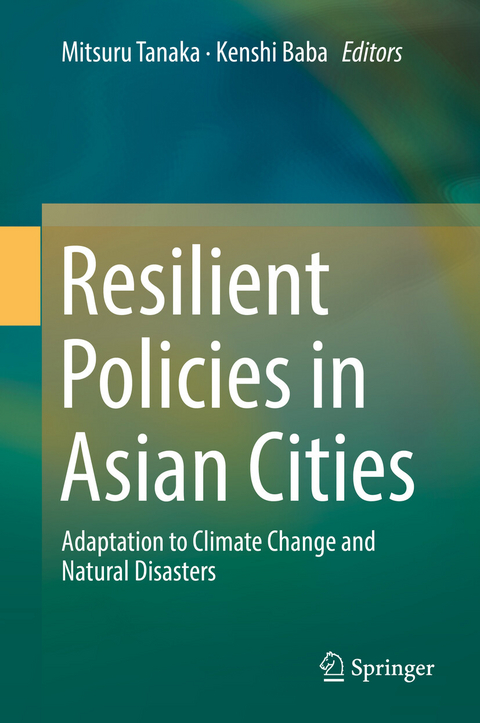
Resilient Policies in Asian Cities (eBook)
253 Seiten
Springer Singapore (Verlag)
978-981-13-8600-8 (ISBN)
This book presents a comprehensive framework and indicators that can be used to assess a city's degree of resilience. Based on surveys using bottom-up assessment tools, it proposes the concept, framework and indicators of a resilient policy model (including some participatory approaches). It also presents case studies of this and similar tools applied to Japanese and Asian cities, the highlights including information not previously available in English. Today, the term 'resilience' is prevalent in the context of sustainable societies. The IPCC AR5 published in 2014 again stressed the impact of climate change on natural disasters, while in March 2015 at the World Conference on Disaster Risk Reduction, the United Nations International Strategy of Disaster Reduction (UNISDR) published the Sendai Framework for Disaster Risk Reduction Action 2015-2030 , which serves as a guideline for local governments. Offering transdisciplinary perspectives from fields such as policy science, urban planning, environmental science, social psychology, management development and geography, this book discusses the lessons learned from Asian case studies, explaining the challenges and the effectiveness of the tools, and offering transdisciplinary insights for policymakers.
?Mitsuru Tanaka
Professor
Faculty of Social Sciences
Hosei University
Tokyo, Japan
Kenshi BABA
Professor
Faculty of Environmental Studies
Tokyo City University
Kanagawa, Japan
This book presents a comprehensive framework and indicators that can be used to assess a city's degree of resilience. Based on surveys using bottom-up assessment tools, it proposes the concept, framework and indicators of a resilient policy model (including some participatory approaches). It also presents case studies of this and similar tools applied to Japanese and Asian cities, the highlights including information not previously available in English. Today, the term "e;resilience"e; is prevalent in the context of sustainable societies. The IPCC AR5 published in 2014 again stressed the impact of climate change on natural disasters, while in March 2015 at the World Conference on Disaster Risk Reduction, the United Nations International Strategy of Disaster Reduction (UNISDR) published the Sendai Framework for Disaster Risk Reduction Action 2015-2030 , which serves as a guideline for local governments. Offering transdisciplinary perspectives from fields such as policy science, urban planning, environmental science, social psychology, management development and geography, this book discusses the lessons learned from Asian case studies, explaining the challenges and the effectiveness of the tools, and offering transdisciplinary insights for policymakers.
| Erscheint lt. Verlag | 13.8.2019 |
|---|---|
| Zusatzinfo | VIII, 253 p. 69 illus., 32 illus. in color. |
| Sprache | englisch |
| Themenwelt | Naturwissenschaften ► Biologie ► Ökologie / Naturschutz |
| Naturwissenschaften ► Geowissenschaften ► Geografie / Kartografie | |
| Naturwissenschaften ► Geowissenschaften ► Meteorologie / Klimatologie | |
| Sozialwissenschaften ► Politik / Verwaltung | |
| Sozialwissenschaften ► Soziologie | |
| Technik ► Architektur | |
| Schlagworte | Assessment tool • climate change • Climate Change Management • Covenant of Mayors • disaster management • energy system • Global Environmental Change • OECD • participatory approach • Policy Transfer • Resilient city • SDGs future city • Social ecological system • urban geography and urbanism • urban planning |
| ISBN-10 | 981-13-8600-5 / 9811386005 |
| ISBN-13 | 978-981-13-8600-8 / 9789811386008 |
| Informationen gemäß Produktsicherheitsverordnung (GPSR) | |
| Haben Sie eine Frage zum Produkt? |
 PDF (Wasserzeichen)
DRM: Digitales Wasserzeichen
Dieses eBook enthält ein digitales Wasserzeichen und ist damit für Sie personalisiert. Bei einer missbräuchlichen Weitergabe des eBooks an Dritte ist eine Rückverfolgung an die Quelle möglich.
Dateiformat: PDF (Portable Document Format)
Mit einem festen Seitenlayout eignet sich die PDF besonders für Fachbücher mit Spalten, Tabellen und Abbildungen. Eine PDF kann auf fast allen Geräten angezeigt werden, ist aber für kleine Displays (Smartphone, eReader) nur eingeschränkt geeignet.
Systemvoraussetzungen:
PC/Mac: Mit einem PC oder Mac können Sie dieses eBook lesen. Sie benötigen dafür einen PDF-Viewer - z.B. den Adobe Reader oder Adobe Digital Editions.
eReader: Dieses eBook kann mit (fast) allen eBook-Readern gelesen werden. Mit dem amazon-Kindle ist es aber nicht kompatibel.
Smartphone/Tablet: Egal ob Apple oder Android, dieses eBook können Sie lesen. Sie benötigen dafür einen PDF-Viewer - z.B. die kostenlose Adobe Digital Editions-App.
Buying eBooks from abroad
For tax law reasons we can sell eBooks just within Germany and Switzerland. Regrettably we cannot fulfill eBook-orders from other countries.
aus dem Bereich