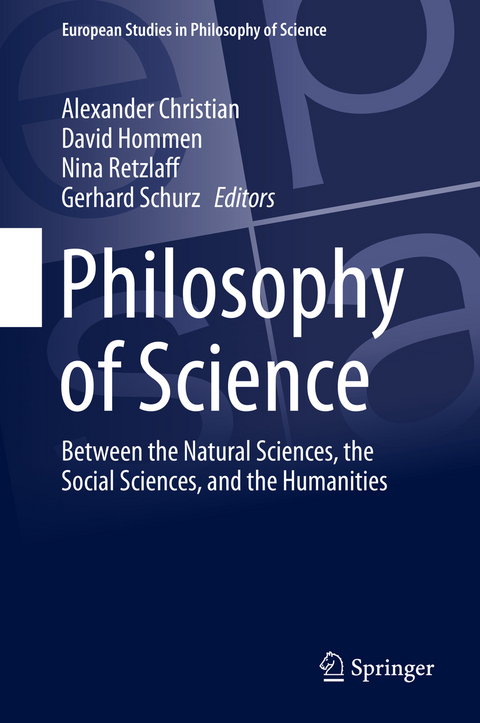
Philosophy of Science (eBook)
XXI, 274 Seiten
Springer International Publishing (Verlag)
978-3-319-72577-2 (ISBN)
This broad and insightful book presents current scholarship in important subfields of philosophy of science and addresses an interdisciplinary and multidisciplinary readership. It groups carefully selected contributions into the four fields of I) philosophy of physics, II) philosophy of life sciences, III) philosophy of social sciences and values in science, and IV) philosophy of mathematics and formal modeling.
Readers will discover research papers by Paul Hoyningen-Huene, Keizo Matsubara, Kian Salimkhani, Andrea Reichenberger, Anne Sophie Meincke, Javier Suárez, Roger Deulofeu, Ludger Jansen, Peter Hucklenbroich, Martin Carrier, Elizaveta Kostrova, Lara Huber, Jens Harbecke, Antonio Piccolomini d'Aragona and Axel Gelfert. This collection fosters dialogue between philosophers of science working in different subfields, and brings readers the finest and latest work across the breadth of the field, illustrating that contemporary philosophy of science has successfully broadened its scope of reflection. It will interest and inspire a wide audience of philosophers as well as scholars of the natural sciences, social sciences and the humanities.
The volume shares selected contributions from the prestigious second triennial conference of the German Society for Philosophy of Science/ Gesellschaft für Wissenschaftsphilosophie (GWP.2016, March 8, 2016 - March 11, 2016).
Alexander Christian is a research fellow at the Düsseldorf center for Logic and Philosophy of Science (DCLPS) at the Heinrich Heine University Düsseldorf. His main research areas are general philosophy of science and ethics of science, with a particular focus on bias, questionable research practices and scientific misconduct in medical research. He published about the demarcation problem ('Wissenschaft und Pseudowissenschaft', Peter Lang, 2013), values in science and the suppression of empirical evidence.
David Hommen is currently Post-Doctoral research fellow in the DFG Collaborative Research Centre 'The Structure of Representations in Language, Cognition, and Science' at Heinrich Heine University Düsseldorf. His main research areas are philosophy of mind, the theory of concepts, causal theory and the metaphysics of absences. He is co-author of 'Negative Kausalität' (de Gruyter 2012, with Dieter Birnbacher) and author of 'Mentale Verursachung, innere Erfahrung und handelnde Personen' (mentis 2013).
Nina Retzlaff is a research fellow at the Düsseldorf center for Logic and Philosophy of Science (DCLPS) at the Heinrich Heine University Düsseldorf. Her main research interests lie in philosophy of science, causality and metaphysics. In the context of her PhD thesis, she is investigating causality with regard to quantum mechanics.
Gerhard Schurz holds the Chair for Theoretical Philosophy at the Heinrich Heine University Düsseldorf and is the Director of the Düsseldorf Center for Logic and Philosophy of Science (DCLPS). His research areas include general and special philosophy of science, logic, epistemology, generalized evolution theory, artificial intelligence and metaethics. He published more than 200 papers. Among other books, he published 'The Is-Ought Problem', Dordrecht: Kluwer (1997), 'Einführung in die Wissenschaftstheorie', Darmstadt: Wissenschaftliche Buchgesellschaft (2006, 4. Aufl. 2014), 'Evolution in Natur und Kultur', Heidelberg: Spektrum Akademischer Verlag (2011), 'Philosophy of Science: A Unified Approach', New York: Routledge (2013) and 'Wahrscheinlichkeitstheorie', Berlin: DeGruyter (2015).
Alexander Christian is a research fellow at the Düsseldorf center for Logic and Philosophy of Science (DCLPS) at the Heinrich Heine University Düsseldorf. His main research areas are general philosophy of science and ethics of science, with a particular focus on bias, questionable research practices and scientific misconduct in medical research. He published about the demarcation problem (“Wissenschaft und Pseudowissenschaft”, Peter Lang, 2013), values in science and the suppression of empirical evidence.David Hommen is currently Post-Doctoral research fellow in the DFG Collaborative Research Centre “The Structure of Representations in Language, Cognition, and Science” at Heinrich Heine University Düsseldorf. His main research areas are philosophy of mind, the theory of concepts, causal theory and the metaphysics of absences. He is co-author of “Negative Kausalität” (de Gruyter 2012, with Dieter Birnbacher) and author of “Mentale Verursachung, innere Erfahrung und handelnde Personen” (mentis 2013).Nina Retzlaff is a research fellow at the Düsseldorf center for Logic and Philosophy of Science (DCLPS) at the Heinrich Heine University Düsseldorf. Her main research interests lie in philosophy of science, causality and metaphysics. In the context of her PhD thesis, she is investigating causality with regard to quantum mechanics. Gerhard Schurz holds the Chair for Theoretical Philosophy at the Heinrich Heine University Düsseldorf and is the Director of the Düsseldorf Center for Logic and Philosophy of Science (DCLPS). His research areas include general and special philosophy of science, logic, epistemology, generalized evolution theory, artificial intelligence and metaethics. He published more than 200 papers. Among other books, he published “The Is-Ought Problem“, Dordrecht: Kluwer (1997), “Einführung in die Wissenschaftstheorie“, Darmstadt: Wissenschaftliche Buchgesellschaft (2006, 4. Aufl. 2014), “Evolution in Natur und Kultur“, Heidelberg: Spektrum Akademischer Verlag (2011), “Philosophy of Science: A Unified Approach“, New York: Routledge (2013) and “Wahrscheinlichkeitstheorie“, Berlin: DeGruyter (2015).
Acknowledgment 6
Contents 7
Contributors 9
Introduction 13
Part I Philosophy of Physics 22
1 Are There Good Arguments Against Scientific Realism? 23
1.1 Introduction 24
1.2 Levels of Philosophical Radicality 26
1.3 The Miracle Argument 29
1.4 Selective Realism 35
1.5 Conclusion 40
References 41
2 Quantum Gravity: A Dogma of Unification? 43
2.1 Introduction 43
2.2 Some Remarks on Quantum Gravity 44
2.3 The Canonical Picture of General Relativity 47
2.4 Weinberg's Conception of General Relativity 50
2.5 Deriving the Principle of Equivalence 51
2.6 What Do We Learn from This? 55
2.7 Critical Remarks 57
2.8 Unification Revisited 58
References 59
3 On Predictions and Explanations in Multiverse Scenarios 62
3.1 Introduction 62
3.2 String Theory and the Landscape 63
3.3 On Fine-Tuning and the Anthropic Principle 65
3.4 Criteria for Scientifically Respectable Multiverse Theories 68
3.5 Summary and Conclusions 71
References 72
4 The Clock Paradox: Luise Lange's Discussion 74
4.1 The Clock Paradox: Luise Lange's Solution and Its Context 74
4.2 Two Incorrect Solutions 78
4.3 Conclusion 79
References 80
Part II Philosophy of Life Sciences 81
5 Bio-Agency and the Possibility of Artificial Agents 82
5.1 Introduction 82
5.2 The Systems Biological Criticism of Embodied Robotics 86
5.2.1 The Emancipation of Agency from Metabolism 86
5.2.2 No Agency Without Metabolism 88
5.3 No Agency Without Metabolism? 90
5.3.1 A Fundamental Difference 90
5.3.2 The Wrong Matter? 91
5.3.3 Metabolism, Intrinsic Normativity and Agency 98
5.4 Conclusions 104
References 108
6 When Mechanisms Are Not Enough: The Origin of Eukaryotes and Scientific Explanation 111
6.1 Introduction 112
6.2 Symbiosis Theories of the Origin of Eukaryotic Cells 113
6.3 Mechanistic Explanation 116
6.4 Symbiogenesis as a Nomological-Expectable Explanation of the Origin of the Eukaryotic Cell 121
6.5 Concluding Remarks 128
References 129
7 Functions, Malfunctioning, and Negative Causation 132
7.1 Introduction 133
7.2 Desiderata for a Theory of Functions 134
7.3 Varieties of Malfunctioning 136
7.4 Malfunctions and Malfunctionings 138
7.5 Are Functions Dispositions? 140
7.5.1 Are All Dispositions Functions? 140
7.5.2 Are All Functions Dispositions? 141
7.6 Possible Strategies for Special-Disposition Accounts 142
7.7 Non-optionality: Why Functions Are Essential 144
7.8 Causal Efficacy: A Dilemma and a Way Out 146
7.9 Conclusion 148
References 149
8 Disease Entities, Negative Causes, Multifactoriality, and the Naturalness of Disease Classifications. Remarks on Some Philosophical Misperceptions of Medical Pathology 151
8.1 Introduction 152
8.2 The Concept of Disease Entity in Medicine 152
8.2.1 Prehistory of the Concept 152
8.2.2 The Modern Concept 153
8.2.2.1 The Concept of Etiological Factors 154
8.2.2.2 Physiological Laws and Disease Entities 155
8.2.2.3 Disease Entities and Medical Textbooks 156
8.2.2.4 Disease Entities and Individual Sickness 157
8.3 Disease Entities in Philosophy of Medicine 157
8.3.1 H. Tristram Engelhardt's Misguided Interpretation of Disease Entities 158
8.3.2 Caroline Whitbeck's Misrepresentation of Disease Entities 159
8.3.2.1 Whitbeck's Argument Against Objectivity of Etiological Factors 161
8.3.2.2 Whitbeck's Argument Against the Uniqueness and Unambiguousness of Etiological Factors 162
8.3.2.3 Whitbeck's Argument Against the Naturalness of Disease Classifications 163
8.4 Epilogue 164
References 165
Part III Philosophy of Social Sciences and Values in Science 167
9 Identifying Agnotological Ploys: How to Stay Clear of Unjustified Dissent 168
9.1 Delineating Agnotological Endeavors 168
9.2 Characterizing Agnotological Maneuvers 171
9.3 The Impact Centered Approach: Agnotology as the Shift of Inductive Risks 173
9.4 Agnotology and False Advertising 174
9.5 Generalizing the False Advertising Account 175
9.6 Identifying and Coping with Agnotological Machinations 179
9.7 Conclusion 181
References 181
10 The “Ought”-Dimension in Value Theory: The Concept of the Desirable in John Dewey's Definition of Value and Its Significance for the Social Sciences 183
10.1 Introduction 184
10.2 The Invention of the “Desirable”: John Dewey 185
10.3 The Definition of Value for the Social Science: Clyde Kluckhohn 189
10.4 The Convergence of the “Desirable” and the “Important”: Social Psychology 191
10.5 Conclusion: The Normative Aspect of Desirability 193
References 196
11 From Stability to Validity: How Standards Serve Epistemic Ends 198
11.1 Introduction 198
11.2 What Are Standards? 199
11.3 How Do Standards Relate to Ends? 200
11.3.1 Stability as Epistemic End of Standardisation 201
11.3.2 Homogeneity as Epistemic End of Standardisation 203
11.3.3 Internal Validity as Epistemic End of Standardisation 207
11.4 Is There an Epistemic Gain of Standardisation? 209
11.5 Conclusions 210
References 211
Part IV Philosophy of Mathematics and Formal Modeling 213
12 Constitutive Inference and the Problem of a Complete Variation of Factors 214
12.1 Introduction 214
12.2 Explanation in Neuroscience 216
12.3 Regularity Constitution 217
12.4 Constitutive Inference 220
12.5 The Problem of a Full Variation of Factors 224
12.6 Conclusion 228
References 229
13 A Partial Calculus for Dag Prawitz's Theory of Grounds and a Decidability Issue 231
13.1 Introduction 231
13.2 Prawitz on BHK Proofs in 1977 232
13.3 The Theory of Grounds 234
13.3.1 Context 234
13.3.2 Grounds and Their Language 236
13.3.3 Valid Inferences and a Decidability Issue 246
13.4 General and Specific Decidability 247
13.5 Concluding Remarks 250
References 251
14 Models in Search of Targets: Exploratory Modelling and the Case of Turing Patterns 253
14.1 Introduction 253
14.2 Exploration, Heuristics, and the (Im)possibility of `Theory-Free' Science 255
14.3 Functions and Uses of Exploratory Models 260
14.4 The Case of Reaction-Diffusion Models for Biological Pattern Formation 266
14.5 Conclusion 275
References 276
Author Index 278
Subject Index 280
| Erscheint lt. Verlag | 26.3.2018 |
|---|---|
| Reihe/Serie | European Studies in Philosophy of Science | European Studies in Philosophy of Science |
| Zusatzinfo | XXI, 274 p. 17 illus., 4 illus. in color. |
| Verlagsort | Cham |
| Sprache | englisch |
| Themenwelt | Geisteswissenschaften ► Philosophie ► Allgemeines / Lexika |
| Mathematik / Informatik ► Mathematik | |
| Naturwissenschaften | |
| Schlagworte | Agnotological Challenges • Causality in General Relativity • Causation in Physics • Constitutive Inference • Dag Prawitz • Endosymbiotic Theory • Functions, Malfunctioning, and Negative Causation • German Society for Philosophy of Science • Origin of Eukaryotic Cells • Proceedings GWP.2016 • Quantum Gravity • Regularity Account of Mechanistic Constitution • Theories of Function and Dysfunction • Theory of Grounds |
| ISBN-10 | 3-319-72577-7 / 3319725777 |
| ISBN-13 | 978-3-319-72577-2 / 9783319725772 |
| Informationen gemäß Produktsicherheitsverordnung (GPSR) | |
| Haben Sie eine Frage zum Produkt? |
 PDF (Wasserzeichen)
DRM: Digitales Wasserzeichen
Dieses eBook enthält ein digitales Wasserzeichen und ist damit für Sie personalisiert. Bei einer missbräuchlichen Weitergabe des eBooks an Dritte ist eine Rückverfolgung an die Quelle möglich.
Dateiformat: PDF (Portable Document Format)
Mit einem festen Seitenlayout eignet sich die PDF besonders für Fachbücher mit Spalten, Tabellen und Abbildungen. Eine PDF kann auf fast allen Geräten angezeigt werden, ist aber für kleine Displays (Smartphone, eReader) nur eingeschränkt geeignet.
Systemvoraussetzungen:
PC/Mac: Mit einem PC oder Mac können Sie dieses eBook lesen. Sie benötigen dafür einen PDF-Viewer - z.B. den Adobe Reader oder Adobe Digital Editions.
eReader: Dieses eBook kann mit (fast) allen eBook-Readern gelesen werden. Mit dem amazon-Kindle ist es aber nicht kompatibel.
Smartphone/Tablet: Egal ob Apple oder Android, dieses eBook können Sie lesen. Sie benötigen dafür einen PDF-Viewer - z.B. die kostenlose Adobe Digital Editions-App.
Buying eBooks from abroad
For tax law reasons we can sell eBooks just within Germany and Switzerland. Regrettably we cannot fulfill eBook-orders from other countries.
aus dem Bereich