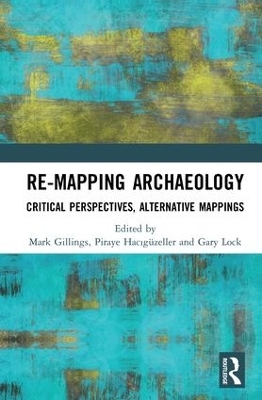
Re-Mapping Archaeology
Routledge (Verlag)
978-1-138-57713-8 (ISBN)
Maps have always been a fundamental tool in archaeological practice, and their prominence and variety have increased along with a growing range of digital technologies used to collect, visualise, query and analyse spatial data. However, unlike in other disciplines, the development of archaeological cartographical critique has been surprisingly slow; a missed opportunity given that archaeology, with its vast and multifaceted experience with space and maps, can significantly contribute to the field of critical mapping.
Re-mapping Archaeology thinks through cartographic challenges in archaeology and critiques the existing mapping traditions used in the social sciences and humanities, especially since the 1990s. It provides a unique archaeological perspective on cartographic theory and innovatively pulls together a wide range of mapping practices applicable to archaeology and other disciplines.
This volume will be suitable for undergraduate and postgraduate students, as well as for established researchers in archaeology, geography, anthropology, history, landscape studies, ethnology and sociology.
Mark Gillings is a Reader in Archaeology at the University of Leicester specialising in the theory and practice of Landscape Archaeology. His fascination with archaeological theory, fieldwork, Geographical Information Systems and prehistoric monumentality are reflected in books such as Spatial Technologies and Archaeology (2002); Avebury (2004); Landscape of the Megaliths (2008) and, most recently, a four-volume critical reader in Landscape Archaeology (2016). Piraye Hacıgüzeller is a postdoctoral researcher at the Ghent Centre for Digital Humanities and the Archaeology Department of Ghent University. She has carried out postdoctoral research on the archaeological applications of GIS and critical mapping at KU Leuven and the University of Oxford, and is currently tasked with coordinating geospatial information activities at the Ghent Center for Digital Humanities. Gary Lock is Emeritus Professor of Archaeology at the University of Oxford, with a long-standing interest in the use of computers in archaeology (Using Computers in Archaeology. Towards Virtual Pasts, 2003). He is particularly interested in the use of Geographical Information Systems in archaeology and their relationship to landscape theory and fieldwork practice (Archaeology and Geographical Information Systems, 1995; Beyond the Map. Archaeology and Spatial Technologies, 2000).
Acknowledgements; Contributors; Chapter 1 On maps and mapping; PART 1 Where do maps come from and what do they do?; Chapter 2 The map as assemblage: landscape archaeology and mapwork; Chapter 3 Cults of the distribution map: geography, utopia and the making of modern archaeology; Chapter 4 Feminist mapping for archaeologists: at the intersection of practices; PART 2 Practices of mapping; Chapter 5 The eye of the beholder: experience, encounter and objectivity in archaeo-topographical survey; Chapter 6 The craft of earthwork survey; PART 3 Experimental mappings and cartographic provocations; Chapter 7 Experimental mapping in archaeology: process, practice and archaeologies of the moment; Chapter 8 Here be worms: map art for the archaeologist (or how I learned to stop worrying and love artistic abstraction in maps); Chapter 9 Describing Hermion/Ermioni. Between Pausanias and digital maps, a topology; Chapter 10 Re-thinking the conversation: a geomythological deep map; 11 Mapping sound: creating a static soundscape; PART 4 Digital transformations; Chapter 12 Archaeology, digital cartography and the question of progress: the case of Çatalhöyük (Turkey); Chapter 13 Cartography and quantum theory: in defence of distribution mapping; PART 5 When all is said and done; Chapter 14 Making maps: a commentary; Index
| Erscheinungsdatum | 18.09.2018 |
|---|---|
| Zusatzinfo | 45 Line drawings, black and white; 31 Halftones, black and white |
| Verlagsort | London |
| Sprache | englisch |
| Maße | 156 x 234 mm |
| Gewicht | 830 g |
| Themenwelt | Geisteswissenschaften ► Archäologie |
| Naturwissenschaften ► Geowissenschaften ► Geografie / Kartografie | |
| ISBN-10 | 1-138-57713-8 / 1138577138 |
| ISBN-13 | 978-1-138-57713-8 / 9781138577138 |
| Zustand | Neuware |
| Informationen gemäß Produktsicherheitsverordnung (GPSR) | |
| Haben Sie eine Frage zum Produkt? |
aus dem Bereich