Ethics of Nature and the Nature of Ethics (eBook)
170 Seiten
Lexington Books (Verlag)
978-1-4985-4435-1 (ISBN)
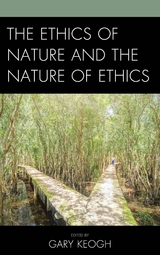
This volume explores questions which emerge from considering the relationship between nature and ethics through philosophical, theological, ethical and environmental lenses. It will examine the nature (understood as essence or character) of ethics itself and whether nature (understood as natural world) has embedded in it a moral code, as well as examining how particular ethical/theological worldviews influence our treatment of nature. Is there an abstract, objective moral code in nature? If so, how do we gain access to this code of ethics? Is it only accessible through revelation, as in some religious traditions, or is this code of ethics more generally accessible to humanity? Indeed, does such an objective notion of ethics exist; could it be that ethics are a natural and subjective development? Is ethics a feature of nature, or have we invented it? There is, this volume might suggest, no consensus on these questions, as they at times divide and at times unite both the contributors to this volume and the bodies of scholarly work with which they engage.As time moves forward, investigations into ethics in the context of the relationship between humanity and nature have become more complex, taking account of advances in the natural sciences and a growing appreciation of nature. How are we to understand our relationship with nature, and how does this have implications for our understandings of ethics? Are we now realising the repercussions of our failure to take seriously our experience of climate change?This volume offers the reader a unique and underrepresented interdisciplinary perspective, from philosophers, theologians and environmentalists on the dynamic relationship between nature and ethics. It offers breadth in terms of the range of theoretical, cultural, philosophical and theological frameworks, but balances this with chapters providing an in-depth treatment of particular lenses, e.g. the work of Hegel, or the work of Gordon Kauffman. Through philosophical and theological investigation, these collected essays deepen and problematize the scientific and pragmatic discourses on nature, offering scholars solid resources to engage with some of the most pressing issues of our time in light of ongoing debates at many levels on dealing with climate change.
Gary Keogh is former lecturer in religions and theology at the University of Manchester.
INTRODUCTION: SECTION ONE: THE NATURE OF ETHICSAristotelian Virtue and the Freudian Challenge to Second NatureThe Moral Tragedy of the Biological Imperative: What Nietzsche can and cannot Teach us about the Evolution of MoralityOn the Relevance of Evolutionary Biology to Ethical NaturalismA Gift or a Given? On the Role of Life in Løgstrup’s EthicsVarieties of Naturalism: From Foot’s ‘Natural Goodness’ to Murdoch’s Non-Dogmatic NaturalismSECTION TWO: THE ETHICS OF NATURE Un/natural Creation(s): Posthumanism, Biotechnology, and Exploring the (Place in) Nature of Humans and Artificial LifeAn Ethics of Fidelity: Luther, Hauerwas and Environmental ActivismThe Ethics of Atmosfear: Communicating the Effects of Climate Change on Extreme WeatherHegel, Nature, and EthicsAlison Stone
This book is not just one more volume on the ethics of nature and the environment but is a profound philosophical and theological mining of selected classical and contemporary thinkers’ relevance for a truly transdisciplinary discourse about the entanglement of our images of nature and morality. Aristotle, Luther, Hegel, Nietzsche, Darwin, Freud and Murdoch meet each other and the reader in a demanding, rich, and thought-provoking dialogue on naturalism, artificiality, virtue, evolution and the painfully gripping question of how to cope with the “atmosfear” in times of anthropogenic climate and weather change.
| Erscheint lt. Verlag | 18.10.2017 |
|---|---|
| Co-Autor | Matthew C Eshleman, Alison Stone, Maria Silvia Vaccarezza, Benjamin J. Wood, Scott M. James, Vladamir Jankovic, Isabel Kaeslin, Gary Keogh, Scott Midson, Parisa Moosavi, David Schultz, Robert Stern |
| Sprache | englisch |
| Themenwelt | Geisteswissenschaften ► Philosophie ► Allgemeines / Lexika |
| Geisteswissenschaften ► Philosophie ► Ethik | |
| Geisteswissenschaften ► Religion / Theologie | |
| Naturwissenschaften ► Biologie ► Ökologie / Naturschutz | |
| Schlagworte | climate change • Ecology • eco-philosophy • eco-theology • Environmental Science • ethics • Nature • Philosophy • Religion • Theology |
| ISBN-10 | 1-4985-4435-5 / 1498544355 |
| ISBN-13 | 978-1-4985-4435-1 / 9781498544351 |
| Informationen gemäß Produktsicherheitsverordnung (GPSR) | |
| Haben Sie eine Frage zum Produkt? |
 EPUB (Adobe DRM)
Kopierschutz: Adobe-DRM
Adobe-DRM ist ein Kopierschutz, der das eBook vor Mißbrauch schützen soll. Dabei wird das eBook bereits beim Download auf Ihre persönliche Adobe-ID autorisiert. Lesen können Sie das eBook dann nur auf den Geräten, welche ebenfalls auf Ihre Adobe-ID registriert sind.
Details zum Adobe-DRM
Dateiformat: EPUB (Electronic Publication)
EPUB ist ein offener Standard für eBooks und eignet sich besonders zur Darstellung von Belletristik und Sachbüchern. Der Fließtext wird dynamisch an die Display- und Schriftgröße angepasst. Auch für mobile Lesegeräte ist EPUB daher gut geeignet.
Systemvoraussetzungen:
PC/Mac: Mit einem PC oder Mac können Sie dieses eBook lesen. Sie benötigen eine
eReader: Dieses eBook kann mit (fast) allen eBook-Readern gelesen werden. Mit dem amazon-Kindle ist es aber nicht kompatibel.
Smartphone/Tablet: Egal ob Apple oder Android, dieses eBook können Sie lesen. Sie benötigen eine
Geräteliste und zusätzliche Hinweise
Buying eBooks from abroad
For tax law reasons we can sell eBooks just within Germany and Switzerland. Regrettably we cannot fulfill eBook-orders from other countries.
aus dem Bereich