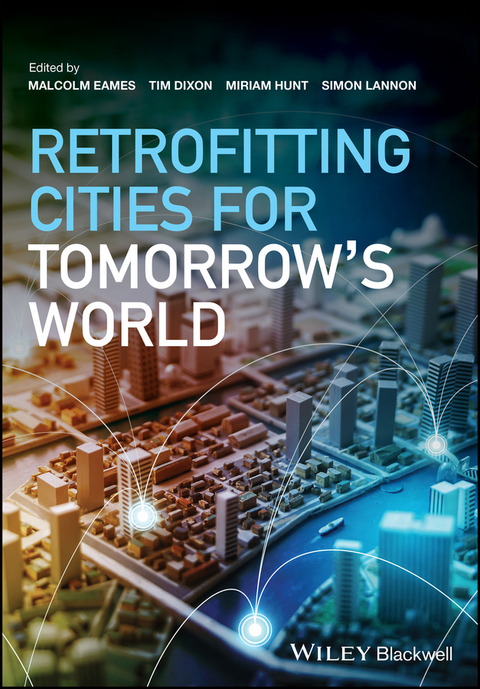
Retrofitting Cities for Tomorrow's World (eBook)
John Wiley & Sons (Verlag)
978-1-119-00723-4 (ISBN)

Malcolm Eames, PhD until recently held a professorial chair in Low Carbon Research with the Low Carbon Research Institute at the Welsh School of Architecture, Cardiff University, UK, and was the Principal Investigator for the EPSRC Retrofit 2050 project.
Tim Dixon, PhD holds a professorial chair in Sustainable Futures in the Built Environment in the School of the Built Environment at the University of Reading and leads the Sustainability in the Built Environment (SustBE) network.
Miriam Hunt is a PhD student at School of Social Sciences, Cardiff University, UK.
Simon Lannon, PhD is a research fellow at the Welsh School of Architecture, Cardiff University, UK.
A groundbreaking exploration of the most promising new ideas for creating the sustainable cities of tomorrow The culmination of a four-year collaborative research project undertaken by leading UK universities, in partnership with city authorities, prominent architecture firms, and major international consultants, Retrofitting Cities for Tomorrow's World explores the theoretical and practical aspects of the transition towards sustainability in the built environment that will occur in the years ahead. The emphasis throughout is on emerging systems innovations and bold new ways of imagining and re-imagining urban retrofitting, set within the context of futures-based thinking. The concept of urban retrofitting has gained prominence within both the research and policy arenas in recent years. While cities are often viewed as a source of environmental stress and resource depletion they are also hubs of learning and innovation offering enormous potential for scaling up technological responses. But city-level action will require a major shift in thinking and a scaling up of positive responses to climate change and the associated threats of environmental and social degradation. Clearly the time has come for a more coordinated, planned, and strategic approach that will allow cities to transition to a sustainable future. This book summarizes many of the best new ideas currently in play on how to achieve those goals. Reviews the most promising ideas for how to approach planning and coordinating a more sustainable urban future by 2050 through retrofitting existing structures Explores how cities need to govern for urban retrofit and how future urban transitions and pathways can be managed, modeled and navigated Offers inter-disciplinary insights from international contributors from both the academic and professional spheres Develops a rigorous conceptual framework for analyzing existing challenges and fostering innovative ways of addressing those challenges Retrofitting Cities for Tomorrow's World is must-reading for academic researchers, including postgraduates insustainability, urban planning, environmental studies, economics, among other fields. It is also an important source of fresh ideas and inspiration for town planners, developers, policy advisors, and consultants working within the field of sustainability, energy, and the urban environment.
Malcolm Eames, PhD until recently held a professorial chair in Low Carbon Research with the Low Carbon Research Institute at the Welsh School of Architecture, Cardiff University, UK, and was the Principal Investigator for the EPSRC Retrofit 2050 project. Tim Dixon, PhD holds a professorial chair in Sustainable Futures in the Built Environment in the School of the Built Environment at the University of Reading and leads the Sustainability in the Built Environment (SustBE) network. Miriam Hunt is a PhD student at School of Social Sciences, Cardiff University, UK. Simon Lannon, PhD is a research fellow at the Welsh School of Architecture, Cardiff University, UK.
Biographies
Hera Antoniades is a Chartered Tax Advisor and a Registered Valuer. She is a member of the Tax Institute, the Australian Property Institute (API), the Australian Institute of Building (AIB), and a Fellow of the Commercial Education Society of Australia. Her industry experience includes specialist engagement with accounting and taxation matters related to the built environment. Her research and publications are focused within the built environment discipline, and include property taxation, forensic trust accounting, occupational licensing, tenancy legislation, strata management, and governance compliance. She is a member of government advisory boards and various professional committees. She is also the President of the Pacific Rim Real Estate Society 2014‐2016, which is an academic society providing a formal focus for property researchers.
Niloufar Bayat is a RIBA qualified architect and has worked on the delivery of numerous new‐built housing projects in the UK. She is currently a researcher with particular interests in low‐carbon housing retrofit and Sustainable Architecture. She is pursuing a doctorate in the School of the Built Environment at the University of Salford focusing on issues concerning the design and construction interface in deep retrofit.
Sarah Bell is Professor of Environmental Engineering at University College London (UCL) and Director of the UCL Engineering Exchange, which facilitates community engagement with engineering research. She is a Chartered Engineer who completed her PhD in Sustainability and Technology Policy at Murdoch University in Australia in 2004. Her research focuses on the relationship between engineering, technology and society, particularly applied to the sustainability of urban water systems. She is a Living With Environmental Change Research Fellow, funded by the Engineering and Physical Sciences Research Council.
Robert Cowley is Lecturer in Sustainable Cities in the Department of Geography at King’s College London, and works as Project Coordinator for the ESRC‐funded SMART ECO research programme. Previously, he was the Network Coordinator for the Leverhulme Trust‐funded international research consortium Tomorrow’s City Today ‐ An International Comparison of Eco‐City Frameworks. His PhD thesis, completed at the University of Westminster, explored the public dimensions of conceptualised and implemented ‘eco‐city’ initiatives. He has lectured internationally and co‐authored several publications on eco‐cities and urban sustainability.
Michael Davies is Professor of Building Physics and Environment at University College London (UCL) and the Director of the Institute for Environmental Design and Engineering (IEDE). IEDE pursues a deeper understanding of the part played by choices relating to buildings and the urban environment in tackling some of the greatest challenges facing humankind, in areas such as health, human well‐being, productivity, energy use and climate change. He is also Director of the Complex Built Environment Systems (CBES) Group at UCL, an ESPRC Platform Grant funded group with a major focus on the Unintended Consequences of Decarbonizing the Built Environment. He has published widely and led a series of large, collaborative research projects; the outputs of this body of work have impacted on a range of relevant key national and international policy formulations.
Carla De Laurentis is currently completing an EPSRC doctorate study that investigates how place and context‐specific conditions influence the mobilization of resources, governance capabilities and actor‐networks in energy transitions. She has worked as a researcher for Cardiff University since 2002. Since joining the Welsh School of Architecture in April 2011, she has worked on the EPSRC project Re‐Engineering the City 2020‐2050 Urban Foresight and Transition Management, investigating sustainability transitions at city‐region level. During her research career she has gained extensive knowledge and expertise in innovation, local and regional development and clustering dynamics in high technology sectors (particularly renewable energy, ICT and new media). Her current research interests lie within the study of innovation, energy policy, renewable energy and sustainability transitions. She has contributed to a number of publications exploring the role of regions in the dynamics of innovation and transformation of the energy sector towards sustainability.
Tim Dixon is Professor of Sustainable Futures in the Built Environment at the University of Reading. With more than 30 years' experience in education, training and research in the built environment, he leads the Sustainability in the Built Environment network at the University of Reading and is co‐director of the TSBE (Technologies for a Sustainable Built Environment) doctoral training centre. He led the Urban Foresight Laboratory work package of EPSRC Retrofit 2050 and is currently working with local and regional partners to develop a 'Reading 2050' smart and sustainable city vision which connects with the UK BIS Future Cities Foresight Programme. He is also currently working on a smart cities and big data project for RICS Research Trust. He is also a member of the international scientific committee for the national 'Visions and Pathways 2040 Australia' Project on cities.
Malcolm Eames (now retired) held a professorial chair in Low Carbon Research at the Welsh School of Architecture, Cardiff University, and was the Principal Investigator for the EPSRC Retrofit 2050 project. With an academic background in science & technology policy and innovation studies, his research interests focused on the interface between: S&T foresight; low carbon innovation; socio‐technological transitions; and, urban sustainability. He previously led the EPSRC’s Citizens Science for Sustainability (SuScit) project and was formerly Director of the BRESE (Brunel Research in Enterprise, Innovation, Sustainability and Ethics) Research Centre at Brunel University.
Aliki Georgakaki is a Mechanical Engineer specializing in energy and sustainability, was a Research Associate at the Welsh School of Architecture at Cardiff University. She has experience in performing techno‐economic assessments on the implementation of new energy technologies. In 2007 she was co‐recipient of the JRC IE Award for Outstanding Scientific Contribution to the Institute for modelling work on ‘The Evolution of the European Fossil Fuel Power Generation Sector and its Impact on the Sustainability of the Energy System’.
Rajat Gupta is Professor of Sustainable Architecture and Climate Change, Director of the multi‐disciplinary Oxford Institute for Sustainable Development (OISD) and Director of the Low Carbon Building Research Group at Oxford Brookes University. He is an appointed member of the EPSRC and ESRC peer review colleges. He also advises government at senior level and is on the boards of several key organizations and task groups internationally and nationally. He has advised UNEP on sustainable social housing, UNFCCC on CDM methodology for energy efficiency measures for buildings, UN‐Habitat on Green Buildings, and the British Council on Cities and climate change. In 2013 he was voted as one of 13 international building science stars and joined the Building4Change’s Virtual Academy of Excellence.
Miriam Hunt is a PhD student at Cardiff University, where her work is concerned with social inclusivity and the museum. She previously worked as a research assistant on the Retrofit 2050 project based at the Welsh School of Architecture, Cardiff University, during which time she explored sustainability and socio‐technical transitions in the built environments of South East Wales and Greater Manchester, as well as questions of equity in energy systems. Her academic interests include sustainable regeneration, and social and economic development and inclusiveness.
Simon Joss is Professor of Science & Technology Studies at the University of Westminster (London), and co‐director of the International Eco‐Cities Initiative. His research addresses the governance of, and policy for, environmental, economic and social sustainability, with special focus on urban innovation and development. He is the author of numerous research articles and books, including Sustainable Cities: Governing for Urban Innovation (2015). He is coordinator of the Leverhulme Trust‐funded international research network Tomorrow’s City Today: An International Comparison of Eco‐City Frameworks, and co‐investigator of the ESRC‐funded SMART ECO multi‐centre research programme on smart cities.
Andrew Karvonen is Assistant Professor of Urban and Regional Studies
KTH Royal Institute of Technology. His research bridges the social sciences and design disciplines by combining ideas from urban planning, human geography, and Science and Technology Studies to explore the social, political, and cultural aspects of urban sustainable development. His 2011 research monograph, Politics of Urban Drainage: Nature, Technology and the Sustainable City, was honoured with the John Friedmann Book Award from the Association of Collegiate Schools of Planning.
John Kolm‐Murray is the Seasonal Health and Affordable Warmth (SHAW) Coordinator in Islington Council, working at the interface of domestic energy efficiency, public health and social policy. He has a keen interest in both...
| Erscheint lt. Verlag | 8.9.2017 |
|---|---|
| Sprache | englisch |
| Themenwelt | Naturwissenschaften ► Biologie ► Ökologie / Naturschutz |
| Technik ► Architektur | |
| Technik ► Bauwesen | |
| Wirtschaft ► Volkswirtschaftslehre | |
| Schlagworte | Architecture • Architektur • Bauingenieur- u. Bauwesen • Building Surveying • challenges to transitioning to sustainable cities • challenges to urban retrofitting • Civil Engineering & Construction • climate change and the built environment • Construction: Sustainability • designing for climate change • designing for global warming • designing green cities • dynamics of urban retrofit transitions • Gebäudevermessung • governing for urban retrofit • Governing Sustainability • green building construction • green buildings • Green Cities • green urban planning • Nachhaltiges Bauen • retrofitting commercial properties • retrofitting residential properties • retrofitting urban buildings • Stadtentwicklung • sustainability • Sustainable Architecture • sustainable built environments • sustainable cities • sustainable cities strategies • sustainable city planning • Sustainable futures • sustainable town planning • sustainable urban environments • sustainable urban planning • transitioning to urban retrofitting • Urban Development • Urban Economics • urban retrofit modeling • urban retrofit strategies • urban retrofitting • urban retrofitting for sustainability |
| ISBN-10 | 1-119-00723-2 / 1119007232 |
| ISBN-13 | 978-1-119-00723-4 / 9781119007234 |
| Informationen gemäß Produktsicherheitsverordnung (GPSR) | |
| Haben Sie eine Frage zum Produkt? |
 EPUB (Adobe DRM)
Kopierschutz: Adobe-DRM
Adobe-DRM ist ein Kopierschutz, der das eBook vor Mißbrauch schützen soll. Dabei wird das eBook bereits beim Download auf Ihre persönliche Adobe-ID autorisiert. Lesen können Sie das eBook dann nur auf den Geräten, welche ebenfalls auf Ihre Adobe-ID registriert sind.
Details zum Adobe-DRM
Dateiformat: EPUB (Electronic Publication)
EPUB ist ein offener Standard für eBooks und eignet sich besonders zur Darstellung von Belletristik und Sachbüchern. Der Fließtext wird dynamisch an die Display- und Schriftgröße angepasst. Auch für mobile Lesegeräte ist EPUB daher gut geeignet.
Systemvoraussetzungen:
PC/Mac: Mit einem PC oder Mac können Sie dieses eBook lesen. Sie benötigen eine
eReader: Dieses eBook kann mit (fast) allen eBook-Readern gelesen werden. Mit dem amazon-Kindle ist es aber nicht kompatibel.
Smartphone/Tablet: Egal ob Apple oder Android, dieses eBook können Sie lesen. Sie benötigen eine
Geräteliste und zusätzliche Hinweise
Buying eBooks from abroad
For tax law reasons we can sell eBooks just within Germany and Switzerland. Regrettably we cannot fulfill eBook-orders from other countries.
aus dem Bereich