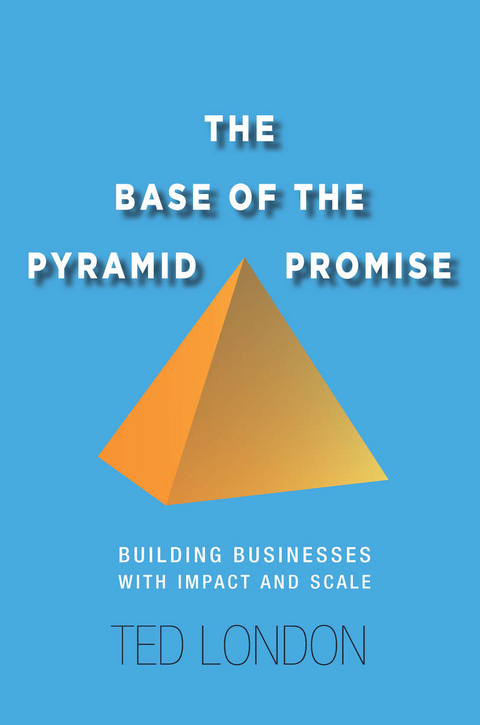
Base of the Pyramid Promise (eBook)
240 Seiten
Stanford University Press (Verlag)
978-0-8047-9733-7 (ISBN)
Ted London is an internationally-recognized expert on enterprise strategy and poverty alleviation. He is Vice President of the William Davidson Institute and a faculty member at the Ross School of Business, University of Michigan.
Contents and AbstractsIntroduction chapter abstractThis chapter introduces the author and establishes his credentials as a researcher and business practitioner in a number of global settings, including base-of-the-pyramid (BoP) contexts. It asserts that the focus in BoP business is, increasingly, "How can we do this better?" It promises that this book will provide practically oriented tools, frameworks and guidelines that can help move BoP enterprises forward, and help them achieve two key goals: an adequate return on investments, and a substantial degree of poverty alleviation. It concludes by describing three foundations on which the book has been constructed: understanding how to build better enterprises, creating value with the BoP by truly understanding the poverty alleviation opportunity, and establishing an ecosystem of partners to sustain those ventures.1Impact Enterprise for the Base of the Pyramid chapter abstractInterest in BoP impact enterprise has been expanding in recent years, both in terms of the literature and the number of enterprises that have been launched. Unfortunately, few such enterprises have achieved sustainability at scale, which is necessary to assure economic viability and alleviate poverty on a large enough scale: here referred to as "impact enterprises." One reason for this is that the learnings of successful impact enterprises have not been widely shared. The chapter differentiates between "fortune-finding" and "fortune-creating," and asserts that the latter strategy is far more effective. Both business leaders and development professionals have good reason to work together to build impact enterprises—but this is far from easy. Obstacles include challenges of value creation, value capture, and the successful bringing-together of two realms that have traditionally eyed each other skeptically. The chapter concludes with a summary of the book's key prescriptions.2Enabling Business Model Innovation chapter abstractThis chapter opens the discussion of the first of the three foundations of the book described in the preface: understanding how to build better BoP enterprises. It stresses the importance of innovation, as opposed to an overriding focus on execution, with an emphasis on "business model R&D—i.e., efforts to invent appropriate business models for specific and demanding contexts. The chapter draws upon a multiyear analysis of 18 BoP initiatives to explore key design variables that should be considered in BoP business-model invention, whether alone or in combination. The "Business Model Innovation (BMI) Framework" is introduced, which captures the four design variables—resources, metrics, structure, and problem solving—that tend to have an outsized effect. The chapter includes case studies of companies that launched significant BoP initiatives—Nike, CEMEX, and "Mondophysic" (a pseudonym)—to show these variables in action, and to explore which innovation processes succeeded, and why.3Building for Scale chapter abstractThis chapter addresses the challenge of scaling: that is, moving from the pilot phase to an impact enterprise. A framework called the "C-I-E scaling strategies" is introduced, focusing on co-creation, innovation, and embedding. Each of these strategies is divided into component parts. Co-creation involves crafting solutions with the BOP and "finding the positive." Innovation involves orchestrating effective experiments and building market opportunities. Embedding involves building collaboration-based competitive advantage and developing social embeddedness. Case studies explore scaling's challenges: the collaboration between two NGOs (CARE and Peace) and a for-profit (Pioneer Hi-Bred International) to bring new kinds of seeds to India; and ITC's efforts to transform rural agriculture. Secondary case studies focus on Honey Care Africa's efforts to scale up Kenya's honey production, and Movirtu's initiative to build a sustainable business based on offering a mobile identity that wasn't tied to a particular mobile device.4Mutual Value Creation chapter abstractThis chapter focuses on the second of the book's three foundations: creating value with the BoP by understanding the poverty alleviation opportunity. Alleviating poverty is critical, because it sits at the heart of the BoP impact enterprise's value proposition. The more value that enterprise creates for the BoP, the more value it can capture for itself. Unfortunately, most impact enterprises have a hard time defining their value added, and instead resort to either anecdotes or output measures. A more effective approach begins with an understanding of the multidimensional nature of poverty, which includes economic, capability, and relationship well-being. 5Creating a Partnership Ecosystem chapter abstractThis chapter begins the discussion of the book's third foundation: establishing an ecosystem of partners. These partners are defined as "scaling facilitators": i.e., the collaborators who will help the impact enterprise scale up through the use of different implementation models. These collaborating organizations can provide support at the enterprise level (enterprise development) and at the macroeconomic level (market creation). The chapter introduces a tool called the Partnership Ecosystem Framework (PEF), which helps the impact enterprise.6Collaborative Interdependence chapter abstractThis chapter looks at how an ecosystem of scaling-facilitation partners is developed and managed over time. It advocates for the creation of a "chief ecosystem director" (CED) position within the impact enterprise—or, at the least, incorporating this role with the existing top management team—to accomplish these important ecosystem-management tasks. It describes the three major challenges faced by the CED—overcoming biases about seeking subsidized support, dealing with internal resistance to partnerships, and responding to cross-organizational tensions—and suggests strategies for dealing with those challenges. A case study of CEMEX's Patrimonio Hoy initiative illustrates the importance of a CED. The concept of "collaborative interdependence", an approach to framing partnership relevant to BoP impact enterprises, is then explained and discussed, emphasizing the CED's responsibility for bringing together independent-but-complementary organizations.7Making the Promise a Reality chapter abstractThe closing chapter recapitulates some of the lessons learned in previous chapters, and looks forward at next steps in the evolution of BoP impact enterprise. The hard-won wisdom of the last decade or so is that BoP impact enterprise is more about fortune-creating than fortune-finding—which means that the would-be impact enterprise has to innovate, as well as execute. That innovation takes place in a complex context of potential scaling facilitators, who have to be identified, selected, recruited, and managed. Most informed observers agree that the alleviation of poverty along its many dimensions can be enhanced through the creation of impact enterprises. It is certainly not the only solution; NGOs will continue their good work, and governments will do their part. But it has to be part of the solution. We have to fulfill the promise of building BoP impact enterprises that are sustainable at scale.
| Erscheint lt. Verlag | 6.1.2016 |
|---|---|
| Sprache | englisch |
| Themenwelt | Naturwissenschaften ► Biologie ► Ökologie / Naturschutz |
| Wirtschaft ► Betriebswirtschaft / Management ► Planung / Organisation | |
| Wirtschaft ► Betriebswirtschaft / Management ► Unternehmensführung / Management | |
| Wirtschaft ► Volkswirtschaftslehre | |
| Schlagworte | Base of the Pyramid • BoP • BoP frameworks • BoP impact enterprise • BoP promise • BoP value propositions • bottom of the pyramid • making profits while alleviating poverty |
| ISBN-10 | 0-8047-9733-1 / 0804797331 |
| ISBN-13 | 978-0-8047-9733-7 / 9780804797337 |
| Informationen gemäß Produktsicherheitsverordnung (GPSR) | |
| Haben Sie eine Frage zum Produkt? |
 EPUB (Adobe DRM)
Kopierschutz: Adobe-DRM
Adobe-DRM ist ein Kopierschutz, der das eBook vor Mißbrauch schützen soll. Dabei wird das eBook bereits beim Download auf Ihre persönliche Adobe-ID autorisiert. Lesen können Sie das eBook dann nur auf den Geräten, welche ebenfalls auf Ihre Adobe-ID registriert sind.
Details zum Adobe-DRM
Dateiformat: EPUB (Electronic Publication)
EPUB ist ein offener Standard für eBooks und eignet sich besonders zur Darstellung von Belletristik und Sachbüchern. Der Fließtext wird dynamisch an die Display- und Schriftgröße angepasst. Auch für mobile Lesegeräte ist EPUB daher gut geeignet.
Systemvoraussetzungen:
PC/Mac: Mit einem PC oder Mac können Sie dieses eBook lesen. Sie benötigen eine
eReader: Dieses eBook kann mit (fast) allen eBook-Readern gelesen werden. Mit dem amazon-Kindle ist es aber nicht kompatibel.
Smartphone/Tablet: Egal ob Apple oder Android, dieses eBook können Sie lesen. Sie benötigen eine
Geräteliste und zusätzliche Hinweise
Buying eBooks from abroad
For tax law reasons we can sell eBooks just within Germany and Switzerland. Regrettably we cannot fulfill eBook-orders from other countries.
aus dem Bereich