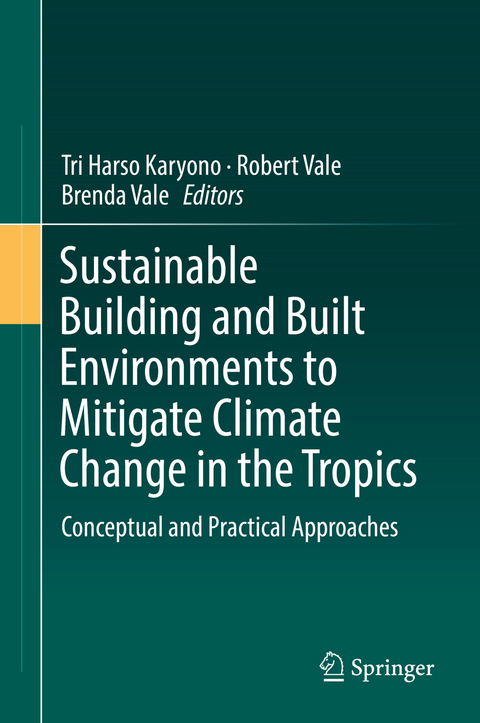
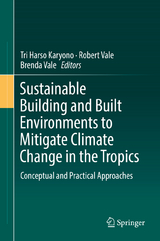
Sustainable Building and Built Environments to Mitigate Climate Change in the Tropics (eBook)
X, 273 Seiten
Springer International Publishing (Verlag)
978-3-319-49601-6 (ISBN)
Professor Tri Harso Karyono, Ir (ITB), MA (York), PhD (Sheffield) was trained as an architect and received an engineering degree from Department of Architecture, Bandung Institute of Technology (ITB), Indonesia. He was awarded an MA degree in Third World Architecture courses from The University of York, UK. He received a PhD from the School of Architectural Studies, University of Sheffield, UK. Tri has designed and built some houses, including his own low energy house in Indonesia. He published a numerous articles in the newspapers and architectural magazines related to low energy and sustainable built environments, also published a number of books, including An Introduction to Green Architecture in Indonesia, and Architecture and Cities in the Tropical Third World Country of Indonesia. Tri is now a professor of Architecture, lecturing subject on sustainable built environments in a number of architectural schools in Indonesia.
Professor Tri Harso Karyono, Ir (ITB), MA (York), PhD (Sheffield) was trained as an architect and received an engineering degree from Department of Architecture, Bandung Institute of Technology (ITB), Indonesia. He was awarded an MA degree in Third World Architecture courses from The University of York, UK. He received a PhD from the School of Architectural Studies, University of Sheffield, UK. Tri has designed and built some houses, including his own low energy house in Indonesia. He published a numerous articles in the newspapers and architectural magazines related to low energy and sustainable built environments, also published a number of books, including An Introduction to Green Architecture in Indonesia, and Architecture and Cities in the Tropical Third World Country of Indonesia. Tri is now a professor of Architecture, lecturing subject on sustainable built environments in a number of architectural schools in Indonesia.Professor Robert Vale MA DipArch (Cambridge) PhD (Nottingham)Professor Brenda Vale MA DipArch (Cambridge) PhD (Sheffield)Professorial Research Fellows, Victoria University of Wellington, Wellington, New ZealandRobert and Brenda Vale are architects and academics. They wrote their first book on sustainable design, “The Autonomous House”, in 1975. Following their design of several award winning sustainable commercial buildings in the UK they went on to design and build the UK’s first autonomous house in 1993 and the first zero-emissions settlement in 1998. They have received international recognition, including awards from the United Nations and the European Solar Energy Society. More recently they developed the Australian government’s National Australian Built Environment Rating System (NABERS) which has now been put into operation. Their most recent environmental books are “Time to Eat the Dog? The real guide to sustainable living”, which analysed the impact on the environment of a western life-style and things people do every day and “Living within a Fair Share Ecological Footprint” which has chapters written by many of their former and existing postgraduate students. Their most recent book is "Architecture on the Carpet" which explores the links over the last hundred years between architecture and construction toys such as Meccano and Lego.
Part One - The sustainability of the built environment.- Mitigating climate change in the Tropics.- Climate change and the built environment in the tropics - is carbon enough to assess human impact.- Monitoring Climate Change Adaptation: The Scottish Approach.- The sustainable portion of Gross Domestic Product: A proposed Social-Ecological Economic Indicator for Sustainable Economic Development.- Smart Community Energy Systems for Low Carbon Living.- Part Two - Mitigating building for climate change.- Development of JKR/BSEEP Technical Passive Design Guidelines for Malaysian Building Industry.- Creating low carbon building through integrated configuration of folding roof-BIPV in an office building in Surabaya.- Building adaptation for higher ambient temperature.- Advancing Sustainability in the Tropics – The International School of Kuala Lumpur. Part Three - Adapting city for climate change.- Adapting city for frequent floods: A case study of Jakarta, Indonesia.- Holistic method on performing microclimate analyses of an urban area in the Tropics.- Bicycle tracks pattern along the East Jakarta’s flood prevented canal.- STEVE Tool Plug-in for SketchUp: a User-friendly Temperature PredictionMapping Tool for Estate Development.- Sustainable fishing settlement in MuaraAngke, North Jakarta.- Adapting the low-income settlements to annual flood in Kampung Melayu, Jakarta.- Part Four - Plants and low carbon emissions.- Low Energy Material, High Impact Community Engagement: Banana Tree Fibers in Disaster Relief Projects.- Plant selection and placement criteria for vertical and rooftop greenery.- Green roofs as a passive cooling strategy in Tehran.
| Erscheint lt. Verlag | 21.2.2017 |
|---|---|
| Zusatzinfo | X, 273 p. 122 illus., 89 illus. in color. |
| Verlagsort | Cham |
| Sprache | englisch |
| Themenwelt | Naturwissenschaften ► Geowissenschaften |
| Sozialwissenschaften ► Politik / Verwaltung | |
| Technik ► Bauwesen | |
| Schlagworte | Built environment in Jakarta • Buliding in tropical climate • carbon emissions • climate change • Climate change impacts • climate change mitigation in the tropics • ecological footprint • Green Materials • Low energy building materials • Sustainable Building • urban geography and urbanism |
| ISBN-10 | 3-319-49601-8 / 3319496018 |
| ISBN-13 | 978-3-319-49601-6 / 9783319496016 |
| Informationen gemäß Produktsicherheitsverordnung (GPSR) | |
| Haben Sie eine Frage zum Produkt? |
 PDF (Wasserzeichen)
DRM: Digitales Wasserzeichen
Dieses eBook enthält ein digitales Wasserzeichen und ist damit für Sie personalisiert. Bei einer missbräuchlichen Weitergabe des eBooks an Dritte ist eine Rückverfolgung an die Quelle möglich.
Dateiformat: PDF (Portable Document Format)
Mit einem festen Seitenlayout eignet sich die PDF besonders für Fachbücher mit Spalten, Tabellen und Abbildungen. Eine PDF kann auf fast allen Geräten angezeigt werden, ist aber für kleine Displays (Smartphone, eReader) nur eingeschränkt geeignet.
Systemvoraussetzungen:
PC/Mac: Mit einem PC oder Mac können Sie dieses eBook lesen. Sie benötigen dafür einen PDF-Viewer - z.B. den Adobe Reader oder Adobe Digital Editions.
eReader: Dieses eBook kann mit (fast) allen eBook-Readern gelesen werden. Mit dem amazon-Kindle ist es aber nicht kompatibel.
Smartphone/Tablet: Egal ob Apple oder Android, dieses eBook können Sie lesen. Sie benötigen dafür einen PDF-Viewer - z.B. die kostenlose Adobe Digital Editions-App.
Buying eBooks from abroad
For tax law reasons we can sell eBooks just within Germany and Switzerland. Regrettably we cannot fulfill eBook-orders from other countries.
aus dem Bereich