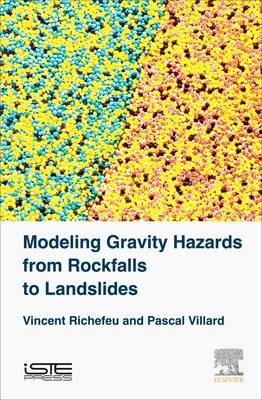
Modeling Gravity Hazards from Rockfalls to Landslides (eBook)
178 Seiten
Elsevier Science (Verlag)
978-0-08-101197-3 (ISBN)
Vincent Richefeu is a researcher at University Grenoble Alpes in France, in the 3SR group. He has been working within the framework of a European project related to Medium and Small Size rockfall hazard Assessment (MASSA) since 2009. His current research interests focus on the modeling of granular media by introducing more physics at low scales.
Gravity hazards are a major concern to those living in mountainous areas. To protect infrastructure and human life in these areas, engineers require numerical tools for trajectory analysis, for application from fragmental rockfalls to large-scale avalanches or landslides.This book explores state-of-the-art methods to model the propagation (flows and stops) of masses, using the discrete element method (DEM) to study the evolution of kinetics during an event. Taking into account the shape of the blocks and the topology of the terrain provides an explicit and sophisticated consideration of geometries, eliminating the need for stochastic inputs to rockfall simulations. This method is validated experimentally, before the authors apply it to real case studies. The book ends with an introduction to and comparison with the material point method (MPM), a new and promising approach able to bridge the gap between cases dominated by discreteness and those involving a very large number of elements.Engineering consulting firms, researchers and students should find the approaches outlined in this book useful, whether designing prevention and protection systems for gravity hazards, or exploring new ways to model gravity hazards. - Covers conventional methods used to study gravitational phenomena using empirical parameters- Presents a new numerical tool taking account of the physical phenomenon (friction, dissipation, realistic block shapes) and a methodology for parameter calibration and the achievement of numerical simulations- Applies the numerical model to real cases with a critical analysis of its applicability in the field of engineering- Emphasizes the discrete element method (DEM)
| Erscheint lt. Verlag | 11.10.2016 |
|---|---|
| Sprache | englisch |
| Themenwelt | Naturwissenschaften ► Geowissenschaften ► Geologie |
| Technik ► Bauwesen | |
| Technik ► Umwelttechnik / Biotechnologie | |
| ISBN-10 | 0-08-101197-0 / 0081011970 |
| ISBN-13 | 978-0-08-101197-3 / 9780081011973 |
| Informationen gemäß Produktsicherheitsverordnung (GPSR) | |
| Haben Sie eine Frage zum Produkt? |
 EPUB (Adobe DRM)
Kopierschutz: Adobe-DRM
Adobe-DRM ist ein Kopierschutz, der das eBook vor Mißbrauch schützen soll. Dabei wird das eBook bereits beim Download auf Ihre persönliche Adobe-ID autorisiert. Lesen können Sie das eBook dann nur auf den Geräten, welche ebenfalls auf Ihre Adobe-ID registriert sind.
Details zum Adobe-DRM
Dateiformat: EPUB (Electronic Publication)
EPUB ist ein offener Standard für eBooks und eignet sich besonders zur Darstellung von Belletristik und Sachbüchern. Der Fließtext wird dynamisch an die Display- und Schriftgröße angepasst. Auch für mobile Lesegeräte ist EPUB daher gut geeignet.
Systemvoraussetzungen:
PC/Mac: Mit einem PC oder Mac können Sie dieses eBook lesen. Sie benötigen eine
eReader: Dieses eBook kann mit (fast) allen eBook-Readern gelesen werden. Mit dem amazon-Kindle ist es aber nicht kompatibel.
Smartphone/Tablet: Egal ob Apple oder Android, dieses eBook können Sie lesen. Sie benötigen eine
Geräteliste und zusätzliche Hinweise
Buying eBooks from abroad
For tax law reasons we can sell eBooks just within Germany and Switzerland. Regrettably we cannot fulfill eBook-orders from other countries.
aus dem Bereich